

Archive position — measured, not model output
1 like on Devpost
505 of the 7,850 archived projects have more likes, and 1,758 share exactly 1 — so this project's #2,236 place in the like-ranked listing is a tie-break inside that group, not a ranking.
Projects (log scale)
Likes on Devpost. ▲ marks this project's group.
Show the figures
| Likes | Projects | Share of archive |
|---|---|---|
| 0 | 5,587 | 71.2% |
| 1 | 1,758 | 22.4% |
| 2 | 284 | 3.6% |
| 3–4 | 132 | 1.7% |
| 5–9 | 75 | 1.0% |
| 10+ | 14 | 0.2% |
 User Stories BotA demo video on every pull request
Get a demo video on every new feature
GitHub App that watches your pull requests and records a narrated, captioned demo.
Save time on demo prep and make informed decisions faster with a video walkthrough of every new feature.
Executive Summary
What the company appears to be
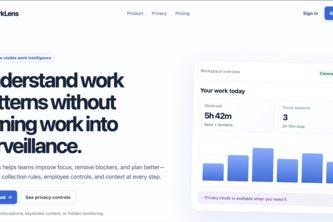
WorkLens is a self-reported SaaS product designed to provide "work intelligence" by tracking employee activity in remote/hybrid teams while emphasizing privacy controls and transparency. It collects application usage, website browsing, and time spent across categories like development, research, communication, and personal browsing. The system uses AI to generate summaries of work patterns but avoids invasive data collection such as keystrokes or passwords.
What changed
The project was submitted as part of the OpenAI 2026 hackathon. It is described as a completed prototype with an end-to-end experience including desktop agent, browser extension, web dashboard, and AI-assisted reporting features. The authors state they built it to address concerns about invasive monitoring tools and create a more transparent alternative.
The single most important open question
Is there any evidence of actual user adoption or feedback from real organizations using this tool? The description contains no data on traction, revenue, customers, or usage beyond the authors' own claims.
What The Product Actually Is
- The description states that WorkLens is a work intelligence platform that records employee activity during configured schedules.
- It tracks:
- Application names and active time
- Website domains
- Work categories (development, research, communication, administration, personal browsing)
- Activity duration
- Team and organization coverage
- Optional screenshots controlled by workspace policy
- Desktop agent and browser extension status
- It does not collect keystrokes, passwords, form entries, page content, microphone audio, or webcam video.
- The system automatically classifies activity into work areas without requiring manual explanation from employees.
- At the end of a period (week/month), it generates reports showing:
- Time recorded
- Work area distribution
- Team coverage
- Activity timelines
- Uncategorized activity
- AI-assisted plain-language summaries
Inference The product appears to be a hybrid desktop/browser tool with backend reporting capabilities, intended for use in remote or hybrid work environments.
Positioning & Claim Evolution
- The description states that WorkLens was built to address the problem of invasive monitoring tools, which focus on screenshots and keystrokes.
- It positions itself as a transparent work intelligence platform that helps teams understand work patterns while respecting employee privacy.
- The authors claim it offers:
- A better way to understand how work happens
- Employee visibility into what is being collected
- Control over privacy settings (e.g., enabling/disabling privacy mode)
- AI-generated summaries instead of raw data
- They emphasize that the system does not treat employees like machines being watched.
- The long-term goal is to become the trusted work intelligence layer for modern teams, helping organizations understand how work happens while preserving dignity and privacy.
Inference This is a positioning shift from traditional time-tracking tools toward a more privacy-conscious, AI-enhanced approach. However, no evidence exists that this has been validated in practice or adopted by users beyond the authors.
Target Customer & ICP
- The description states that WorkLens targets remote and hybrid teams.
- It is designed to help organizations understand work patterns without treating employees like machines being watched.
- The product includes features such as:
- Role-based dashboards
- Team and organization coverage metrics
- Privacy controls visible to employees
- Policy-driven collection rules
Inference The ICP likely includes small-to-medium-sized companies or teams that are transitioning to hybrid work models and want to monitor productivity without compromising employee trust.
Business Model & Pricing Evidence
- No pricing information, business model details, or monetization strategy are provided in the description.
- The product is described as a SaaS platform, but there is no mention of subscription tiers, per-user costs, or enterprise licensing models.
- There is no indication whether WorkLens intends to sell directly to customers or through partners.
Inference The business model remains undefined. It is unclear how the company plans to generate revenue from this product.
Technical & Delivery Signals
- WorkLens consists of:
- A web application
- A backend API
- A native desktop agent (Electron-based)
- A browser extension
- The backend uses:
- REST API
- Node.js, Express.js, Next.js
- PostgreSQL with Prisma ORM
- OpenAI integration (specifically GPT-5.6)
- Codex for code inspection and debugging
- It supports:
- Authentication
- Session persistence
- Role-based access control
- Activity ingestion
- Report generation
- Privacy policies
- Audit events
- The desktop agent handles:
- Local configuration
- Background activity collection
- Connection status
- Retry behavior
- Communication with backend
- AI is used for generating report narratives, but with a deterministic fallback if the AI provider is unavailable.
- It includes offline and reconnection handling.
Inference The technical stack suggests a full-stack SaaS product built using modern web and cloud technologies. However, no evidence of production deployment or scalability beyond prototype status.
Traction & Maturity Signals
- Not evidenced.
- No mention of:
- Customers
- Revenue
- User engagement
- Product usage metrics
- Beta testing or pilot programs
- Any form of traction or adoption data
Inference There is no evidence that WorkLens has moved beyond the prototype stage or gained any real-world traction.
Competitive Context
- The description does not reference competitors.
- It implies a gap in the market for less invasive monitoring tools compared to existing solutions that focus on screenshots, keystrokes, and constant surveillance.
- The authors state their goal is to offer a more transparent alternative, which suggests they perceive current offerings as lacking in privacy or employee trust.
Inference While the product addresses a known pain point (invasive monitoring), there is no evidence of competitive analysis or awareness of existing players in this space.
Open Questions & Risks
- The project is described as a hackathon submission, not a commercial product.
- No evidence of:
- Revenue
- Customers
- Product-market fit
- Scalability
- Real-world testing
- The use of GPT-5.6 (which may not exist) raises questions about feasibility or accuracy of AI claims.
- The system relies heavily on AI for summarization, but includes a fallback mechanism, suggesting potential reliability issues.
- There is no indication of:
- Legal compliance
- Data governance
- Employee consent processes
- Integration with HR or payroll systems
Inference This appears to be an early-stage concept or prototype. The lack of traction, revenue, and customer feedback makes it difficult to assess viability as a commercial product.
Questions the description leaves open
- What is the current status of WorkLens? Is it in production, beta, or still a prototype?
- Have you conducted any user research or interviews with potential customers?
- How do you plan to monetize this product? Are there any pricing models or revenue streams already defined?
- What are your plans for scaling and supporting enterprise users?
- Can you provide examples of how the AI-generated summaries have been validated in practice?
- Have you considered legal or compliance implications around employee monitoring and data privacy?
- How do you intend to differentiate from existing tools like RescueTime, Toggl, or Clockify?
Overall Assessment
- Not evidenced.
- No information is available regarding:
- Valuation
- Funding history
- Team traction
- Market opportunity size
- Strategic fit for potential investors or partners
Inference Based on the self-reported description alone, there is insufficient evidence to support an investment or partnership decision. The project appears to be a hackathon prototype with no demonstrated commercial viability or market validation.
User Stories BotA demo video on every pull request
Get a demo video on every new feature
GitHub App that watches your pull requests and records a narrated, captioned demo.
Save time on demo prep and make informed decisions faster with a video walkthrough of every new feature.
Source
Submitted to the OpenAI 2026 hackathon on Devpost. Project home on Devpost. Back to the full gallery on Devpost.
This competitive analysis was produced by top-founders.com (opens in a new tab)
Generated by a language model from this project's public Devpost page — its tagline, the author's own write-up and any built-with tags listed there — as captured in August 2026. Short quotations are the author's words. It is an opinion on the idea as a business, not on the people behind it, and it reflects the description as published then. If the project has moved on, request a correction below. The analysis is not independent research and contains no verified traction, revenue or customer data.
An independent guide by KFG International LLC — not affiliated with, endorsed by, or connected to Devpost or OpenAI.