

Archive position — measured, not model output
2 likes on Devpost
221 of the 7,850 archived projects have more likes, and 284 share exactly 2 — so this project's #273 place in the like-ranked listing is a tie-break inside that group, not a ranking.
Projects (log scale)
Likes on Devpost. ▲ marks this project's group.
Show the figures
| Likes | Projects | Share of archive |
|---|---|---|
| 0 | 5,587 | 71.2% |
| 1 | 1,758 | 22.4% |
| 2 | 284 | 3.6% |
| 3–4 | 132 | 1.7% |
| 5–9 | 75 | 1.0% |
| 10+ | 14 | 0.2% |
 User Stories BotA demo video on every pull request
Get a demo video on every new feature
GitHub App that watches your pull requests and records a narrated, captioned demo.
Save time on demo prep and make informed decisions faster with a video walkthrough of every new feature.
Executive Summary
The company appears to be a solo developer project named Chonky Cat (뚱냥이), submitted as a hackathon entry to the OpenAI 2026 hackathon. The author describes it as a macOS desktop pet application that uses AI to diagnose why a Mac is slow and propose cleanup actions, while also allowing users to generate custom desktop themes from photos of their own pets.
The project is described as a "weekend toy" that was expanded during a Build Week hackathon. It integrates OpenAI's GPT-5.6 and gpt-image-2 models for its core functionality, with the AI layer built using Codex in one session thread. The app has no revenue or customer data, and the author is the sole team member.
The single most important open question is: what is the actual commercial viability of this concept, and whether it can be scaled beyond a hackathon-level prototype?
This analysis is based entirely on self-reported information from the project description. No independent verification or traction data is available.
What The Product Actually Is
- The description states that Chonky Cat (뚱냥이) is a macOS desktop pet application.
- It has three core functions:
- Diagnosis: Right-clicking the cat prompts GPT-5.6 to analyze why the Mac is slow, identifying apps that hog memory and suggesting safe-to-delete items.
- Cleanup: The diagnosis proposes a cleanup plan (browser caches, old downloads, Xcode junk), which users must approve before any deletion occurs.
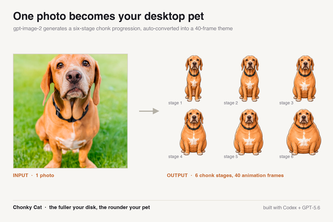
- Customization: Users can upload a photo of their real pet to generate a custom desktop theme using gpt-image-2 in ~30 seconds.
- It is built with Python and PyObjC, with AI components generated via Codex.
- The app uses GPT-5.6 for both diagnosis and cleanup logic, as well as for generating the visual themes from user photos.
Not evidenced: No details on how the product works technically beyond the tools used, or whether it has been tested in real-world conditions.
Positioning & Claim Evolution
- The description states that the project was inspired by a friend’s frustration with disk space issues and the lack of clarity around what was consuming storage.
- It evolved from a "tiny weekend toy" into a more functional tool during Build Week.
- The author frames it as an AI-powered desktop assistant that combines utility with whimsy — using a cat metaphor to make file management less intimidating.
- The positioning is described as:
- A diagnostic tool for Mac users, leveraging AI to explain why their system is slow.
- A personalized desktop pet experience, where users can create custom themes from their own pets.
- A fun but safe way to manage disk space through a metaphorical "diet plan" that requires user approval.
Inference: The evolution from toy to tool suggests an intent to build something more than just a novelty, though the description does not confirm any market demand or adoption.
Target Customer & ICP
- The description states that the app is designed for Mac users who are confused about why their disk space is filling up.
- It targets people who may not understand how their system works but are open to AI-assisted help.
- The customization feature implies a desire to personalize the experience, targeting users who value emotional connection with digital tools.
Not evidenced: No information on actual user segments, personas, or whether there’s a defined ideal customer profile beyond general Mac users.
Business Model & Pricing Evidence
- The description does not mention any pricing model or monetization strategy.
- It is described as a free desktop application, with no indication of paid features or subscriptions.
- There is no evidence of revenue streams, partnerships, or commercial use cases beyond the hackathon submission.
Inference: If this were to become a product, it would likely be free-to-use with optional premium features, but that is speculative.
Technical & Delivery Signals
- Built using Python + PyObjC, with AI components generated via Codex.
- Uses GPT-5.6 and gpt-image-2 for core functionality.
- The AI layer was built in a single session thread, suggesting rapid prototyping.
- Includes 68 tests to ensure reliability of the AI logic.
- The app supports auto-detection of system language (English/Korean).
- The visual themes are auto-converted into full 40-frame desktop animations.
Not evidenced: No information on scalability, performance metrics, or long-term maintainability.
Traction & Maturity Signals
- The project is described as a hackathon submission, not yet a commercial product.
- It was built in a Build Week hackathon, suggesting it's early-stage.
- There is no evidence of:
- Revenue
- Customers
- User adoption
- Product-market fit
- Any form of monetization or growth
Inference: The project has not reached any measurable traction or maturity beyond prototype status.
Competitive Context
- The description does not provide any information about competitors.
- It is unclear whether similar tools exist in the market for Mac disk diagnostics or desktop pet customization.
- No mention of existing AI-powered system health tools, desktop customization apps, or pet-themed utilities.
Not evidenced: No competitive landscape analysis or differentiation from existing solutions.
Open Questions & Risks
- Unproven commercial viability: The app is described as a hackathon project with no evidence of traction or monetization.
- AI dependency risk: Heavy reliance on GPT-5.6 and gpt-image-2, which may not be available long-term or could change in functionality.
- Single-person development: Only one team member (the author), raising concerns about scalability and long-term maintenance.
- Limited scope: The app is macOS-only and lacks advanced features like Windows support or deeper system integration.
- Novelty over utility: While the cat metaphor is engaging, it's unclear if this adds real value beyond entertainment.
Inference: If the project were to be commercialized, it would face significant challenges in scaling and monetizing a niche product.
Questions the description leaves open
- What is your plan for monetization or revenue generation?
- How do you intend to scale this beyond a single developer and hackathon prototype?
- Have you tested the AI diagnosis accuracy with real users or in different environments?
- Are there any plans to expand to Windows or other platforms?
- What are the long-term risks of relying on third-party AI models like GPT-5.6?
- How do you plan to ensure trust and safety around file deletion (e.g., handling edge cases)?
- Is there any interest from users beyond the hackathon context?
Overall Assessment
- The project is described as a hackathon submission, not a commercial product.
- There is no evidence of revenue, customers, or traction.
- It is built by a single developer, with no indication of team expansion or support structure.
- The concept is novel and whimsical, but lacks clear commercial viability or scalability.
- The use of AI models like GPT-5.6 suggests potential for innovation, but also introduces dependency risks.
Assessment: Not ready for investment or partnership at this stage. This appears to be a prototype with limited evidence of market demand or product-market fit. Further development and traction would be required before considering any strategic interest.
User Stories BotA demo video on every pull request
Get a demo video on every new feature
GitHub App that watches your pull requests and records a narrated, captioned demo.
Save time on demo prep and make informed decisions faster with a video walkthrough of every new feature.
Source
Submitted to the OpenAI 2026 hackathon on Devpost. Project home on Devpost. Back to the full gallery on Devpost.
This competitive analysis was produced by top-founders.com (opens in a new tab)
Generated by a language model from this project's public Devpost page — its tagline, the author's own write-up and any built-with tags listed there — as captured in August 2026. Short quotations are the author's words. It is an opinion on the idea as a business, not on the people behind it, and it reflects the description as published then. If the project has moved on, request a correction below. The analysis is not independent research and contains no verified traction, revenue or customer data.
An independent guide by KFG International LLC — not affiliated with, endorsed by, or connected to Devpost or OpenAI.