

Archive position — measured, not model output
2 likes on Devpost
221 of the 7,850 archived projects have more likes, and 284 share exactly 2 — so this project's #272 place in the like-ranked listing is a tie-break inside that group, not a ranking.
Projects (log scale)
Likes on Devpost. ▲ marks this project's group.
Show the figures
| Likes | Projects | Share of archive |
|---|---|---|
| 0 | 5,587 | 71.2% |
| 1 | 1,758 | 22.4% |
| 2 | 284 | 3.6% |
| 3–4 | 132 | 1.7% |
| 5–9 | 75 | 1.0% |
| 10+ | 14 | 0.2% |
 User Stories BotA demo video on every pull request
Get a demo video on every new feature
GitHub App that watches your pull requests and records a narrated, captioned demo.
Save time on demo prep and make informed decisions faster with a video walkthrough of every new feature.
Executive Summary
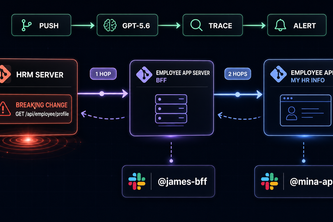
What the company appears to be: CHAIN is a developer tool that monitors API changes in repositories and traces their impact across a dependency graph before those changes reach production. It uses static code analysis and GPT-5.6 to detect breaking contract changes, then sends targeted Slack alerts to affected developers.
What changed: The project was built as part of an OpenAI 2026 hackathon submission. It is described as a working prototype with an interactive demo that traces API dependencies through BFFs and notifies relevant teams about breaking changes before they affect users.
Single most important open question: Does CHAIN have any real-world adoption or usage beyond the hackathon demo? The description states no revenue, customers or traction data are available beyond what the author claims.
What The Product Actually Is
The description states that CHAIN is a Python/FastAPI application that:
- Maintains a live REST dependency graph across repositories
- Analyzes GitHub push webhooks to detect breaking API contract changes
- Uses GPT-5.6 to determine if diffs break external API contracts
- Walks backward through proxy or BFF hops in the dependency graph
- Resolves affected repository owners and product features
- Sends targeted Slack alerts with endpoint, change, dependency path, hop distance, owner, and feature at risk
The system is described as using static analysis of JavaScript/TypeScript code to identify Express route definitions, outbound fetch/axios calls, and constants/environment-backed base URLs. It also uses GPT-5.6 for semantic reasoning at uncertain boundaries.
Positioning & Claim Evolution
The description states that CHAIN positions itself as a tool that helps developers see the blast radius of API changes before users do. The tagline "Change Happened. Anyone Informed? Nope. Trace breaking APIs across repos before production finds out" frames it as a solution to the problem where backend teams make changes that silently break downstream products.
The author claims this addresses a common scenario where:
- An HR backend changes an endpoint from session authentication to Bearer tokens
- The employee app never calls that backend directly—it calls a BFF
- Neither team can easily see the full blast radius until production fails
Target Customer & ICP
The description states that CHAIN targets developers working in teams with distributed codebases where API contracts are fragmented across repositories and teams. It is positioned as a tool for backend teams making changes that could affect downstream services.
The product appears to be aimed at organizations with:
- Multiple repositories
- BFF (Backend-for-Frontend) patterns
- Teams that need to understand the impact of their API changes before they reach production
Business Model & Pricing Evidence
Not evidenced. The description does not contain any information about pricing, monetization, or business model.
Technical & Delivery Signals
The description states that CHAIN is built with:
- Python/FastAPI application
- Atomic JSON graph store
- Static repository analysis of JavaScript/TypeScript for Express route definitions, outbound fetch/axios calls, constants and environment-backed base URLs
- GPT-5.6 via OpenAI Responses API for breaking-change classification and fuzzy edge inference
- GitHub HMAC SHA-256 webhook verification
- GitHub Compare API diff retrieval
- Slack Incoming Webhook delivery
- Three runnable Node.js sample services
- 23 automated tests
The system is described as using incremental dependency graph updates where only nodes and edges produced by the pushed repository are replaced, preserving evidence discovered in other repositories.
Traction & Maturity Signals
Not evidenced. The description states that this was a hackathon submission to the OpenAI 2026 hackathon and that no revenue, customer or traction data is available beyond what they state.
The project has:
- An interactive demo
- A deployed visualization
- 23 automated tests
- Three sample services that complete real app → BFF → HR request chains
However, there is no evidence of actual usage, customers, or revenue generation.
Competitive Context
Not evidenced. The description does not contain any information about competitors or the competitive landscape for this type of tool.
Open Questions & Risks
- No traction evidence: This appears to be a hackathon project with no demonstrated adoption or usage beyond the demo
- Unproven commercial viability: No revenue, customers or business model described
- Dependency on GPT-5.6: The system relies heavily on a proprietary AI model that may not be available in production environments
- Limited scope: The MVP is described as intentionally staying focused on core developer tool experience without broader features like OpenAPI schema comparison or CODEOWNERS integration
- Single-person team: The project has only one team member (Harim Jung), which may limit development capacity
Questions the description leaves open
- What is the actual business model for CHAIN? How do you plan to monetize this tool?
- Has there been any real-world usage or testing beyond the hackathon demo?
- What are the technical limitations of relying on GPT-5.6 for breaking-change detection?
- How does CHAIN handle edge cases like dynamic URL construction or complex routing scenarios?
- What is the roadmap for moving beyond the MVP to a production-ready product?
- How do you plan to integrate with existing CI/CD pipelines and development workflows?
- What are the scalability limitations of the current architecture?
Overall Assessment
Not evidenced. The description does not contain any information about funding rounds, valuations, or investment status beyond the fact that it was submitted to a hackathon.
The project appears to be an early-stage prototype with no demonstrated traction, revenue, or customers. While the concept addresses a real developer pain point, there is insufficient evidence to assess commercial viability or market potential. The single-person team and hackathon origin suggest this is still in very early development stages.
User Stories BotA demo video on every pull request
Get a demo video on every new feature
GitHub App that watches your pull requests and records a narrated, captioned demo.
Save time on demo prep and make informed decisions faster with a video walkthrough of every new feature.
Source
Submitted to the OpenAI 2026 hackathon on Devpost. Project home on Devpost. Back to the full gallery on Devpost.
This competitive analysis was produced by top-founders.com (opens in a new tab)
Generated by a language model from this project's public Devpost page — its tagline, the author's own write-up and any built-with tags listed there — as captured in August 2026. Short quotations are the author's words. It is an opinion on the idea as a business, not on the people behind it, and it reflects the description as published then. If the project has moved on, request a correction below. The analysis is not independent research and contains no verified traction, revenue or customer data.
An independent guide by KFG International LLC — not affiliated with, endorsed by, or connected to Devpost or OpenAI.