

Archive position — measured, not model output
0 likes on Devpost
2,263 of the 7,850 archived projects have more likes, and 5,587 share exactly 0 — so this project's #6,052 place in the like-ranked listing is a tie-break inside that group, not a ranking.
Projects (log scale)
Likes on Devpost. ▲ marks this project's group.
Show the figures
| Likes | Projects | Share of archive |
|---|---|---|
| 0 | 5,587 | 71.2% |
| 1 | 1,758 | 22.4% |
| 2 | 284 | 3.6% |
| 3–4 | 132 | 1.7% |
| 5–9 | 75 | 1.0% |
| 10+ | 14 | 0.2% |
 User Stories BotA demo video on every pull request
Get a demo video on every new feature
GitHub App that watches your pull requests and records a narrated, captioned demo.
Save time on demo prep and make informed decisions faster with a video walkthrough of every new feature.
Executive Summary
What the company appears to be
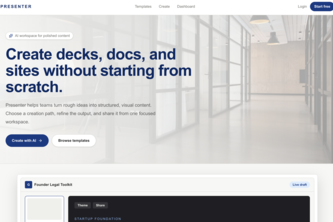
Presenter is an AI-native presentation tool that generates structured, editable presentations from prompts, documents, or URLs. The author states it aims to bridge the gap between traditional tools (which offer control but require manual effort) and AI tools (which generate quickly but are rigid). It supports rich themes, drag-and-drop editing, direct visual manipulation, and export capabilities.
What changed
The author describes building a system where AI output remains fully editable through a structured document model. This includes using an intermediate representation to preserve semantic content and design intent, enabling granular control over generated elements.
Single most important open question
Is there evidence of user adoption or product-market fit beyond the single-person build? The description lacks any data on usage, revenue, customers, or traction — only self-reported claims about functionality and architecture.
Note: All findings are based on the author's own account. No external verification is available. This analysis treats every statement as a claim unless otherwise specified.
What The Product Actually Is
The description states that Presenter is an AI-native presentation tool designed to generate polished, interactive presentations from ideas, documents, or URLs. It allows users to:
- Generate full presentations via prompts.
- Import content from documents and URLs.
- Apply rich themes (affecting typography, spacing, colors, etc.).
- Edit individual blocks (text, images, charts, tables, etc.) directly on the canvas.
- Reorder, resize, duplicate, or move content using drag-and-drop.
- Crop and reposition images with masks, focal points, zoom, and layering.
- Rewrite selected text with AI assistance.
- Use templates containing editable components.
- Undo/redo, review history, and rely on automatic saving.
- Present, publish, or export work.
It uses a structured card-and-block document model. The AI pipeline generates outlines, content blocks, layout intent, image requirements, and theme-aware design decisions, which are then validated before reaching the editor so all elements remain editable through the same system as manually created content.
Inference: The product is described as an editing environment where AI generation integrates seamlessly with manual control. It is not a static generator but a dynamic workspace.
Positioning & Claim Evolution
The author states that Presenter was built to address two main problems in presentation creation:
- Traditional tools offer control but require hours of manual design.
- Many AI tools generate quickly but produce rigid results that are difficult to customize.
Presenter positions itself as a solution that combines the speed of generative AI with the precision of a professional editor, allowing users to move from an idea to a polished presentation they can call their own.
Claim: The tool aims to be “AI-native” and preserves creative control during editing.
Inference: This is a positioning shift from simple AI-to-slide tools toward a hybrid workspace that supports both generation and fine-grained manipulation.
Target Customer & ICP
The description does not explicitly name target customers or define an ideal customer profile (ICP). However, it implies the tool serves individuals who need to create presentations quickly but also want to maintain control over their output. It is likely aimed at professionals, students, educators, or creators who value both speed and customization.
Claim: The tool targets users who want fast, AI-assisted presentation creation without sacrificing editing freedom.
Inference: Based on the features described (drag-and-drop, rich themes, editable charts, etc.), it may appeal to those working in business, education, or creative fields where visual storytelling matters.
Business Model & Pricing Evidence
There is no evidence in the description of a business model or pricing strategy. The author does not mention monetization plans, subscriptions, freemium tiers, or any commercial structure.
Claim: No information provided about how the product will be sold or funded.
Inference: Since this is a hackathon submission and no revenue data exists, it's likely early-stage with unclear commercial viability.
Technical & Delivery Signals
The author provides extensive technical details:
- Built with Next.js, React, TypeScript, Tailwind CSS.
- Uses Tiptap for rich-text editing.
- Implements dnd-kit for drag-and-drop interactions.
- Employs Zustand for state management and undo/redo functionality.
- Utilizes Drizzle ORM and PostgreSQL for persistent documents and revisions.
- Integrates Better Auth for authentication.
- Uses Recharts for editable data visualizations.
- Includes a custom image pipeline for generation, sourcing, cropping, masks, focal points, and freeform placement.
- Supports export pipelines for presentation and document formats.
- Tested with Vitest, Testing Library, and Playwright.
Claim: The system uses structured representations to ensure AI output remains editable.
Inference: The architecture suggests a focus on reliability, persistence, and user experience — key signals of a mature product development approach.
Traction & Maturity Signals
There is no evidence of traction or maturity beyond the single-person build. No customer data, usage metrics, revenue figures, or adoption indicators are mentioned. The project was submitted to a hackathon, indicating it's likely in an early stage.
Claim: No evidence of users, customers, or market traction.
Inference: The lack of any mention of real-world usage or feedback suggests this is a prototype or proof-of-concept rather than a commercial product.
Competitive Context
The author mentions studying leading presentation products in depth, including how selection, contextual toolbars, themes, templates, cropping, nested blocks, and direct manipulation behave. However, no specific competitors are named.
Claim: The author studied existing tools to inform implementation.
Inference: This implies awareness of the competitive landscape but does not reveal specific market positioning or differentiation from known players.
Open Questions & Risks
- No commercial traction: No evidence of users, customers, or revenue.
- Single-person build: The entire project was built by one person (Kc pele), raising questions about scalability and long-term maintenance.
- Unproven market demand: The author’s own write-up is the only source of information; no external validation exists.
- Unclear monetization strategy: No indication of how the product will be monetized or whether it has a viable business model.
Inference: Without traction, funding, or clear commercial intent, this appears to be an experimental project rather than a scalable venture.
Questions the description leaves open
- What is your plan for monetization and pricing?
- Have you tested the product with real users beyond yourself?
- How do you intend to scale beyond a single developer?
- Are there any technical limitations or edge cases that have not been addressed?
- What are your long-term goals for the product — is it intended to be a standalone tool, or part of a larger platform?
Overall Assessment
Not evidenced.
Note: The description provides no data on revenue, customers, traction, or financials. It does not indicate whether this represents a viable investment opportunity or partnership candidate. The project appears to be a hackathon submission with no commercial evidence beyond the author’s own account.
User Stories BotA demo video on every pull request
Get a demo video on every new feature
GitHub App that watches your pull requests and records a narrated, captioned demo.
Save time on demo prep and make informed decisions faster with a video walkthrough of every new feature.
Source
Submitted to the OpenAI 2026 hackathon on Devpost. Project home on Devpost. Back to the full gallery on Devpost.
This competitive analysis was produced by top-founders.com (opens in a new tab)
Generated by a language model from this project's public Devpost page — its tagline, the author's own write-up and any built-with tags listed there — as captured in August 2026. Short quotations are the author's words. It is an opinion on the idea as a business, not on the people behind it, and it reflects the description as published then. If the project has moved on, request a correction below. The analysis is not independent research and contains no verified traction, revenue or customer data.
An independent guide by KFG International LLC — not affiliated with, endorsed by, or connected to Devpost or OpenAI.