

Archive position — measured, not model output
1 like on Devpost
505 of the 7,850 archived projects have more likes, and 1,758 share exactly 1 — so this project's #2,128 place in the like-ranked listing is a tie-break inside that group, not a ranking.
Projects (log scale)
Likes on Devpost. ▲ marks this project's group.
Show the figures
| Likes | Projects | Share of archive |
|---|---|---|
| 0 | 5,587 | 71.2% |
| 1 | 1,758 | 22.4% |
| 2 | 284 | 3.6% |
| 3–4 | 132 | 1.7% |
| 5–9 | 75 | 1.0% |
| 10+ | 14 | 0.2% |
 User Stories BotA demo video on every pull request
Get a demo video on every new feature
GitHub App that watches your pull requests and records a narrated, captioned demo.
Save time on demo prep and make informed decisions faster with a video walkthrough of every new feature.
Executive Summary
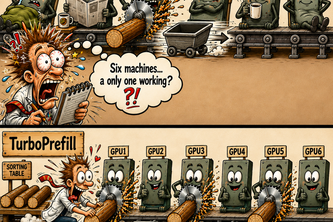
The company appears to be a solo project (1 person) named TurboPrefill, developed by Serhii Trykhlieb. The project claims to improve multi-GPU LLM prefill performance by pipelining microbatches across GPUs, reducing idle time and inter-GPU communication bottlenecks.
What changed: The author states that the project was initially built for llama.cpp and later ported to ik_llama.cpp during an OpenAI Build Week hackathon. It includes modifications to source files, benchmark scripts, test contexts, and diagnostic logging.
The single most important open question: Is there any evidence of real-world deployment or adoption beyond the author’s own testing? The description provides no information on whether TurboPrefill has been used in production systems, integrated into larger platforms, or validated by third parties.
What The Product Actually Is
- The description states that TurboPrefill is a system for accelerating multi-GPU LLM prefill.
- It works by pipelining microbatches across GPUs, instead of processing them sequentially through all GPUs.
- It targets the prefill stage of LLM inference, where prompts are processed before decoding begins.
- The implementation was originally developed for
llama.cppand later ported toik_llama.cpp. - It includes modified source files, benchmark scripts, test contexts, and diagnostic versions.
Note: No evidence of actual product delivery or customer usage is provided. This is a self-reported technical contribution, not a commercial offering.
Positioning & Claim Evolution
- The author positions TurboPrefill as a solution to inter-GPU communication bottlenecks during LLM prefill, especially in systems without NVLink or with slow PCIe connections.
- It is described as an optimization technique that improves performance by changing how microbatches are scheduled across GPUs.
- The project was submitted to the OpenAI 2026 hackathon, suggesting it is a technical prototype or experimental work.
Inference: The positioning implies a focus on low-level systems optimization for LLM inference, not a general-purpose SaaS product or platform. It does not appear to be positioned as a commercial tool for end-users.
Target Customer & ICP
- Not evidenced.
Absence of evidence: There is no mention in the description of target customers, use cases, or personas. The project is described as a technical hackathon submission and optimization for developers working with LLMs on multi-GPU systems.
Business Model & Pricing Evidence
- Not evidenced.
Absence of evidence: No information is provided about pricing, monetization, licensing, or any business model. The description focuses entirely on the technical implementation.
Technical & Delivery Signals
- TurboPrefill was built using:
- C++
- CUDA
- llama.cpp and ik_llama.cpp
- Tools like Codex and GPT-5.6 were used for development assistance
- It was tested on:
- Different GPU generations
- Large models
- Systems with limited inter-GPU bandwidth
- The author reports performance improvements:
- For GPT-OSS-20B at 1,024 tokens: prefill increased from ~184 to ~602 tokens/second
- It includes:
- Modified source code
- Benchmark scripts
- Diagnostic logging
- Test contexts
Inference: The technical approach is consistent with systems-level optimization for LLM inference. However, no evidence of integration into larger platforms or production use.
Traction & Maturity Signals
- Not evidenced.
Absence of evidence: No data on adoption, customers, revenue, usage metrics, or product maturity beyond the author’s own testing and benchmarking is provided. The project appears to be a prototype or experimental work.
Competitive Context
- Not evidenced.
Absence of evidence: There is no mention of competitors, market positioning, or competitive landscape. The description does not reference other tools or systems that address similar bottlenecks in multi-GPU LLM inference.
Open Questions & Risks
- Solo development: Only one team member is listed (Serhii Trykhlieb), which may limit scalability and long-term maintenance.
- No commercial traction: No evidence of real-world deployment, customer adoption, or monetization.
- Hackathon origin: The project was submitted to a hackathon, suggesting it is experimental in nature and not yet mature for production use.
- Self-reported performance gains: Improvements are based on internal benchmarks without independent validation.
Inference: If this were to evolve into a product, the lack of team size, traction, or commercialization signals may pose risks for long-term viability.
Questions the description leaves open
- What is the current status of TurboPrefill? Is it being used in any production systems?
- Has the performance improvement been validated by independent benchmarks or third-party testing?
- Are there plans to commercialize this work, and if so, what would that look like?
- How does TurboPrefill integrate with existing LLM inference frameworks beyond llama.cpp?
- What are the scalability limitations of this approach across different GPU architectures?
Overall Assessment
- Not evidenced.
Absence of evidence: No information is provided about funding, valuation, or investment interest. The project is described as a solo effort submitted to a hackathon and lacks any commercial or financial indicators.
User Stories BotA demo video on every pull request
Get a demo video on every new feature
GitHub App that watches your pull requests and records a narrated, captioned demo.
Save time on demo prep and make informed decisions faster with a video walkthrough of every new feature.
Source
Submitted to the OpenAI 2026 hackathon on Devpost. Project home on Devpost. Back to the full gallery on Devpost.
This competitive analysis was produced by top-founders.com (opens in a new tab)
Generated by a language model from this project's public Devpost page — its tagline, the author's own write-up and any built-with tags listed there — as captured in August 2026. Short quotations are the author's words. It is an opinion on the idea as a business, not on the people behind it, and it reflects the description as published then. If the project has moved on, request a correction below. The analysis is not independent research and contains no verified traction, revenue or customer data.
An independent guide by KFG International LLC — not affiliated with, endorsed by, or connected to Devpost or OpenAI.