

Archive position — measured, not model output
0 likes on Devpost
2,263 of the 7,850 archived projects have more likes, and 5,587 share exactly 0 — so this project's #6,054 place in the like-ranked listing is a tie-break inside that group, not a ranking.
Projects (log scale)
Likes on Devpost. ▲ marks this project's group.
Show the figures
| Likes | Projects | Share of archive |
|---|---|---|
| 0 | 5,587 | 71.2% |
| 1 | 1,758 | 22.4% |
| 2 | 284 | 3.6% |
| 3–4 | 132 | 1.7% |
| 5–9 | 75 | 1.0% |
| 10+ | 14 | 0.2% |
 User Stories BotA demo video on every pull request
Get a demo video on every new feature
GitHub App that watches your pull requests and records a narrated, captioned demo.
Save time on demo prep and make informed decisions faster with a video walkthrough of every new feature.
Executive Summary
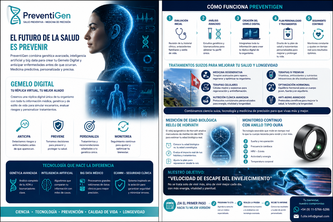
The Preventigen AI Platform ecosystem is a self-reported, multi-vertical health-tech platform that claims to transform fragmented clinical data into dynamic digital health twins using GPT-5.6, ECAMM AI agents, and predictive medicine. The author describes it as an integrated system with multiple verticals including hospitals, clinics, telemedicine, real estate, wearables, insurance, and corporate wellness — all connected through a membership-based model with three tiers (Blue, Silver, Gold). The platform is positioned to enable preventive medicine, reduce medical errors, and generate recurring revenue streams across various business segments.
What Changed: The project description presents a significant expansion from a single product or service into a multi-layered ecosystem. It moves beyond traditional EHRs or telemedicine to propose a "living data" model with digital twins, predictive risk engines, and AI agents, suggesting a shift toward continuous monitoring and proactive care.
Most Important Open Question: Is there any evidence of actual implementation, traction, or revenue generation beyond the author’s claims?
What The Product Actually Is
The description states that Preventigen is an AI platform that connects multiple healthcare ecosystems in a single intelligent environment powered by GPT-5.6 and ECAMM agents.
It includes:
- Digital Health Twin
- ST 4.1 Smart Clinical Center
- ECAMM Medical Security System
- AI-Powered Medical Agents
- Predictive Risk Engine
- Preventive Medicine Dashboard
- Population Health Analytics
- Corporate Wellness
- Blue Zones Health Club
- Laboratory Integration
- Medical Imaging Integration
- Pharmacy Robot and Medication Distribution
- Insurance and Prepaid Health Services Integration
The platform is described as transforming static medical records into continuously evolving clinical intelligence.
Inference: The system appears to be a conceptual framework for integrating diverse health data sources into a unified, AI-driven model. However, no evidence of actual product delivery or technical architecture is provided.
Positioning & Claim Evolution
The author positions Preventigen as a platform that moves away from traditional electronic health records (EHRs) and toward "living intelligence" — dynamic, real-time digital twins of patient data.
Key claims:
- Health data is transformed from “dead” to “living,” enabling predictive clinical medicine.
- Inspired by Airbus’s ECAM philosophy used in aviation for safety monitoring.
- Aims to reduce preventable medical errors through clinical verification, predictive alerts, and decision support.
- Not intended to replace physicians but to assist them with evidence-based recommendations.
Inference: The positioning evolves from a data integration tool to a full-scale ecosystem for preventive medicine and long-term patient engagement. It attempts to align itself with concepts like “digital twin,” “predictive analytics,” and “preventive care” — all of which are common in health-tech narratives but not yet proven in this case.
Target Customer & ICP
The description identifies several target customer segments:
- Hospitals, clinics, private practices
- Laboratories, diagnostic centers
- Corporate wellness programs
- Insurance providers
- Longevity and senior living communities
- Telemedicine platforms
- Wearable device users
- Mass market consumers via shopping centers or media channels
Membership tiers are defined as:
- Blue Card (USD 15/month)
- Silver Card (USD 35/month)
- Gold Card (USD 75/month)
Each tier offers increasing levels of access and services.
Inference: The ICP seems broad, ranging from individual consumers to large institutional partners. This suggests a multi-sided business model with both B2C and B2B components, though no evidence of specific customer acquisition or retention strategies is provided.
Business Model & Pricing Evidence
The business model is described as membership-based with three tiers:
- Blue Card: USD 15/month
- Silver Card: USD 35/month
- Gold Card: USD 75/month
Revenue projections are based on:
- Initial scenario: 10,000 members at average ticket of USD 20/month = USD 2.4 million annually.
- Breakdown across operational verticals such as hospitals, clinics, real estate, hotels, insurance, wearables, etc.
Additional monetization methods include:
- Device sales (e.g., smart rings, watches)
- Subscription fees for monitoring and AI services
- Integration with insurance and prepaid health plans
- Corporate wellness programs
- Content and education offerings
Inference: The model relies heavily on recurring revenue from memberships and subscriptions. However, there is no evidence of actual pricing in the market, customer adoption, or financial performance beyond stated estimates.
Technical & Delivery Signals
The platform is built using:
- GPT-5.6
- ECAMM AI agents
- Cloud infrastructure (AWS)
- Wearables and sensors for continuous monitoring
- APIs for integration with labs, diagnostics, imaging, pharmacy, insurance, etc.
It includes features like:
- Digital twin generation
- Predictive risk engine
- Smart clinical center (ST 4.1)
- Telemedicine capabilities
Inference: The technical architecture appears conceptual rather than implemented. No details on how the platform functions in practice, or whether it has been tested or deployed, are provided.
Traction & Maturity Signals
The author claims:
- Implementation in Paraguay (San Lucas Clinic, Bollier Pharmaceutical Laboratory)
- Expansion into Argentina with AWS and Waiken partners
- Use cases across multiple verticals including hospitals, clinics, real estate, hotels, insurance, wearables, etc.
- Estimated revenue projections across various verticals
However, there is no evidence of:
- Actual users or customers
- Revenue figures
- Product demos or live systems
- Pilot programs or case studies beyond self-reported presentations
Inference: While the author describes several implementations and use cases, none are independently verified. The lack of traction data makes it difficult to assess maturity or viability.
Competitive Context
The description does not directly reference competitors. However, based on its positioning:
- It overlaps with EHR vendors (e.g., Epic, Cerner)
- It aligns with digital twin and predictive analytics platforms
- It competes with telemedicine services (e.g., Teladoc, Amwell)
- It integrates elements of wearable health tech (e.g., Fitbit, Garmin)
- It touches on longevity and wellness ecosystems
Inference: The competitive landscape is unclear due to lack of specific competitor identification or differentiation. The platform appears to aim for a broad, cross-sector approach that could potentially compete with multiple types of players.
Open Questions & Risks
- Unverified Claims: All information is self-reported and unverified.
- Lack of Traction: No evidence of revenue, customers, or product deployment.
- Overambitious Scope: The platform spans 12 verticals with unclear integration points.
- Unclear Technical Feasibility: No details on how GPT-5.6 and ECAMM agents are implemented or scaled.
- Membership Model Risk: The pricing structure assumes high adoption rates without evidence of market demand.
- Regulatory Uncertainty: Health data handling, privacy, and compliance are not addressed.
Inference: The project lacks any concrete evidence of execution or commercial success, raising significant concerns about its readiness for investment or partnership.
Questions the description leaves open
- What specific proof do you have of implementation in Paraguay and Argentina?
- Can you provide examples of actual users or pilot programs?
- How is the predictive risk engine validated? What data sources are used?
- What is the current status of product development and technical architecture?
- Are there any third-party integrations or partnerships confirmed?
- What are the key assumptions behind your revenue projections?
- How do you plan to scale across different verticals without clear evidence of traction in any one?
- What regulatory compliance measures are in place for handling health data?
Overall Assessment
The Preventigen AI Platform ecosystem is described as a highly ambitious, multi-vertical health-tech platform that aims to transform fragmented health data into living digital twins using advanced AI technologies.
However, the description contains no verifiable evidence of traction, revenue, or product delivery. All claims are self-reported and unverified.
Assessment: Not suitable for investment or partnership at this stage due to lack of demonstrated progress, customer validation, or financial performance. The project is conceptual and lacks any measurable commercial signal.
User Stories BotA demo video on every pull request
Get a demo video on every new feature
GitHub App that watches your pull requests and records a narrated, captioned demo.
Save time on demo prep and make informed decisions faster with a video walkthrough of every new feature.
Source
Submitted to the OpenAI 2026 hackathon on Devpost. Project home on Devpost. Back to the full gallery on Devpost.
This competitive analysis was produced by top-founders.com (opens in a new tab)
Generated by a language model from this project's public Devpost page — its tagline, the author's own write-up and any built-with tags listed there — as captured in August 2026. Short quotations are the author's words. It is an opinion on the idea as a business, not on the people behind it, and it reflects the description as published then. If the project has moved on, request a correction below. The analysis is not independent research and contains no verified traction, revenue or customer data.
An independent guide by KFG International LLC — not affiliated with, endorsed by, or connected to Devpost or OpenAI.