

Archive position — measured, not model output
0 likes on Devpost
2,263 of the 7,850 archived projects have more likes, and 5,587 share exactly 0 — so this project's #6,056 place in the like-ranked listing is a tie-break inside that group, not a ranking.
Projects (log scale)
Likes on Devpost. ▲ marks this project's group.
Show the figures
| Likes | Projects | Share of archive |
|---|---|---|
| 0 | 5,587 | 71.2% |
| 1 | 1,758 | 22.4% |
| 2 | 284 | 3.6% |
| 3–4 | 132 | 1.7% |
| 5–9 | 75 | 1.0% |
| 10+ | 14 | 0.2% |
 User Stories BotA demo video on every pull request
Get a demo video on every new feature
GitHub App that watches your pull requests and records a narrated, captioned demo.
Save time on demo prep and make informed decisions faster with a video walkthrough of every new feature.
Executive Summary
What the company appears to be
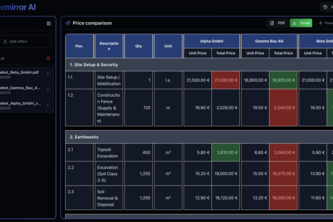
Pricemirror AI is a self-reported web application that converts unstructured supplier quotes (PDF, XLSX, XLS, CSV) into polished, editable Excel workbooks using AI. It claims to support OCR, semantic matching of line items across vendors, formula generation, and native output with themes applied post-generation.
What changed
The project description is a self-reported submission for the OpenAI 2026 hackathon. No evidence of prior traction, revenue, or customer adoption is provided. The author states this is a production web app built in a short timeframe, but there is no indication of ongoing operations or market validation.
Single most important open question
Is there any evidence that Pricemirror AI has been used beyond the hackathon context, and if so, by whom? The description does not indicate any commercial use or user base beyond its own demonstration.
What The Product Actually Is
The description states that Pricemirror AI is a web application that converts supplier quotes into structured, editable Excel workbooks. It supports:
- Upload of PDF, XLSX, XLS, or CSV files (including scanned documents)
- Extraction and reconciliation of line items across vendors
- Generation of structured tables with formulas, subtotals, totals, and visual hierarchy
- Editing of the generated table directly
- Theme selection/customization post-generation without altering underlying content
- Native XLSX or paginated PDF export
- Automatic highlighting of lowest/highest prices
- EU-only AI processing for data-residency compliance
The result is described as a native, editable spreadsheet, not an image or static export.
Inference The product appears to be a tool for procurement professionals or supply chain teams who need to compare vendor offers quickly and professionally.
Positioning & Claim Evolution
The author positions Pricemirror AI as solving the problem of turning unstructured AI-generated spreadsheet content into polished, professional, editable workbooks. It emphasizes:
- Professional rendering with clear visual hierarchy
- Reliable formulas and structured layouts
- Native output that remains editable after theme changes
- Support for messy real-world inputs (scanned docs, inconsistent naming)
- Compliance features like EU-only processing
This is a product-first positioning, focused on technical capability rather than market segment or customer persona.
Inference The product is positioned as an enhancement to existing AI tools that generate content but don’t deliver polished, usable spreadsheets.
Target Customer & ICP
The description does not name specific customers or personas. However, it implies use cases around:
- Procurement teams
- Supply chain managers
- Business analysts comparing vendor offers
- Users needing structured comparison of supplier quotes
It also mentions multilingual support in English, German, and French, suggesting a European market focus.
Inference The ICP likely includes procurement or finance professionals working with supplier data in B2B environments. However, no explicit customer segmentation or buyer personas are provided.
Business Model & Pricing Evidence
There is no evidence of pricing, monetization strategy, or business model in the description. The author does not state whether this is a freemium, SaaS, or one-time tool, nor how it would be sold or priced.
Inference The project appears to be a prototype or hackathon submission with no commercial structure evident.
Technical & Delivery Signals
The system uses a staged pipeline including:
- Secure upload and storage
- Text/spreadsheet extraction with OCR fallback
- AI normalization and semantic matching of line items
- Structured intermediate table with formula metadata
- Sanitization and schema-bound validation
- Independent theme application in browser
- Native XLSX/PDF rendering with preserved formatting
Technology stack includes
- Next.js 16, React 19, TypeScript, Tailwind CSS, Supabase
- Vercel AI SDK, Vercel AI Gateway, Google Vertex AI, ExcelJS, jsPDF
- Codex for code navigation and debugging across layers
The author states that GPT-5.6 and Codex were used as engineering agents, helping with implementation, refactoring, testing, and verification.
Inference The product is built on modern web and AI stacks, with a focus on deterministic outputs and robustness in rendering/export.
Traction & Maturity Signals
There is no evidence of traction or maturity beyond the hackathon submission. No revenue data, customer base, usage metrics, or operational history are provided.
The author notes that this was built for a hackathon and does not mention any ongoing product development or user feedback loops.
Inference The project has no demonstrated market adoption or long-term viability.
Competitive Context
The description does not reference competitors. However, based on the stated functionality — converting supplier quotes into structured Excel workbooks with AI — it likely competes with:
- AI-powered document processing tools
- Procurement and supplier management platforms
- Spreadsheet automation tools (e.g., Zapier, Make)
- Data reconciliation and comparison tools
Inference The competitive landscape is unclear without direct competitor names or market positioning.
Open Questions & Risks
- No commercial traction or revenue evidence: This is a hackathon submission with no indication of real-world usage.
- Unverified claims: All features are self-reported; there's no third-party validation or user testing.
- Limited team size: Only one member (Maximilian Zelle) is listed, which may limit scalability and execution.
- Unclear monetization strategy: No pricing, business model, or go-to-market plan is evident.
- High technical complexity without proven delivery: The system involves complex AI pipelines, rendering, and export logic — but no evidence of successful deployment or performance.
Questions the description leaves open
- What is the actual user base beyond the hackathon?
- How does the product handle edge cases in supplier data (e.g., missing fields, inconsistent units)?
- Has the team tested the tool with real procurement workflows?
- Are there any plans for monetization or commercial deployment?
- What are the limitations of the current AI pipeline in terms of accuracy and scalability?
- How does the product ensure formula integrity during export to XLSX/PDF?
Overall Assessment
Not evidenced.
There is no evidence of revenue, customers, or traction beyond a hackathon submission. The project is described as a prototype with no commercial structure, user base, or operational history.
The author states this is a production web app built in a short timeframe, but there is no indication that it has moved beyond the experimental stage.
Confidence level Low. This is a self-reported, unverified description of a hackathon project with no demonstrated market validation or commercial viability.
User Stories BotA demo video on every pull request
Get a demo video on every new feature
GitHub App that watches your pull requests and records a narrated, captioned demo.
Save time on demo prep and make informed decisions faster with a video walkthrough of every new feature.
Source
Submitted to the OpenAI 2026 hackathon on Devpost. Project home on Devpost. Back to the full gallery on Devpost.
This competitive analysis was produced by top-founders.com (opens in a new tab)
Generated by a language model from this project's public Devpost page — its tagline, the author's own write-up and any built-with tags listed there — as captured in August 2026. Short quotations are the author's words. It is an opinion on the idea as a business, not on the people behind it, and it reflects the description as published then. If the project has moved on, request a correction below. The analysis is not independent research and contains no verified traction, revenue or customer data.
An independent guide by KFG International LLC — not affiliated with, endorsed by, or connected to Devpost or OpenAI.