

Archive position — measured, not model output
1 like on Devpost
505 of the 7,850 archived projects have more likes, and 1,758 share exactly 1 — so this project's #2,132 place in the like-ranked listing is a tie-break inside that group, not a ranking.
Projects (log scale)
Likes on Devpost. ▲ marks this project's group.
Show the figures
| Likes | Projects | Share of archive |
|---|---|---|
| 0 | 5,587 | 71.2% |
| 1 | 1,758 | 22.4% |
| 2 | 284 | 3.6% |
| 3–4 | 132 | 1.7% |
| 5–9 | 75 | 1.0% |
| 10+ | 14 | 0.2% |
 User Stories BotA demo video on every pull request
Get a demo video on every new feature
GitHub App that watches your pull requests and records a narrated, captioned demo.
Save time on demo prep and make informed decisions faster with a video walkthrough of every new feature.
Executive Summary
What the company appears to be
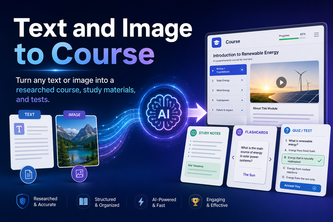
The description states that txt2crs is a tool that takes any sort of input (text or image) and turns it into a well-researched, well-developed course, including study material and tests with answer keys. The author describes it as a project submitted to the OpenAI 2026 hackathon.
What changed
No evidence of prior version, evolution or change is provided. This appears to be a new submission without prior history.
The single most important open question
Is there any evidence of actual usage, revenue, or traction from users beyond the author's own self-report? The description provides no indication of adoption, customers, or monetization.
What The Product Actually Is
The description states:
"Take any sort of input and turn that into a well researched, well-developed course. It will also create the study material and it will create a test on all the material along with answer key."
Inference This is a tool that converts arbitrary inputs (text or image) into structured educational content — including full courses, materials, and assessments.
Evidence strength Not evidenced. The description does not clarify how this conversion works technically or what the output format looks like.
Positioning & Claim Evolution
The author states:
"txt2crs"
"Take any sort of input and turn that into a well researched, well-developed course."
Claim
The tool is positioned as an automated educational content generator that transforms inputs into complete learning modules.
Inference It appears to be a product in the AI-powered education or edtech space, possibly targeting educators, learners, or content creators who want to rapidly generate structured course material.
Evidence strength Not evidenced. No prior positioning, evolution of claims, or marketing narrative is provided.
Target Customer & ICP
The description states:
"Take any sort of input and turn that into a well researched, well-developed course."
Inference Potential users may include educators, corporate trainers, content creators, or learners who need to quickly generate educational material from raw inputs.
Evidence strength Not evidenced. No customer personas, user segments, or buyer profiles are described.
Business Model & Pricing Evidence
The description states:
"Take any sort of input and turn that into a well researched, well-developed course."
Inference If this is a commercial product, it likely operates on a usage-based model (e.g., per course generated or per input processed), but no pricing or monetization details are provided.
Evidence strength Not evidenced. No business model, pricing structure, or revenue streams are mentioned.
Technical & Delivery Signals
The author states:
"Built with (author-declared): codex, fastapi, gpt5.6, openai, python, react, sol"
Inference The tool is built using AI models (GPT-5.6), backend frameworks (FastAPI), frontend (React), and possibly smart contract components (sol). This suggests a tech stack aligned with generative AI and web-based delivery.
Evidence strength Not evidenced. No details on how the system works, scalability, or delivery mechanism are provided beyond the tech stack.
Traction & Maturity Signals
The description states:
"This project was submitted to the OpenAI 2026 hackathon on Devpost."
Inference This is a hackathon submission. No evidence of traction, user adoption, or product maturity beyond this point is provided.
Evidence strength Not evidenced. No data on usage, retention, revenue, or product development milestones are available.
Competitive Context
The description states:
"This project was submitted to the OpenAI 2026 hackathon."
Inference It is likely in a competitive space with other AI-powered educational tools, but no comparison or market positioning is given.
Evidence strength Not evidenced. No competitor analysis or market context is provided.
Open Questions & Risks
- No evidence of product-market fit or traction: The tool is described only as a hackathon submission.
- Unclear monetization strategy: No pricing, business model, or revenue path is evident.
- Unverified claims: All descriptions are self-reported and unverified.
- No customer data or feedback: No indication of user testing or real-world usage.
Evidence strength Not evidenced. These risks are inferred from the lack of any substantive evidence.
Questions the description leaves open
- What is the actual process by which inputs (text/image) are converted into courses?
- How does the tool ensure the accuracy and quality of generated content?
- Has there been any user testing or feedback on the output?
- Is this intended to be a commercial product, and if so, what is the monetization model?
- What are the technical limitations or edge cases in how it processes inputs?
Overall Assessment
Assessment Not evidenced.
The description provides no evidence of traction, revenue, customers, or even a clear understanding of the product’s functionality beyond its hackathon submission. The tool is described as a concept with a tech stack but no commercial or user validation.
Confidence level Low. This is a self-reported, unverified project with no substantiating data or evidence of real-world use or business development.
User Stories BotA demo video on every pull request
Get a demo video on every new feature
GitHub App that watches your pull requests and records a narrated, captioned demo.
Save time on demo prep and make informed decisions faster with a video walkthrough of every new feature.
Source
Submitted to the OpenAI 2026 hackathon on Devpost. Project home on Devpost. Back to the full gallery on Devpost.
This competitive analysis was produced by top-founders.com (opens in a new tab)
Generated by a language model from this project's public Devpost page — its tagline and any built-with tags listed there, since the author published no write-up — as captured in August 2026. Short quotations are the author's words. It is an opinion on the idea as a business, not on the people behind it, and it reflects the description as published then. If the project has moved on, request a correction below. The analysis is not independent research and contains no verified traction, revenue or customer data.
An independent guide by KFG International LLC — not affiliated with, endorsed by, or connected to Devpost or OpenAI.