

Archive position — measured, not model output
0 likes on Devpost
2,263 of the 7,850 archived projects have more likes, and 5,587 share exactly 0 — so this project's #4,091 place in the like-ranked listing is a tie-break inside that group, not a ranking.
Projects (log scale)
Likes on Devpost. ▲ marks this project's group.
Show the figures
| Likes | Projects | Share of archive |
|---|---|---|
| 0 | 5,587 | 71.2% |
| 1 | 1,758 | 22.4% |
| 2 | 284 | 3.6% |
| 3–4 | 132 | 1.7% |
| 5–9 | 75 | 1.0% |
| 10+ | 14 | 0.2% |
 User Stories BotA demo video on every pull request
Get a demo video on every new feature
GitHub App that watches your pull requests and records a narrated, captioned demo.
Save time on demo prep and make informed decisions faster with a video walkthrough of every new feature.
Executive Summary
Company: FigureFirst Physics
Self-reported basis: The description is entirely from the author’s own submission to the OpenAI 2026 hackathon on Devpost. No third-party verification or historical data is available.
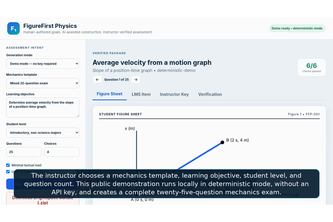
What it appears to be: A prototype web application for creating diagram-led physics assessments, built with AI assistance and deterministic scientific checks.
What changed: The project was submitted as a hackathon prototype; no evidence of product evolution or commercial traction beyond the initial build.
Single most important open question: Is there a viable path from this prototype to a scalable, instructor-facing SaaS product that can be monetized in educational markets?
What The Product Actually Is
The description states that FigureFirst Physics is an instructor-facing web application for creating verified, diagram-led introductory physics assessments. It produces synchronized outputs including:
- A student-facing physics diagram
- A multiple-choice question with plausible distractors
- An instructor solution with units shown throughout the calculation
- A verification report
- Export-ready assessment content
The application independently recomputes physics, checks correctness of answers, validates units and required fields, and ensures agreement between the diagram and numerical parameters. It blocks export if inconsistencies are detected.
Inference: The tool is designed to reduce manual effort in creating assessments while maintaining scientific rigor. It uses deterministic logic for verification rather than relying on AI-generated judgments.
Positioning & Claim Evolution
The author claims that FigureFirst Physics addresses a problem in physics instruction: the need for assessments that test physical reasoning, not rote text reproduction. The tool aims to make diagram-led question creation faster and more reliable.
It positions itself as a solution that combines:
- AI-assisted construction
- Deterministic scientific checks
- Instructor control
Inference: This is an early-stage prototype aimed at educators, with a focus on improving workflow efficiency in assessment design. It does not claim to be a full SaaS product or marketplace.
Target Customer & ICP
The description states that the tool is for physics instructors, particularly those teaching introductory physics. The target audience includes:
- Educators who create assessments
- Instructors using LMS platforms like Brightspace
Inference: The ICP appears to be community college and university-level physics educators, but no specific customer segments or personas are defined.
Business Model & Pricing Evidence
No evidence of pricing, monetization strategy, or business model is provided in the description. The tool was built as a prototype for a hackathon.
Inference: There is no indication that the product has moved beyond the prototype stage or has any commercial revenue streams.
Technical & Delivery Signals
The application was built using:
- Frontend: JavaScript, HTML, CSS
- Backend: Node.js
- AI tools: Codex, GPT-5.6
- Optional API integration: OpenAI API
- Deterministic mode: Works without API key
The system includes:
- Automated tests (13 passing)
- Release hardening
- MIT License source code published
Inference: The prototype is technically functional and shows some engineering maturity, but it remains a single-developer hackathon project with no evidence of scalability or production deployment.
Traction & Maturity Signals
The description states that the team built a working instructor-facing prototype, completed release hardening, and published source code under MIT License. It also mentions:
- Automated tests
- Instructor testing in community-college courses (planned)
- Next steps include expanding to more physics topics
Inference: There is no evidence of actual user adoption, revenue, or customer traction beyond the prototype phase.
Competitive Context
No competitive analysis or market positioning relative to existing tools is provided. The description does not mention competitors or similar products in the educational assessment space.
Inference: No information is available about how this product compares to other tools for creating physics assessments or educational content.
Open Questions & Risks
- Single-founder project: Only one team member listed (Vasiliy S. Znamenskiy)
- Prototype only: No evidence of commercial traction, customers, or revenue
- Unclear monetization path: No pricing or business model described
- Limited scope: Focus on introductory physics and LMS export
- No external validation: No third-party reviews, user feedback, or institutional partnerships
Inference: The project is in an early stage with no clear path to commercial viability. Risks include lack of product-market fit, scalability issues, and limited team capacity.
Questions the description leaves open
- What specific educational institutions or instructors are you planning to target for pilot testing?
- How do you plan to monetize this tool if it remains instructor-facing and not a marketplace or platform?
- Have you validated the need for this tool with actual educators, or is it based on assumptions?
- What are your plans for expanding beyond introductory physics topics?
- Do you have any experience in educational technology or SaaS product development?
Overall Assessment
Not evidenced: There is no evidence of revenue, customers, or traction to support a commercial due-diligence read.
Inference: This is an early-stage prototype with potential for further development. However, without any sign of product-market fit, customer validation, or monetization strategy, it does not appear ready for investment or partnership at this stage. The project may be a candidate for incubation or early-stage funding if the team can demonstrate traction and scalability.
User Stories BotA demo video on every pull request
Get a demo video on every new feature
GitHub App that watches your pull requests and records a narrated, captioned demo.
Save time on demo prep and make informed decisions faster with a video walkthrough of every new feature.
Source
Submitted to the OpenAI 2026 hackathon on Devpost. Project home on Devpost. Back to the full gallery on Devpost.
This competitive analysis was produced by top-founders.com (opens in a new tab)
Generated by a language model from this project's public Devpost page — its tagline, the author's own write-up and any built-with tags listed there — as captured in August 2026. Short quotations are the author's words. It is an opinion on the idea as a business, not on the people behind it, and it reflects the description as published then. If the project has moved on, request a correction below. The analysis is not independent research and contains no verified traction, revenue or customer data.
An independent guide by KFG International LLC — not affiliated with, endorsed by, or connected to Devpost or OpenAI.