

Archive position — measured, not model output
0 likes on Devpost
2,263 of the 7,850 archived projects have more likes, and 5,587 share exactly 0 — so this project's #4,093 place in the like-ranked listing is a tie-break inside that group, not a ranking.
Projects (log scale)
Likes on Devpost. ▲ marks this project's group.
Show the figures
| Likes | Projects | Share of archive |
|---|---|---|
| 0 | 5,587 | 71.2% |
| 1 | 1,758 | 22.4% |
| 2 | 284 | 3.6% |
| 3–4 | 132 | 1.7% |
| 5–9 | 75 | 1.0% |
| 10+ | 14 | 0.2% |
 User Stories BotA demo video on every pull request
Get a demo video on every new feature
GitHub App that watches your pull requests and records a narrated, captioned demo.
Save time on demo prep and make informed decisions faster with a video walkthrough of every new feature.
Executive Summary
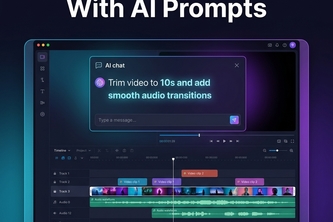
The company appears to be a solo-developer project named Filmidi, a video editor that uses natural language commands to automate editing tasks. The author states it leverages AI (GPT-5.6, Qwen) and audio/video processing libraries to enable text-based editing with frame-accurate control. It includes a native MCP server for integration with external AI tools.
What changed: This is a self-reported hackathon submission describing an experimental tool built in a short timeframe. There is no evidence of prior traction, revenue or customer adoption.
The single most important open question: Is there any evidence that this product has been used beyond the author’s own development environment, or whether it can be scaled to real-world video editing workflows?
What The Product Actually Is
- The description states Filmidi is a smart video editor.
- It allows users to edit videos using simple text commands, such as “cut dead air >1.5s” or “sync cuts to music”.
- It supports frame-accurate control, including multi-track placement, speed adjustments, and effects.
- It includes an MCP server (port 19790) that exposes functionality for external AI tools like Claude Desktop.
- It uses auto-transcription of speech for word-level trimming and removal of filler words.
- The system is built using technologies including React, Bun, WebAudio, WASM, and AI models like GPT-5.6 and Qwen.
Note: This is a self-reported description. No independent verification or demonstration of actual product usage exists in the provided evidence.
Positioning & Claim Evolution
- The author positions Filmidi as a natural language-driven video editor.
- It claims to automate repetitive editing tasks, such as cutting silences, matching beats, and removing filler words.
- It emphasizes real-time execution of edits based on text prompts.
- It describes itself as enabling creators to focus on storytelling rather than mechanical work.
Inference: The positioning suggests a shift from traditional GUI-based editors toward AI-assisted, prompt-driven editing. However, this is not backed by any market data or user feedback.
Target Customer & ICP
- The description does not name specific target customers.
- It implies the product is aimed at content creators who perform repetitive video editing tasks.
- It targets users looking to reduce time spent on mechanical edits, especially those working with audio synchronization and trimming.
Not evidenced: No explicit customer segments, personas or buyer profiles are provided.
Business Model & Pricing Evidence
- The description does not mention any pricing model or monetization strategy.
- It is described as open-source under GPL-3.0-or-later license.
- There is no indication of paid features, subscriptions, or commercial use restrictions.
Not evidenced: No evidence of a business model or pricing structure beyond the open-source nature of the codebase.
Technical & Delivery Signals
- The project uses Bun for backend execution and React for frontend UI.
- It integrates with AI APIs (Anthropic, OpenAI, Qwen) via tools like MCP SDK.
- It implements audio processing using WebAudio API and WASM-based RNNoise noise suppression.
- It includes real-time beat detection, waveform correlation algorithms, and frame mapping logic.
- The architecture is described as a client-side desktop app with IPC between frontend and backend.
- It supports 50+ tools for various editing functions like clipping, audio sync, color grading, etc.
Inference: The technical stack suggests a developer-oriented tool with strong AI integration. However, no evidence of production deployment or scalability is present.
Traction & Maturity Signals
- The project was submitted to the OpenAI 2026 hackathon, indicating it’s an experimental prototype.
- It includes source code and setup instructions (git clone, bun install).
- It has a single developer team member (Chirantan Patra).
- There is no mention of users, customers, revenue, or adoption metrics.
Not evidenced: No signs of traction, growth, or user engagement beyond the author’s own development.
Competitive Context
- The description does not reference existing competitors.
- It appears to be positioned in a space that includes AI-powered video editing tools, such as Runway, Descript, and Lumen5.
- It differs by focusing on natural language input and MCP integration, which may offer unique developer or automation advantages.
Not evidenced: No competitive analysis or differentiation from existing solutions is provided.
Open Questions & Risks
- The project is a single-person hackathon submission, with no evidence of team expansion or investment.
- It is open-source and not monetized, raising questions about long-term viability or commercial intent.
- There is no indication of real-world testing or feedback loops from users.
- The use of GPT-5.6 (not yet publicly released) implies a speculative or early-stage technology stack.
- It’s unclear whether the tool can be scaled beyond local desktop environments.
Inference: The lack of traction, commercialization, and team support raises concerns about product-market fit and sustainability.
Questions the description leaves open
- What is your plan for monetizing this tool if it remains open-source?
- Have you tested the tool with actual content creators or editors outside of your own workflow?
- How do you intend to scale beyond a local desktop application?
- Are there any planned integrations with existing video editing platforms (e.g., Adobe Premiere, DaVinci)?
- What is the expected latency and performance for real-time editing in practice?
Overall Assessment
- Not evidenced: No financials, traction, or commercial viability data are available.
- The project appears to be a proof-of-concept or prototype, not a commercial product.
- It has no demonstrated revenue, customers, or market traction.
- Its positioning as an AI-powered, text-driven video editor is compelling in concept but lacks validation.
Assessment: At this stage, there is insufficient evidence to support investment or partnership interest. The project may be a promising idea with potential for future development, but it currently lacks the commercial maturity required for due-diligence evaluation.
User Stories BotA demo video on every pull request
Get a demo video on every new feature
GitHub App that watches your pull requests and records a narrated, captioned demo.
Save time on demo prep and make informed decisions faster with a video walkthrough of every new feature.
Source
Submitted to the OpenAI 2026 hackathon on Devpost. Project home on Devpost. Back to the full gallery on Devpost.
This competitive analysis was produced by top-founders.com (opens in a new tab)
Generated by a language model from this project's public Devpost page — its tagline, the author's own write-up and any built-with tags listed there — as captured in August 2026. Short quotations are the author's words. It is an opinion on the idea as a business, not on the people behind it, and it reflects the description as published then. If the project has moved on, request a correction below. The analysis is not independent research and contains no verified traction, revenue or customer data.
An independent guide by KFG International LLC — not affiliated with, endorsed by, or connected to Devpost or OpenAI.