

Archive position — measured, not model output
3 likes on Devpost
128 of the 7,850 archived projects have more likes, and 93 share exactly 3 — so this project's #165 place in the like-ranked listing is a tie-break inside that group, not a ranking.
Projects (log scale)
Likes on Devpost. ▲ marks this project's group.
Show the figures
| Likes | Projects | Share of archive |
|---|---|---|
| 0 | 5,587 | 71.2% |
| 1 | 1,758 | 22.4% |
| 2 | 284 | 3.6% |
| 3–4 | 132 | 1.7% |
| 5–9 | 75 | 1.0% |
| 10+ | 14 | 0.2% |
 User Stories BotA demo video on every pull request
Get a demo video on every new feature
GitHub App that watches your pull requests and records a narrated, captioned demo.
Save time on demo prep and make informed decisions faster with a video walkthrough of every new feature.
Executive Summary
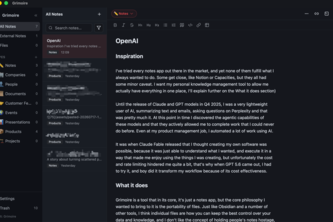
Grimoire is a self-reported local-first notes application built for personal knowledge management, with a focus on portability of markdown files across devices. The author describes it as a cross-platform tool that allows users to link notes between themselves and chat with AI via CLI. It supports note types, properties, bi-directional linking, external file handling (PPTX, DOCX), and an embedded terminal for AI interaction.
The project is described as a solo effort by Tiago Rio Pereira, who built it using GPT 5.6 and open-source technologies including React, TypeScript, Tauri, CodeMirror, and Rust. It currently targets macOS only but has plans to support Windows, Linux, and mobile platforms.
Key commercial due-diligence read
The description provides no evidence of revenue, customers, or traction. The product is described as a personal tool built for the author’s own use, with no indication of market demand or adoption beyond its creator. The business model remains unclear, and monetization plans are not evident.
What The Product Actually Is
The description states that Grimoire is:
- A cross-platform local app for linked markdown notes across devices.
- A notes app built around the philosophy of file portability.
- A tool where individual files are kept under user control, avoiding vendor lock-in.
- Capable of displaying markdown files from a folder and sub-folders.
- Supporting note types (e.g., projects, people, products) and properties (static or relations).
- Featuring bi-directional linking between notes.
- Allowing users to open external files (PPTX, DOCX) and convert them into markdown notes within the app.
- Including an embedded terminal for AI interaction using CLI tools like Claude or Codex.
Inference The product is a local-first knowledge management tool with a focus on markdown portability and AI integration. It appears to be built as a desktop application using Tauri, React, and Rust.
Positioning & Claim Evolution
The author claims that:
- Existing note-taking tools like Notion or Capacities fall short of their needs.
- They built Grimoire to fulfill a personal workflow need after discovering AI agentic capabilities in late 2025.
- The app is designed to be lightweight and portable, avoiding cloud-based solutions.
- It allows for collaboration with team members by preserving local file locations without forcing users into a centralized system.
Inference The positioning evolved from a personal productivity tool to one that addresses the limitations of existing tools in terms of portability, AI integration, and collaboration. However, there is no evidence of market testing or user feedback beyond the author’s own experience.
Target Customer & ICP
The description states:
- Grimoire is intended for individuals managing personal knowledge.
- It was built with a product management and sales role in mind.
- The author uses it for daily work involving projects, people, and products.
Inference The target customer appears to be a self-employed or individual professional who values local data control and wants to integrate AI into their note-taking workflow. However, there is no evidence of a defined ICP beyond the author’s personal use case.
Business Model & Pricing Evidence
The description states:
- Monetization is not planned.
- Everything in the current functionality will forever be free.
- No pricing information or revenue model is provided.
Inference There is no evidence of any business model or monetization strategy. The app is described as a personal tool with no indication of commercial intent.
Technical & Delivery Signals
The description states:
- Built using React, TypeScript, Tauri, CodeMirror, Rust, and other open-source tools.
- Uses a hybrid architecture: React for UI, TypeScript for logic, Rust for native OS operations.
- Supports macOS only currently, with plans to support Windows, Linux, and mobile.
- Includes features like embedded terminal, conflict detection, filesystem synchronization, and bi-directional linking.
Inference The technical stack suggests a modern, local-first approach using open-source tools. The architecture is described as well-thought-out, especially in handling edge cases such as file conflicts and native OS integration.
Traction & Maturity Signals
The description states:
- The project was submitted to the OpenAI 2026 hackathon.
- It is a solo effort by one developer (Tiago Rio Pereira).
- No revenue, customer data, or usage metrics are mentioned.
- The author expects to use it personally and plans to make it open source.
Inference There is no evidence of traction, adoption, or user engagement. The project appears to be in early development with no commercial validation.
Competitive Context
The description states:
- The author has tried other note-taking tools like Notion and Capacities.
- They aim to improve upon the shortcomings of these tools.
- It competes with tools that support markdown, linking, and AI integration.
Inference Grimoire is positioned as a local-first alternative to popular note-taking apps. However, there is no evidence of competitive analysis or market positioning beyond the author’s personal experience.
Open Questions & Risks
The description states:
- The app is built by one person.
- It is not yet available on all platforms (Windows, Linux, mobile).
- No monetization strategy is evident.
- The author has no prior coding experience, though they claim to understand software structure.
Inference Key risks include lack of scalability, limited platform support, unclear long-term viability, and potential technical limitations due to the solo developer model. The absence of a monetization plan raises questions about sustainability.
Questions the description leaves open
- What is your definition of "portability" in this context, and how does it differ from other tools?
- How do you plan to scale beyond a single developer?
- Are there any plans for user feedback or community engagement?
- What are the specific challenges you’ve faced in cross-platform development?
- Do you have any plans to monetize the product, and if so, what form will it take?
Overall Assessment
Not evidenced.
The description provides no evidence of revenue, customers, or traction. The project is described as a personal tool built by one individual with no indication of commercial intent or market demand. There is no evidence of any business model, monetization strategy, or user base.
Confidence: Low.
This analysis is based entirely on self-reported information from the author and lacks independent verification or data on performance, adoption, or financials. The project appears to be in an early stage with no commercial validation.
User Stories BotA demo video on every pull request
Get a demo video on every new feature
GitHub App that watches your pull requests and records a narrated, captioned demo.
Save time on demo prep and make informed decisions faster with a video walkthrough of every new feature.
Source
Submitted to the OpenAI 2026 hackathon on Devpost. Project home on Devpost. Back to the full gallery on Devpost.
This competitive analysis was produced by top-founders.com (opens in a new tab)
Generated by a language model from this project's public Devpost page — its tagline, the author's own write-up and any built-with tags listed there — as captured in August 2026. Short quotations are the author's words. It is an opinion on the idea as a business, not on the people behind it, and it reflects the description as published then. If the project has moved on, request a correction below. The analysis is not independent research and contains no verified traction, revenue or customer data.
An independent guide by KFG International LLC — not affiliated with, endorsed by, or connected to Devpost or OpenAI.