

Archive position — measured, not model output
0 likes on Devpost
2,263 of the 7,850 archived projects have more likes, and 5,587 share exactly 0 — so this project's #6,053 place in the like-ranked listing is a tie-break inside that group, not a ranking.
Projects (log scale)
Likes on Devpost. ▲ marks this project's group.
Show the figures
| Likes | Projects | Share of archive |
|---|---|---|
| 0 | 5,587 | 71.2% |
| 1 | 1,758 | 22.4% |
| 2 | 284 | 3.6% |
| 3–4 | 132 | 1.7% |
| 5–9 | 75 | 1.0% |
| 10+ | 14 | 0.2% |
 User Stories BotA demo video on every pull request
Get a demo video on every new feature
GitHub App that watches your pull requests and records a narrated, captioned demo.
Save time on demo prep and make informed decisions faster with a video walkthrough of every new feature.
Executive Summary
What the company appears to be
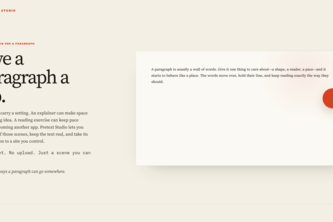
Pretext Studio is a browser-based tool for creative developers, editorial designers, educators, and curious authors who want to make text move with purpose without turning it into a screenshot, gimmick, or hosted platform they do not control. It allows users to compose real text that can flow around forms or images, respond to readers through deliberate behavior, or guide pacing and rehearsal — then export portable scenes to sites they control.
What changed
The project evolved from an existing technical library (pretext-flow) into a user-facing browser application (Pretext Studio). It was built as part of the OpenAI 2026 hackathon submission. The author states that this is a new product using pre-existing code, not a rebrand or pivot.
Single most important open question
Is there evidence of traction, revenue, or adoption beyond the author’s own use and demonstration?
Note: This analysis is based entirely on the self-reported project description provided by the caller. No external verification, archived data, or third-party sources are available. All claims are treated as stated by the author and not proven.
What The Product Actually Is
The description states that Pretext Studio is a browser application built with vanilla JavaScript, HTML, and CSS on top of a separately maintained library called pretext-flow. It uses tools like Codex and GPT-5.6 for implementation and verification, and Claude for design thinking.
It enables users to take real text and make it do meaningful things such as:
- Flow around a form or image;
- Respond to a reader through deliberate behavior;
- Become a reading surface that guides pacing and rehearsal.
The output is a portable scene configuration and renderer example that can be hosted on the author's own site. The tool does not host writing, images, accounts, or publishing — it only exports what the user creates.
Inference: The product appears to be an interactive text layout tool with export capabilities, built for creators who want control over their content and presentation.
Positioning & Claim Evolution
The author claims that Pretext Studio addresses a missing capability of the web: precise paragraph measurement and layout that can become part of an interaction rather than just a static block. It builds on prior work (pretext-flow) but aims to make this idea more approachable for non-developers or those unfamiliar with custom implementation.
It positions itself as:
- A small browser studio;
- For creative developers, editorial designers, educators, and curious authors;
- Not a hosted platform, not a screenshot tool, not a gimmick;
- A way to "compose real text that moves with purpose" and export it for use elsewhere.
Claim: The author positions Pretext Studio as an accessible interface to a technical capability previously only available through code. This is a self-described evolution from abstract idea to usable product.
Target Customer & ICP
The description states the target audience includes:
- Creative developers;
- Editorial designers;
- Educators;
- Curious authors;
These users are described as wanting to make text move with purpose without losing control over their content or being forced into a hosted solution.
Inference: The ICP seems to be technically inclined individuals or teams who value semantic text, readability, and portability but may lack the time or expertise to implement complex layout behaviors themselves.
Business Model & Pricing Evidence
There is no evidence of pricing, monetization, or business model in the description. The author states that the tool does not host writing, images, accounts, or publishing — it only exports what the user creates.
Not evidenced: No indication of how the product will be monetized or whether there are any paid features or tiers.
Technical & Delivery Signals
The project is built using:
- Vanilla JavaScript, HTML, CSS
- The
pretext-flowlibrary (separately maintained) - Tools like Codex, GPT-5.6, and Claude for development and verification
- Web components and canvas API
It uses a DOM publishing route to preserve semantic text while keeping the scene format portable.
Inference: The technical stack suggests a lightweight, web-native approach focused on portability and control over content. The use of AI tools indicates an experimental or rapid-development methodology.
Traction & Maturity Signals
There is no evidence of traction, revenue, customers, or adoption beyond the author’s own account. The project was submitted to a hackathon (OpenAI 2026), which implies early-stage development and limited real-world usage.
Not evidenced: No data on user engagement, retention, monetization, or product usage metrics.
Competitive Context
The description does not mention any competitors directly. However, it implies a niche in interactive text layout tools that allow for semantic text behavior without requiring screenshots or hosted platforms.
Inference: The space likely overlaps with creative coding tools, web animation libraries, and content design systems — though no specific names or products are cited.
Open Questions & Risks
- No traction or revenue evidence: The project is described as a hackathon submission with no indication of real-world adoption.
- Unproven market demand: There is no evidence that the target users actually need this functionality or are willing to pay for it.
- Limited team size: Only one member (Nour Al-Sheikh) is listed, which raises questions about scalability and long-term maintenance.
- Self-reported only: All claims are unverified; there is no external validation of the product’s capabilities or market fit.
Open question: The lack of any commercial or user data makes it difficult to assess viability or potential for growth.
Questions the description leaves open
- What specific use cases have you identified where users would benefit from this tool over existing alternatives?
- Have you tested the export functionality with real users? How do they respond to the output?
- Are there plans to support additional formats or integrations beyond what is currently described?
- What is your roadmap for product development and long-term maintenance?
- Do you have any early adopters or pilot users who are actively using the tool?
Overall Assessment
There is no evidence of revenue, customers, traction, or commercial viability beyond the author’s own description. The project appears to be an experimental tool built during a hackathon and lacks any indication of market demand or monetization strategy.
Confidence level: Low — based on sparse self-reported information with no external validation or proof of traction.
Assessment: Not ready for investment or partnership consideration without further evidence of product-market fit, user adoption, or commercial viability.
User Stories BotA demo video on every pull request
Get a demo video on every new feature
GitHub App that watches your pull requests and records a narrated, captioned demo.
Save time on demo prep and make informed decisions faster with a video walkthrough of every new feature.
Source
Submitted to the OpenAI 2026 hackathon on Devpost. Project home on Devpost. Back to the full gallery on Devpost.
This competitive analysis was produced by top-founders.com (opens in a new tab)
Generated by a language model from this project's public Devpost page — its tagline, the author's own write-up and any built-with tags listed there — as captured in August 2026. Short quotations are the author's words. It is an opinion on the idea as a business, not on the people behind it, and it reflects the description as published then. If the project has moved on, request a correction below. The analysis is not independent research and contains no verified traction, revenue or customer data.
An independent guide by KFG International LLC — not affiliated with, endorsed by, or connected to Devpost or OpenAI.