

Archive position — measured, not model output
1 like on Devpost
505 of the 7,850 archived projects have more likes, and 1,758 share exactly 1 — so this project's #1,526 place in the like-ranked listing is a tie-break inside that group, not a ranking.
Projects (log scale)
Likes on Devpost. ▲ marks this project's group.
Show the figures
| Likes | Projects | Share of archive |
|---|---|---|
| 0 | 5,587 | 71.2% |
| 1 | 1,758 | 22.4% |
| 2 | 284 | 3.6% |
| 3–4 | 132 | 1.7% |
| 5–9 | 75 | 1.0% |
| 10+ | 14 | 0.2% |
 User Stories BotA demo video on every pull request
Get a demo video on every new feature
GitHub App that watches your pull requests and records a narrated, captioned demo.
Save time on demo prep and make informed decisions faster with a video walkthrough of every new feature.
Executive Summary
What the company appears to be
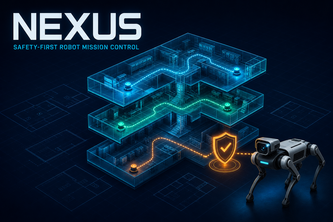
NEXUS is a self-reported simulation-first robot mission control platform that enables operators to define jobs using plain-language or map-based input. It claims to support memory-backed job execution, deterministic robot assignment, route planning through digital twins, and human-gated deployment. The system includes a safety boundary that prevents AI from issuing physical commands, relying instead on a read-only camera adapter for real-world telemetry.
What changed
The project was submitted as part of the OpenAI 2026 hackathon. It is described as a proof-of-concept with no revenue or customer traction. The author states it uses FastAPI, React, Docker, and GPT-5.6 in development but does not claim any production use or commercial adoption.
Single most important open question
Is there evidence of a viable market need for this type of simulation-first, memory-backed robot control system, or is the project purely experimental?
What The Product Actually Is
The description states that NEXUS is a safety-first robot mission control plane. It turns plain-language objectives into jobs with:
- Memory recall (location, procedure, experience)
- Deterministic robot assignment
- Route calculation through a metric three-floor digital twin
- Six-stage pipeline: intent, memory, safety validation, navigation, inspection, evidence, and learning
It supports both virtual robots in simulation and an optional read-only Boston Dynamics Spot camera feed. The system includes:
- A FastAPI backend with PostgreSQL and Pydantic
- A React-based operator console with Three.js rendering
- C++ occupancy-grid core for navigation
- WebSocket streaming of robot telemetry at 4 Hz
- Human approval gates and audit chains
Inference The product is a simulation-based control system, not a certified robot controller. It is designed to be human-in-the-loop and safety-boundary enforced.
Positioning & Claim Evolution
The author describes NEXUS as:
- A safety-first mission control
- A simulation-first engineering foundation
- A platform that supports memory-backed jobs, explainable AI, and human-gated deployment
It is positioned as a non-certified robot controller but demonstrates how AI-assisted planning can remain useful, explainable, and human-controlled.
Inference The positioning is clearly focused on safety, transparency, and simulation-first workflows. It does not claim to be a production-grade or certified control system.
Target Customer & ICP
The description does not name specific customers or target industries. However, it implies use cases in:
- Robotics engineering teams
- Simulation-based mission planning
- Safety-critical environments where human oversight is required
It suggests a need for systems that support memory-backed workflows, explainable decision-making, and human approval gates.
Inference The ICP likely includes robotics engineers, simulation developers, or safety-focused teams in industrial or research settings. No evidence of actual customers or use cases beyond the hackathon demo.
Business Model & Pricing Evidence
There is no mention of pricing, monetization, or business model in the description.
Inference The project is a hackathon submission with no commercial traction or pricing structure. It is not evidenced to have any revenue-generating mechanism.
Technical & Delivery Signals
The system is built using:
- Backend: FastAPI, PostgreSQL, SQLAlchemy, Pydantic
- Frontend: React, TypeScript, Vite, Three.js
- Navigation Core: C++ occupancy-grid
- Deployment: Docker Compose
- AI Tools: Codex, GPT-5.6 (used for development only)
- Simulation: Virtual robots with WebSocket streaming
The demo includes:
- Live virtual robots moving at 4 Hz
- Interactive 2D/3D building models
- Human-gated deployment
- Hash-linked audit chain
- Read-only Spot camera adapter
Inference The system is technically complete for a demo, but it is not production-ready. It lacks real robot control and is described as simulation-first.
Traction & Maturity Signals
The project is described as a hackathon submission, with no evidence of:
- Revenue
- Customers
- Product adoption
- Market traction
- Production use
It includes:
- 43 backend tests, 78 frontend tests
- C++ navigation test passing
- Docker health checks
- Zero browser console errors
Inference The project is at a demo or prototype stage, not a mature product. It has no commercial or user traction.
Competitive Context
The description does not mention competitors or market context.
Inference No evidence of competitive landscape, existing products, or market positioning beyond the hackathon submission.
Open Questions & Risks
- No commercial traction: The project is a hackathon demo with no revenue or customers.
- AI dependency without production use: GPT-5.6 was used for development but not in any live system.
- Simulation-only: Not a certified robot controller, and lacks physical robot control.
- Unproven market need: No evidence of demand or customer validation beyond the author’s own claims.
- No pricing or monetization model: No indication of how this would be commercialized.
Questions the description leaves open
- What is the intended use case for NEXUS in a real-world setting?
- How does the system handle edge cases in route planning or robot behavior?
- Are there any plans to integrate with certified robot controllers or safety systems?
- What are the technical and regulatory barriers to moving from simulation to physical deployment?
- Is there any interest from robotics teams or industrial partners in using this system?
Overall Assessment
Not evidenced
The project is a hackathon submission, not a commercial product. There is no evidence of revenue, customers, traction, or business model.
Confidence Level Low This analysis is based entirely on the self-reported description and lacks any independent verification or market data. The author states that NEXUS is a simulation-first engineering foundation, not a certified robot controller, and that it demonstrates how AI-assisted mission planning can remain human-controlled — but no evidence of adoption or commercial viability is provided.
Inference This project is not ready for investment or partnership at this stage. It is an experimental prototype with no demonstrated market need or commercial potential.
User Stories BotA demo video on every pull request
Get a demo video on every new feature
GitHub App that watches your pull requests and records a narrated, captioned demo.
Save time on demo prep and make informed decisions faster with a video walkthrough of every new feature.
Source
Submitted to the OpenAI 2026 hackathon on Devpost. Project home on Devpost. Back to the full gallery on Devpost.
This competitive analysis was produced by top-founders.com (opens in a new tab)
Generated by a language model from this project's public Devpost page — its tagline, the author's own write-up and any built-with tags listed there — as captured in August 2026. Short quotations are the author's words. It is an opinion on the idea as a business, not on the people behind it, and it reflects the description as published then. If the project has moved on, request a correction below. The analysis is not independent research and contains no verified traction, revenue or customer data.
An independent guide by KFG International LLC — not affiliated with, endorsed by, or connected to Devpost or OpenAI.