

Archive position — measured, not model output
0 likes on Devpost
2,263 of the 7,850 archived projects have more likes, and 5,587 share exactly 0 — so this project's #3,489 place in the like-ranked listing is a tie-break inside that group, not a ranking.
Projects (log scale)
Likes on Devpost. ▲ marks this project's group.
Show the figures
| Likes | Projects | Share of archive |
|---|---|---|
| 0 | 5,587 | 71.2% |
| 1 | 1,758 | 22.4% |
| 2 | 284 | 3.6% |
| 3–4 | 132 | 1.7% |
| 5–9 | 75 | 1.0% |
| 10+ | 14 | 0.2% |
 User Stories BotA demo video on every pull request
Get a demo video on every new feature
GitHub App that watches your pull requests and records a narrated, captioned demo.
Save time on demo prep and make informed decisions faster with a video walkthrough of every new feature.
Executive Summary
What the company appears to be
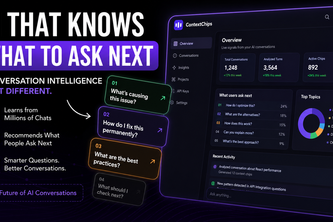
ContextChips is a developer infrastructure tool that aims to improve conversational AI experiences by generating context-aware follow-up questions (referred to as "chips") after an AI assistant answers a user query. It is positioned as a solution for custom AI products to avoid “dead ends” in conversations and provide guidance, while also offering product teams structured insights into user behavior.
What changed
The project was built during the OpenAI 2026 hackathon. It introduces a dual-loop architecture designed to reduce latency and enable real-time generation of follow-up prompts without blocking the main AI response. The author describes integrating this with a server-side SDK, analytics dashboard, and background processing.
Single most important open question
Is there any evidence that developers are actually using or adopting ContextChips beyond its hackathon prototype? There is no revenue, customer base, or usage data provided in the description.
Note: This analysis is based entirely on the self-reported project description supplied by the caller. No external verification or historical data exists for this project. All claims are stated by the author and not independently confirmed.
What The Product Actually Is
The description states that ContextChips is:
- A high-performance, multi-tenant TypeScript platform.
- Composed of:
- A server-side SDK
- An ingestion API
- A Next.js analytics dashboard
- A background worker
- An interactive testing sandbox
It is described as a system that:
- Turns every AI answer into a guided path forward
- Learns from real user behavior within a specific AI product
- Returns up to three context-aware follow-up chips
- Transforms post-response friction into actionable product intelligence
The architecture uses a dual-loop approach:
- Pre-response loop (startTurn): Performs lexical retrieval in parallel with the host AI model’s response generation.
- Post-response loop (completeTurn): Uses GPT-5.6 to filter and select 3 distinct chips based on the answer.
- A background worker handles PII redaction and dashboard updates.
Inference: The product is described as a developer-facing tool that integrates into existing AI applications, not a standalone consumer-facing product.
Positioning & Claim Evolution
The author positions ContextChips as:
- A developer infrastructure layer for AI products.
- Designed to solve the problem of “robotic dead ends” in conversational AI.
- Inspired by Google’s "People Also Ask" and ChatGPT's internal follow-up mechanisms.
- Tailored specifically to each AI product’s vocabulary, workflows, and users.
Key claims:
- Every custom AI product needs its own version of “People Also Ask.”
- The tool is answer-aware, privacy-conscious, and grounded in user behavior.
- It aims to reduce drop-off rates and provide product teams with structured visibility into user confusion.
Claim vs Fact: These are self-described positioning statements. No evidence of actual adoption, customer feedback, or market validation is provided.
Target Customer & ICP
The description states that ContextChips targets:
- Developer teams building custom AI products (e.g., in healthcare, e-commerce, developer tools).
- Product teams who want to improve conversational momentum and gain insights from chat logs.
- Users of AI assistants or agents where engagement drops off after an answer.
Inference: The ICP is likely small to mid-sized development teams working on AI integrations, not enterprise-scale adopters. No evidence of customer segmentation or targeting strategy beyond this.
Business Model & Pricing Evidence
There is no information in the description about:
- Pricing
- Revenue model
- Monetization strategy
- Subscription tiers
- Customer acquisition costs
Not evidenced: The business model remains undefined.
Technical & Delivery Signals
The author provides technical details including:
- Built with: codex, fastify, gpt-5.6, next.js, openai-responses-api, supabase, typescript
- Dual-loop architecture to avoid latency
- SDK integration method for server-side agentic runtimes
- Use of HMAC-SHA256 for API key security
- Mathematical constraints on total overhead and selection timeout
- Answer-aware filtering using GPT-5.6
Inference: The technical implementation appears sophisticated, with attention to latency, tenant isolation, and prompt engineering.
Traction & Maturity Signals
The description states:
- This was built during a hackathon (OpenAI 2026)
- It is described as a prototype, not a production-ready product
- No mention of:
- Customers
- Revenue
- User adoption
- Product usage metrics
- Market traction
Not evidenced: There is no evidence of traction or maturity beyond the hackathon submission.
Competitive Context
The author references:
- Google’s “People Also Ask” for search
- ChatGPT’s internal follow-up mechanisms
- The need for AI products to avoid “dead ends”
No mention of:
- Direct competitors
- Market size estimates
- Competitive advantages or differentiation strategies
Not evidenced: No competitive landscape or competitive positioning is described.
Open Questions & Risks
Key risks inferred from the description:
- Prototype vs Product Gap: The tool was built for a hackathon and lacks evidence of production readiness.
- No Market Validation: No customers, revenue, or usage data provided.
- Dependency on GPT-5.6: Heavy reliance on a single LLM may pose scalability or cost risks.
- Developer Adoption Risk: Without clear value to developers, adoption is uncertain.
- Privacy & Data Handling: Though described as privacy-conscious, no details are given about data governance or compliance.
Inference: The risk of failure is high if the tool does not gain traction beyond its hackathon prototype.
Questions the description leaves open
- What is the current status of the product? Is it in production or still a prototype?
- Have you received any feedback from early adopters or developers who have tried the SDK?
- How do you plan to monetize this tool? Is there a pricing model or roadmap for revenue?
- What are your plans for scaling beyond the current architecture (e.g., vector search, multi-tenant support)?
- Are you planning to release UI components or drop-in integrations for common frameworks like React or Flutter?
- How do you handle edge cases such as ambiguous answers or low-conversation volumes?
- What is the expected latency and performance under load?
Overall Assessment
Assessment: Not ready for investment or partnership.
Reasoning:
- The project is described as a hackathon prototype, not a product with traction.
- No evidence of revenue, customers, or usage metrics.
- The tool is developer-facing, but no adoption data or feedback is provided.
- While the architecture is technically sound, there is no indication that it has been tested in real-world conditions.
Confidence Level: Low. This is a self-reported, unverified description of a prototype with no evidence of commercial viability or traction.
User Stories BotA demo video on every pull request
Get a demo video on every new feature
GitHub App that watches your pull requests and records a narrated, captioned demo.
Save time on demo prep and make informed decisions faster with a video walkthrough of every new feature.
Source
Submitted to the OpenAI 2026 hackathon on Devpost. Project home on Devpost. Back to the full gallery on Devpost.
This competitive analysis was produced by top-founders.com (opens in a new tab)
Generated by a language model from this project's public Devpost page — its tagline, the author's own write-up and any built-with tags listed there — as captured in August 2026. Short quotations are the author's words. It is an opinion on the idea as a business, not on the people behind it, and it reflects the description as published then. If the project has moved on, request a correction below. The analysis is not independent research and contains no verified traction, revenue or customer data.
An independent guide by KFG International LLC — not affiliated with, endorsed by, or connected to Devpost or OpenAI.