

Archive position — measured, not model output
0 likes on Devpost
2,263 of the 7,850 archived projects have more likes, and 5,587 share exactly 0 — so this project's #5,452 place in the like-ranked listing is a tie-break inside that group, not a ranking.
Projects (log scale)
Likes on Devpost. ▲ marks this project's group.
Show the figures
| Likes | Projects | Share of archive |
|---|---|---|
| 0 | 5,587 | 71.2% |
| 1 | 1,758 | 22.4% |
| 2 | 284 | 3.6% |
| 3–4 | 132 | 1.7% |
| 5–9 | 75 | 1.0% |
| 10+ | 14 | 0.2% |
 User Stories BotA demo video on every pull request
Get a demo video on every new feature
GitHub App that watches your pull requests and records a narrated, captioned demo.
Save time on demo prep and make informed decisions faster with a video walkthrough of every new feature.
Executive Summary
What the company appears to be
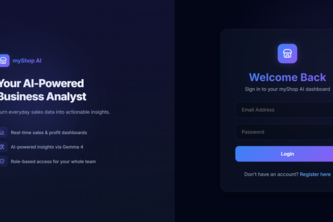
The project described as myShop AI is a self-reported, full-stack web application built by one developer (Sushmoy Nandi) that integrates Google’s Gemma 4 LLM into a dashboard for small business owners in emerging markets. It claims to automate sales analytics and decision-making using AI insights, with features like automated reporting, bilingual AI-generated business advice, dynamic pricing optimization, and restock planning.
What changed
This is a hackathon submission (submitted to the OpenAI 2026 hackathon) that presents an ambitious vision for democratizing data intelligence in SMEs. The author describes a functional prototype with integration of LLMs, React frontend, FastAPI backend, and SQLite database — all built in a short timeframe.
The single most important open question
Is there any evidence of actual use by small businesses or traction beyond the developer’s own prototype?
Note: All claims are self-reported and unverified. No revenue, customers, or adoption data is provided.
What The Product Actually Is
- The description states that myShop AI is an “AI-powered sales management and analytics dashboard for small businesses.”
- It is built with React (frontend), FastAPI (backend), and Google Gemma 4 (AI engine).
- The system includes:
- A full-stack dashboard supporting CRUD operations on sales orders.
- Role-based access control.
- On-demand bilingual AI business insights.
- Dynamic AI pricing optimizer.
- AI restock planner.
- Automated daily performance emails.
- It integrates with Google Sheets and supports data hydration from .xlsx or Google Sheets exports.
- The backend uses Python, SQLite (for local dev), and APScheduler for background automation.
- The frontend is a React SPA built with Vite.
Inference: Based on the architecture described, it appears to be a prototype or MVP that has been developed as part of a hackathon project. It does not appear to have any commercial deployment or live users at this stage.
Positioning & Claim Evolution
- The author positions myShop AI as an “enterprise-level AI analytics platform” for small businesses.
- It aims to transform manual spreadsheet workflows into automated, intelligent dashboards.
- The platform is described as:
- Easy-to-use and requiring zero technical knowledge.
- Capable of delivering actionable business insights via AI.
- Designed specifically for SMEs in emerging markets (e.g., Bangladesh).
- Key claims include:
- Democratizing data intelligence.
- Acting as a “Data Analyst in a Box.”
- Providing multilingual support (Bengali and English).
- Offering automated daily reports, pricing optimization, and restock planning.
Claim vs Fact: These are self-stated positioning and intent. No evidence of actual market fit or customer feedback is provided.
Target Customer & ICP
- The description states that the target audience includes:
- Small and medium business owners in emerging markets (e.g., Bangladesh).
- Users who currently rely on spreadsheets, paper ledgers, or messaging apps.
- It targets users who lack access to technical experts or data analysts.
- The platform is intended for non-technical users with no prior experience in analytics.
Not evidenced: No information about specific customer segments, personas, or actual user interviews. No evidence of market validation or customer feedback.
Business Model & Pricing Evidence
- There is no mention of pricing, monetization strategy, or business model in the description.
- The author does not state whether the platform will be sold as a SaaS product, offered for free with premium tiers, or through another revenue mechanism.
- No indication of how the team plans to generate revenue from this tool.
Not evidenced: No evidence of pricing structure, subscription models, or monetization strategy.
Technical & Delivery Signals
- Built using:
- Frontend: React.js + Vite
- Backend: FastAPI (Python)
- AI Engine: Google Gemma 4 via Google AI Studio REST API
- Database: SQLite (with potential upgrade path to PostgreSQL)
- Features include:
- JWT authentication with role-based access control.
- Structured outputs from LLMs using Pydantic schemas.
- Background task scheduling using APScheduler.
- Integration with Google Sheets and Apps Script.
- Fallback mechanisms for reliability during API timeouts or rate limits.
- The system is designed to be scalable, fast, and responsive.
Inference: The technical stack suggests a lean, modern approach suitable for MVP development. However, no production deployment or scalability testing details are provided.
Traction & Maturity Signals
- The project was submitted to the OpenAI 2026 hackathon.
- It is described as a prototype built by one developer (Sushmoy Nandi).
- No evidence of:
- Live users.
- Revenue or monetization.
- Customer acquisition or retention metrics.
- Product-market fit validation.
- Any form of commercial traction.
Absence of evidence: There is no indication that the product has moved beyond a prototype stage or gained any real-world usage.
Competitive Context
- The description does not reference competitors directly.
- However, it implies a competitive space involving:
- Sales analytics dashboards for small businesses.
- AI-powered business intelligence tools.
- Solutions tailored for emerging markets and non-technical users.
- Similar tools may include platforms like Zoho, QuickBooks, or local alternatives in South Asia.
Not evidenced: No competitive analysis, benchmarking, or differentiation from existing solutions is provided.
Open Questions & Risks
- Single Developer Team: The entire project was built by one person — raises concerns about scalability and long-term maintenance.
- Unverified Claims: All features are self-reported without independent verification.
- No Traction or Revenue: No evidence of actual use, customers, or monetization.
- LLM Dependency Risk: Heavy reliance on Google’s Gemma 4 LLM introduces risks related to API availability, cost, and hallucinations (though mitigated via prompt engineering).
- Market Fit Uncertainty: No evidence of market validation or user feedback.
- Limited Scope: The project is presented as a hackathon submission — not a commercial product.
Inference: This is a high-risk, unproven concept with no demonstrated traction or business viability.
Questions the description leaves open
- What specific problems do you observe in how small businesses currently manage their sales data?
- Have you tested this solution with any real users from the target market (e.g., Bangladesh)?
- How do you plan to monetize this platform once it moves beyond a prototype?
- Can you describe your roadmap for scaling beyond the current MVP?
- What are the key assumptions behind your AI integration, and how have they been validated?
- Are there any known limitations or edge cases where the LLM fails to deliver reliable output?
- How do you intend to onboard users who are not digitally literate?
Overall Assessment
- This is a self-reported hackathon project with no verified traction, revenue, or customer base.
- It presents an ambitious vision but lacks evidence of product-market fit or commercial viability.
- The author states that the tool is built by one person and has not yet been deployed for real-world use.
- While technically feasible, there are significant risks due to lack of validation, scalability concerns, and no monetization strategy.
Assessment: Not ready for investment or partnership at this stage. This appears to be a promising idea in need of further development, testing, and market validation before any serious consideration.
User Stories BotA demo video on every pull request
Get a demo video on every new feature
GitHub App that watches your pull requests and records a narrated, captioned demo.
Save time on demo prep and make informed decisions faster with a video walkthrough of every new feature.
Source
Submitted to the OpenAI 2026 hackathon on Devpost. Project home on Devpost. Back to the full gallery on Devpost.
This competitive analysis was produced by top-founders.com (opens in a new tab)
Generated by a language model from this project's public Devpost page — its tagline, the author's own write-up and any built-with tags listed there — as captured in August 2026. Short quotations are the author's words. It is an opinion on the idea as a business, not on the people behind it, and it reflects the description as published then. If the project has moved on, request a correction below. The analysis is not independent research and contains no verified traction, revenue or customer data.
An independent guide by KFG International LLC — not affiliated with, endorsed by, or connected to Devpost or OpenAI.