

Archive position — measured, not model output
1 like on Devpost
505 of the 7,850 archived projects have more likes, and 1,758 share exactly 1 — so this project's #1,528 place in the like-ranked listing is a tie-break inside that group, not a ranking.
Projects (log scale)
Likes on Devpost. ▲ marks this project's group.
Show the figures
| Likes | Projects | Share of archive |
|---|---|---|
| 0 | 5,587 | 71.2% |
| 1 | 1,758 | 22.4% |
| 2 | 284 | 3.6% |
| 3–4 | 132 | 1.7% |
| 5–9 | 75 | 1.0% |
| 10+ | 14 | 0.2% |
 User Stories BotA demo video on every pull request
Get a demo video on every new feature
GitHub App that watches your pull requests and records a narrated, captioned demo.
Save time on demo prep and make informed decisions faster with a video walkthrough of every new feature.
Executive Summary
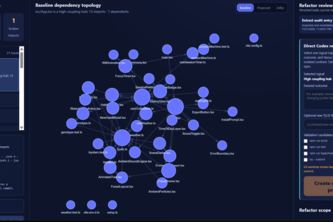
The description states that Nexus — Safe Codex Refactors is a local Windows desktop application built to help developers review and validate AI-generated code refactors from Codex. The author, Siddhant Phukan, describes it as a tool for "visual supervision" of Codex runs, aiming to make the decision to merge changes visible and safe by providing evidence before merging.
The project is self-reported as a desktop app built with Electron, React, TypeScript, and Cytoscape.js. It uses Codex (with GPT-5.6) during development and execution, and operates within isolated Git worktrees to evaluate changes without affecting the main repository.
Key commercial signals are absent: no revenue, customers, pricing, or traction data are provided. The tool is described as an MVP focused on TypeScript/JavaScript dependency analysis, with scope limited to relative imports and excluding monorepos, aliases, and multi-language parsing.
The single most important open question is whether Nexus can meaningfully improve developer workflows at scale — a claim not evidenced in the description.
What The Product Actually Is
- The description states that Nexus is a local Windows desktop workspace for safe, reviewable Codex refactors.
- It maps TypeScript/JavaScript file dependencies and identifies architecture risks such as cycles and hubs.
- It turns one issue into a bounded refactor contract and evaluates the proposal in an isolated Git worktree.
- Its core experience involves three steps: inspect current architecture → create bounded proposal → review diff, validation evidence, signal changes, and scope compliance before manual merge.
Inference: Based on the description, Nexus appears to be a developer tool for managing AI-assisted code refactoring with emphasis on safety and visibility. It is not a SaaS product or cloud-based service but a desktop application.
Positioning & Claim Evolution
- The description states that Nexus was built to answer the question: "how do I know an AI-generated refactor stayed inside scope, improved the architecture, and is genuinely safe to merge?"
- It positions itself as a tool that makes the decision to merge visible, rather than treating a completed Codex run as proof.
- The author claims it provides evidence before merging, using a workflow of before → proposed → impact.
Inference: The positioning evolved from a general problem (AI-generated code safety) to a specific solution (a local desktop tool for reviewing and validating Codex outputs). It frames itself as a developer workflow enabler, not an AI agent itself.
Target Customer & ICP
- The description states that Nexus is intended for developers working with TypeScript/JavaScript.
- It targets users who are already using or considering Codex for code refactoring.
- The tool is designed to be used in a local development environment, specifically on Windows desktops.
Inference: The primary customer is likely a developer or team of developers who use AI-assisted coding tools like Codex and want to ensure that generated changes are safe, scoped, and architecturally sound. The ICP appears to be narrow — focused on TypeScript/JavaScript developers using local environments.
Business Model & Pricing Evidence
- Not evidenced.
Inference: There is no indication of a business model or pricing strategy in the description. The tool is described as a desktop application built during a hackathon, with no mention of monetization or commercial use cases.
Technical & Delivery Signals
- The description states that Nexus is built using Electron, React, TypeScript, and Cytoscape.js.
- It uses Codex with GPT-5.6 for refinement and implementation.
- It handles local repository analysis, Git worktrees, file watching, validation, and optional Codex CLI execution.
- It never uses approval-bypass flags, automatic commits, or automatic merges.
- The app is designed to run in workspace-write sandboxing inside an isolated worktree.
Inference: The technical stack suggests a desktop application with strong integration into Git workflows and dependency visualization. The emphasis on isolation and manual merging implies a cautious, developer-centric approach to AI-assisted refactoring.
Traction & Maturity Signals
- Not evidenced.
Inference: There is no evidence of revenue, customers, or adoption beyond the author's own development and demo. The project is described as an MVP with limited scope (TypeScript/JavaScript only), suggesting early-stage maturity.
Competitive Context
- Not evidenced.
Inference: No competitive landscape or direct competitors are mentioned in the description. The tool appears to be positioned within a niche space of AI-assisted code refactoring, but no market context is provided.
Open Questions & Risks
- The project is described as a single-person effort, which raises questions about scalability and long-term maintenance.
- It is limited to TypeScript/JavaScript and excludes monorepos, aliases, and multi-language parsing — potentially limiting its applicability.
- The tool is designed for local desktop use only, which may restrict adoption in enterprise or distributed teams.
- There is no evidence of any commercial traction, pricing, or customer feedback.
Questions the description leaves open
- What specific problems are you solving that existing tools don’t address?
- How do you plan to scale beyond a single developer’s workflow?
- Are there plans to support other languages or frameworks beyond TypeScript/JavaScript?
- What is the long-term vision for Nexus — is it intended as a standalone tool or part of a larger platform?
- How are you thinking about user feedback and iteration in the absence of early adopters?
Overall Assessment
- Not evidenced.
Inference: Given the lack of revenue, customers, or traction data, and the limited scope of the MVP, there is insufficient evidence to support a commercial investment or partnership decision. The tool appears to be an experimental solution with unclear market demand or scalability potential.
User Stories BotA demo video on every pull request
Get a demo video on every new feature
GitHub App that watches your pull requests and records a narrated, captioned demo.
Save time on demo prep and make informed decisions faster with a video walkthrough of every new feature.
Source
Submitted to the OpenAI 2026 hackathon on Devpost. Project home on Devpost. Back to the full gallery on Devpost.
This competitive analysis was produced by top-founders.com (opens in a new tab)
Generated by a language model from this project's public Devpost page — its tagline, the author's own write-up and any built-with tags listed there — as captured in August 2026. Short quotations are the author's words. It is an opinion on the idea as a business, not on the people behind it, and it reflects the description as published then. If the project has moved on, request a correction below. The analysis is not independent research and contains no verified traction, revenue or customer data.
An independent guide by KFG International LLC — not affiliated with, endorsed by, or connected to Devpost or OpenAI.