

Archive position — measured, not model output
1 like on Devpost
505 of the 7,850 archived projects have more likes, and 1,758 share exactly 1 — so this project's #1,527 place in the like-ranked listing is a tie-break inside that group, not a ranking.
Projects (log scale)
Likes on Devpost. ▲ marks this project's group.
Show the figures
| Likes | Projects | Share of archive |
|---|---|---|
| 0 | 5,587 | 71.2% |
| 1 | 1,758 | 22.4% |
| 2 | 284 | 3.6% |
| 3–4 | 132 | 1.7% |
| 5–9 | 75 | 1.0% |
| 10+ | 14 | 0.2% |
 User Stories BotA demo video on every pull request
Get a demo video on every new feature
GitHub App that watches your pull requests and records a narrated, captioned demo.
Save time on demo prep and make informed decisions faster with a video walkthrough of every new feature.
Executive Summary
What the company appears to be
NEXUS AI is an AI-native decision intelligence platform for critical infrastructure, built as a railway operations platform with real-time digital twin capabilities and human-in-the-loop AI planning. The author states it uses GPT-5.6 (self-declared), digital twins, and multi-agent simulations to support dispatchers during disruptions.
What changed
The project was submitted to the OpenAI 2026 hackathon. It is a self-reported prototype or proof-of-concept, not yet a commercial product or service with customers or revenue.
Single most important open question
Is there any evidence of traction, real-world deployment, or customer feedback beyond the author’s own description?
What The Product Actually Is
The description states that NEXUS AI is an AI-powered railway operations platform. It includes:
- A real-time railway digital twin
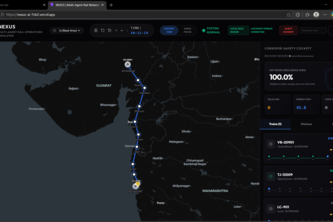
- An interactive operations cockpit with live maps and telemetry
- AI-assisted recovery planning, using OpenAI’s Responses API
- A human-in-the-loop workflow, where dispatchers approve or reject AI recommendations
- Deterministic fallback planning in case of AI unavailability
- Audit trails, replay history, and scenario management
The system is built with a full-stack architecture: frontend in React/TypeScript/Vite; backend in FastAPI/Python/SimPy; and integration with tools like OpenAI Codex and GitHub Actions.
Inference The product appears to be a prototype or hackathon submission, not yet a commercial-grade SaaS offering. It is described as an AI-assisted decision support tool for railway dispatchers rather than a standalone chatbot or dashboard.
Positioning & Claim Evolution
The author positions NEXUS AI as:
- An AI-native decision intelligence platform
- Designed for critical infrastructure (railway, with expansion plans)
- Using GPT-5.6, digital twins, and multi-agent simulations
- Aims to enhance operational decisions without replacing human operators
The claim evolution shows a shift from:
- A basic dashboard or chatbot → to an AI-assisted decision support system
- With emphasis on safety, transparency, and human oversight
Inference The positioning is that of a human-in-the-loop AI platform, not an autonomous system. It is framed as a tool to augment dispatcher expertise, not replace it.
Target Customer & ICP
The description states:
- Primary target: railway dispatchers
- Use case: operational disruptions in railway networks
- Secondary use cases: network resilience, congestion management, passenger flow prediction
It also mentions that the platform is designed to be a foundation for an AI operating system for critical infrastructure, with plans to expand into airports, ports, logistics, and smart energy grids.
Inference The ICP (Ideal Customer Profile) is likely operators of critical infrastructure, particularly those managing railway systems. The expansion plans suggest a broader B2B market opportunity beyond rail.
Business Model & Pricing Evidence
Not evidenced.
The description does not mention:
- Revenue model
- Pricing structure
- Customers or contracts
- Monetization strategy
Inference No evidence of any business model or pricing in the self-reported description.
Technical & Delivery Signals
The system is built with:
- Frontend: React, TypeScript, Vite, Tailwind CSS, Leaflet.js, React Flow
- Backend: FastAPI, Python, SimPy, NetworkX
- AI Integration: OpenAI Responses API, OpenAI Codex
- Real-time Communication: Server-Sent Events (SSE)
- Storage: SQLite
- Deployment Tools: Docker, GitHub Actions, Railway, Vercel, Render
The platform includes:
- Human-in-the-loop AI workflow
- Deterministic fallback planning
- Audit logging and replay capabilities
Inference The system is a full-stack prototype, built with modern tools and designed for real-time, distributed systems. It shows technical sophistication but lacks evidence of production deployment or scalability.
Traction & Maturity Signals
Not evidenced.
The description does not include:
- Customers
- Revenue
- Usage metrics
- Product adoption
- Market traction
- Any form of live deployment
Inference The project is a self-reported hackathon submission, with no evidence of real-world usage or product maturity.
Competitive Context
Not evidenced.
The description does not mention:
- Competitors
- Market size
- Competitive advantages
- Differentiation from existing solutions
Inference No competitive context is provided. The author does not reference any existing players in the railway AI or digital twin space.
Open Questions & Risks
- Unverified claims: The description states “GPT-5.6” and “multi-agent simulations,” but these are self-declared and unverified.
- No traction or revenue: The project is a hackathon submission with no evidence of real-world adoption.
- Prototype-only status: No indication of production readiness, scalability, or long-term viability.
- Limited team size: Only one member (Jatin Kumar) is listed.
- No commercialization path: No mention of monetization, partnerships, or go-to-market strategy.
Inference The project is a conceptual prototype, not a commercial product. Risks include lack of validation, scalability concerns, and unproven market demand.
Questions the description leaves open
- What specific railway networks or operators have you engaged with for testing or feedback?
- How do you plan to validate the safety and accuracy of AI-generated recommendations in real-world settings?
- Has the platform been tested with actual dispatchers or operators?
- What is your roadmap for transitioning from prototype to a commercial product?
- Are there any existing partnerships or pilot programs with railway infrastructure providers?
- How do you plan to monetize this platform, and what pricing model are you considering?
- What are the technical limitations of the current system that would prevent it from scaling to larger networks?
Overall Assessment
Not evidenced.
The description does not provide:
- Financials
- Valuation
- Funding history
- Strategic partners or investors
- Commercial traction
Inference This is a pre-product, pre-revenue concept, likely at an early-stage prototype or hackathon level. It lacks the commercial due-diligence signals required for investment or partnership consideration.
User Stories BotA demo video on every pull request
Get a demo video on every new feature
GitHub App that watches your pull requests and records a narrated, captioned demo.
Save time on demo prep and make informed decisions faster with a video walkthrough of every new feature.
Source
Submitted to the OpenAI 2026 hackathon on Devpost. Project home on Devpost. Back to the full gallery on Devpost.
This competitive analysis was produced by top-founders.com (opens in a new tab)
Generated by a language model from this project's public Devpost page — its tagline, the author's own write-up and any built-with tags listed there — as captured in August 2026. Short quotations are the author's words. It is an opinion on the idea as a business, not on the people behind it, and it reflects the description as published then. If the project has moved on, request a correction below. The analysis is not independent research and contains no verified traction, revenue or customer data.
An independent guide by KFG International LLC — not affiliated with, endorsed by, or connected to Devpost or OpenAI.