

Archive position — measured, not model output
0 likes on Devpost
2,263 of the 7,850 archived projects have more likes, and 5,587 share exactly 0 — so this project's #5,471 place in the like-ranked listing is a tie-break inside that group, not a ranking.
Projects (log scale)
Likes on Devpost. ▲ marks this project's group.
Show the figures
| Likes | Projects | Share of archive |
|---|---|---|
| 0 | 5,587 | 71.2% |
| 1 | 1,758 | 22.4% |
| 2 | 284 | 3.6% |
| 3–4 | 132 | 1.7% |
| 5–9 | 75 | 1.0% |
| 10+ | 14 | 0.2% |
 User Stories BotA demo video on every pull request
Get a demo video on every new feature
GitHub App that watches your pull requests and records a narrated, captioned demo.
Save time on demo prep and make informed decisions faster with a video walkthrough of every new feature.
Executive Summary
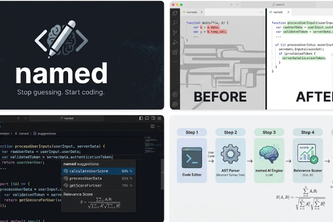
The description states that "named" is a contextual semantic naming engine designed to help developers generate readable, convention-compliant variable, function, and class names by analyzing code context using an Abstract Syntax Tree (AST) and Large Language Models (LLMs). It was built as part of a hackathon submission and has no evidenced traction, revenue, or customer data. The single most important open question is whether the product demonstrates sufficient technical feasibility and commercial viability to warrant further due-diligence effort.
What The Product Actually Is
The description states that "named" is a contextual semantic naming engine. It acts as an intelligent coding companion that analyzes Abstract Syntax Tree (AST) and surrounding code context to suggest highly readable, convention-compliant names for variables, functions, and classes. It uses FastAPI (Python) for backend logic, React with TailwindCSS for frontend, and integrates LLMs to generate suggestions based on semantic similarity between generated name embeddings and code documentation embeddings.
Positioning & Claim Evolution
The description states that "named" aims to solve the problem of poor naming in codebases, which leads to technical debt and confusing code. It positions itself as an intelligent coding companion that eliminates cognitive load for developers so they can focus on architecture and logic. The author references Phil Karlton's quote about naming being one of the two hardest things in computer science, suggesting a claim of solving a fundamental developer pain point.
Target Customer & ICP
The description states that "named" is aimed at developers who struggle with naming variables, functions, and classes. It targets those who experience cognitive load when trying to summarize complex logic into concise variable names. The product appears designed for individual developers working in codebases rather than teams or organizations.
Business Model & Pricing Evidence
Not evidenced. The description does not contain any information about pricing models, monetization strategies, or business model assumptions.
Technical & Delivery Signals
The description states that the backend is built with FastAPI (Python), and the frontend uses React and TailwindCSS. It mentions using LLMs for name generation and calculating semantic similarity via cosine similarity between embeddings. The system employs a custom chunking algorithm to extract relevant code context without exceeding token limits, and includes prompt engineering to enforce specific naming conventions like camelCase or snake_case.
Traction & Maturity Signals
Not evidenced. There is no information in the description about users, customers, revenue, adoption, or any traction metrics beyond its status as a hackathon submission.
Competitive Context
Not evidenced. The description does not mention competitors, existing solutions in this space, or how "named" compares to other tools or approaches for code naming assistance.
Open Questions & Risks
- The product is described as a hackathon submission with no demonstrated traction or commercial viability.
- It relies heavily on LLMs and embedding similarity calculations, which may not be robust enough for production use.
- The custom chunking algorithm to manage token limits suggests potential scalability or accuracy issues.
- No evidence of any business model, pricing, or monetization strategy.
- The team size is listed as one member, raising questions about development capacity and execution ability.
Questions the description leaves open
- What specific technical challenges have you encountered in implementing the semantic similarity calculations and embedding-based name selection?
- How do you plan to scale this solution beyond a single developer's use case?
- Have you tested the system with real-world codebases or only synthetic examples?
- What is your roadmap for moving from a hackathon prototype to a viable product?
- How do you intend to monetize this tool, and what market research supports that approach?
Overall Assessment
Not evidenced. The description provides no information about financials, funding rounds, valuation, or any basis for investment or partnership consideration. The project is described as a hackathon submission with no demonstrated traction or commercial viability.
User Stories BotA demo video on every pull request
Get a demo video on every new feature
GitHub App that watches your pull requests and records a narrated, captioned demo.
Save time on demo prep and make informed decisions faster with a video walkthrough of every new feature.
Source
Submitted to the OpenAI 2026 hackathon on Devpost. Project home on Devpost. Back to the full gallery on Devpost.
This competitive analysis was produced by top-founders.com (opens in a new tab)
Generated by a language model from this project's public Devpost page — its tagline, the author's own write-up and any built-with tags listed there — as captured in August 2026. Short quotations are the author's words. It is an opinion on the idea as a business, not on the people behind it, and it reflects the description as published then. If the project has moved on, request a correction below. The analysis is not independent research and contains no verified traction, revenue or customer data.
An independent guide by KFG International LLC — not affiliated with, endorsed by, or connected to Devpost or OpenAI.