

Archive position — measured, not model output
0 likes on Devpost
2,263 of the 7,850 archived projects have more likes, and 5,587 share exactly 0 — so this project's #5,473 place in the like-ranked listing is a tie-break inside that group, not a ranking.
Projects (log scale)
Likes on Devpost. ▲ marks this project's group.
Show the figures
| Likes | Projects | Share of archive |
|---|---|---|
| 0 | 5,587 | 71.2% |
| 1 | 1,758 | 22.4% |
| 2 | 284 | 3.6% |
| 3–4 | 132 | 1.7% |
| 5–9 | 75 | 1.0% |
| 10+ | 14 | 0.2% |
 User Stories BotA demo video on every pull request
Get a demo video on every new feature
GitHub App that watches your pull requests and records a narrated, captioned demo.
Save time on demo prep and make informed decisions faster with a video walkthrough of every new feature.
Executive Summary
Company: NanoMedic AI
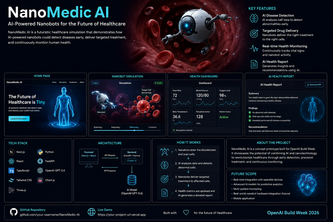
Self-reported purpose: To use AI for coordinating medical nanobots that detect disease, deliver drugs precisely, and monitor health in real time.
Change: Submitted to the OpenAI 2026 hackathon on Devpost — no indication of prior development or commercial activity.
Single most important open question: What is the technical feasibility and validation of the described nanobot-AI coordination system?
This is a self-reported, unverified project description from a hackathon submission. There is no evidence of revenue, customers, traction, funding, or even a working prototype. The description is thin and lacks detail on how the system would function in practice.
What The Product Actually Is
The description states that NanoMedic AI uses AI to coordinate medical nanobots for disease detection, drug delivery, and real-time health monitoring. It implies an integration of artificial intelligence with nanotechnology for personalized treatment.
Evidence:
- The author describes the system as using AI to coordinate nanobots.
- The tagline mentions “detect disease, deliver drugs precisely, and monitor health in real time.”
Inference:
- The product appears to be a conceptual or prototype system combining AI and nanomedicine.
Not evidenced:
- No details on how the AI coordinates nanobots.
- No information on whether this is software, hardware, or a hybrid system.
- No mention of existing or planned clinical trials, partnerships, or regulatory pathways.
Positioning & Claim Evolution
The description positions NanoMedic AI as a solution for faster, safer, and personalized medical treatment using AI-driven nanobot coordination. It implies a futuristic, precision-based approach to medicine.
Evidence:
- Tagline: “NanoMedic AI uses AI to coordinate medical nanobots that detect disease, deliver drugs precisely, and monitor health in real time, enabling faster, safer, and personalized treatment.”
Inference:
- The company is positioning itself as a future-oriented, AI-driven healthcare innovation.
Not evidenced:
- No indication of how this differs from existing or emerging technologies.
- No evidence of prior claims or evolution of the product concept.
- No mention of market validation or early feedback.
Target Customer & ICP
The description does not specify target customers or ideal customer profiles (ICP). It implies a broad application in healthcare, but no segmentation is evident.
Evidence:
- The tagline refers to “medical nanobots” and “health monitoring,” suggesting a healthcare audience.
- No mention of specific user roles, institutions, or patient types.
Inference:
- Likely targets medical institutions, researchers, or pharmaceutical companies working in precision medicine.
Not evidenced:
- No customer personas, use cases, or target segments.
- No indication of whether the system is for clinical use, research, or consumer health.
Business Model & Pricing Evidence
There is no evidence of a business model or pricing structure. The description does not mention monetization, licensing, or any revenue-generating mechanism.
Evidence:
- No mention of how the product will be sold or used commercially.
- No pricing information or commercial strategy.
Inference:
- If this becomes a product, it may involve B2B licensing or research partnerships.
Not evidenced:
- No indication of monetization strategy.
- No evidence of customer acquisition or sales channels.
Technical & Delivery Signals
The author lists technologies used in the project: API, Codex, FastAPI, Firebase, GitHub, GPT-5.6, Python, React.js, Three.js, Vercel.
Evidence:
- The project was built with these tools.
- The use of GPT-5.6 suggests AI integration, though not necessarily in a medical nanobot context.
Inference:
- The system may be software-based or include a web interface for visualization or control.
- The use of React.js and Three.js implies a UI/UX component, possibly for simulation or data visualization.
Not evidenced:
- No evidence of actual nanobot functionality or hardware integration.
- No information on how AI coordinates with nanobots in practice.
- No mention of scalability, safety, or regulatory compliance.
Traction & Maturity Signals
There is no evidence of traction, adoption, or maturity. The project was submitted to a hackathon and has no archived history or external validation.
Evidence:
- Submitted to the OpenAI 2026 hackathon.
- Team size: 1 (Sindhu Suri).
Inference:
- Likely in early conceptual or prototype phase.
- No evidence of user feedback, pilot programs, or product development beyond submission.
Not evidenced:
- No revenue, customers, or usage metrics.
- No indication of prior funding or team experience.
- No mention of product roadmap or future milestones.
Competitive Context
The description does not provide any information on competitors or the competitive landscape. It is unclear whether this project overlaps with existing technologies in nanomedicine or AI-driven healthcare.
Evidence:
- No mention of competitors, market analysis, or differentiation.
Inference:
- The field of AI-driven nanomedicine is highly speculative and likely includes academic research, startups, and large tech companies.
- The project may be a novel idea or a reimagining of existing concepts.
Not evidenced:
- No competitive positioning or market differentiation.
- No mention of existing solutions in the space.
Open Questions & Risks
Several key risks and open questions emerge from the lack of detail and evidence:
- Technical feasibility: No evidence that AI can coordinate nanobots at scale or in real-time.
- Regulatory uncertainty: Medical nanotechnology is heavily regulated; no mention of compliance or approval pathways.
- Lack of traction: Submitted to a hackathon with no prior development or validation.
- Unproven concept: The idea of AI-controlled nanobots for health monitoring is speculative and not demonstrated.
- Single-founder team: No indication of additional expertise or support.
Inference:
- The project may be in early conceptualization, with high technical and commercial risk.
Not evidenced:
- No evidence of validation, testing, or prior work.
- No mention of intellectual property or patents.
Questions the description leaves open
- What is the technical basis for AI coordination of nanobots? Is this a simulation or a real-world system?
- How does this differ from existing research in nanomedicine or AI-driven healthcare?
- Have you validated any part of this concept, even in a lab or prototype setting?
- What are your plans for regulatory compliance and safety testing?
- Are there any existing partnerships or collaborations with medical institutions or researchers?
- How do you plan to monetize this system if it becomes viable?
Overall Assessment
Not evidenced:
- No evidence of commercial viability, traction, or market readiness.
- The project is described as a hackathon submission with no prior development or validation.
Inference:
- This appears to be an early-stage idea or prototype, not a product ready for investment or partnership.
- It may have potential in the future but lacks current evidence of progress or feasibility.
Confidence level: Low. The description is thin and self-reported, with no external corroboration or demonstration of functionality.
User Stories BotA demo video on every pull request
Get a demo video on every new feature
GitHub App that watches your pull requests and records a narrated, captioned demo.
Save time on demo prep and make informed decisions faster with a video walkthrough of every new feature.
Source
Submitted to the OpenAI 2026 hackathon on Devpost. Project home on Devpost. Back to the full gallery on Devpost.
This competitive analysis was produced by top-founders.com (opens in a new tab)
Generated by a language model from this project's public Devpost page — its tagline and any built-with tags listed there, since the author published no write-up — as captured in August 2026. Short quotations are the author's words. It is an opinion on the idea as a business, not on the people behind it, and it reflects the description as published then. If the project has moved on, request a correction below. The analysis is not independent research and contains no verified traction, revenue or customer data.
An independent guide by KFG International LLC — not affiliated with, endorsed by, or connected to Devpost or OpenAI.