

Archive position — measured, not model output
1 like on Devpost
505 of the 7,850 archived projects have more likes, and 1,758 share exactly 1 — so this project's #1,549 place in the like-ranked listing is a tie-break inside that group, not a ranking.
Projects (log scale)
Likes on Devpost. ▲ marks this project's group.
Show the figures
| Likes | Projects | Share of archive |
|---|---|---|
| 0 | 5,587 | 71.2% |
| 1 | 1,758 | 22.4% |
| 2 | 284 | 3.6% |
| 3–4 | 132 | 1.7% |
| 5–9 | 75 | 1.0% |
| 10+ | 14 | 0.2% |
 User Stories BotA demo video on every pull request
Get a demo video on every new feature
GitHub App that watches your pull requests and records a narrated, captioned demo.
Save time on demo prep and make informed decisions faster with a video walkthrough of every new feature.
Executive Summary
What the company appears to be: The Nova Scotia Music Intelligence System (NSMIS) is a self-reported project by one individual, Jesse Potter, that builds a relational database of music ecosystem data for Nova Scotia. It uses Python and SQLite with AI tools like ChatGPT and Codex to collect, normalize, match, and review data from public sources. The system separates candidate facts from approved facts and includes a plain-language interface for querying the database.
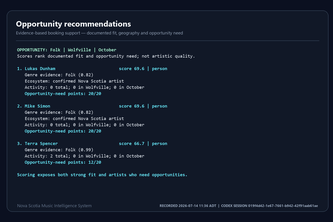
What changed: The author states that this project began as a tool to help organize one local event but evolved into a province-wide intelligence system covering artists, events, venues, festivals, genres, and geographic places. It now includes 735 canonical artist records, 1,839 event records, and 39 imported festival records.
Single most important open question: Is there sufficient evidence of traction, revenue, or customer adoption to validate the commercial potential of this system beyond its creator's personal use?
What The Product Actually Is
The description states that NSMIS is a relational SQLite database that connects various entities in Nova Scotia’s music ecosystem including artists, events, venues, festivals, genres, geographic places, industry professionals, collaborators, ticket prices, career stages, and demand signals.
It includes:
- A plain-language interface for exploring approved music intelligence
- An evidence-first process where candidate information is separated from approved facts
- Tools to collect or import source information, normalize records, match entities, stage uncertain claims for review, and approve/reject those claims before exposing them to reports
The system was built primarily with Python and SQLite, using AI tools like ChatGPT and Codex for development assistance.
Note: The description does not provide evidence of any commercial product or service beyond the self-reported database.
Positioning & Claim Evolution
The author claims that NSMIS is an evidence-backed intelligence system designed to help Nova Scotia organizers discover artists, plan events, match venues, and understand relationships shaping the province’s music ecosystem.
Originally, the idea emerged from a personal need to find performers for a local event (Night Kitchen). The project then expanded into what the author describes as a province-wide music intelligence system, moving beyond a simple database to include:
- Practical questions about artists and venues
- Collaboration patterns
- Genre-specific venue hosting
- Emerging artist opportunity signals
Inference: The evolution from personal tool to province-wide system suggests an ambition to scale, but no evidence of actual scaling or adoption.
Target Customer & ICP
The description states that NSMIS is intended for Nova Scotia organizers, including:
- Event planners
- Festival presenters
- Venue managers
- Industry professionals
- Community groups working in the music space
It also mentions a goal to work with:
- Nova Scotia artists
- Presenters
- Festivals
- Industry organizations
Not evidenced: No specific customer segments, personas, or usage data are provided. The target audience is inferred from the stated use cases.
Business Model & Pricing Evidence
The description does not contain any information about:
- Revenue streams
- Pricing models
- Monetization strategy
- Customer acquisition costs
- Sales process or go-to-market approach
Not evidenced: There is no indication of how this system would generate revenue or whether it has a defined business model.
Technical & Delivery Signals
The project was built using:
- Python and SQLite
- AI tools such as ChatGPT and Codex
- A pipeline that follows an evidence-first process:
- Collect/import
- Normalize
- Match entities
- Stage uncertain claims for review
- Approve/reject claims
- Expose only approved evidence
It includes:
- Automated test suite covering core behaviors
- Structured relationships among entities
- Plain-language interface
- Evidence and review workflows for profiles, geography, identity, career stages, ticket prices, demand signals, and duplicates
Inference: The use of AI tools like Codex suggests a developer-centric approach to building the system. However, no evidence of production deployment or scalability beyond one person’s work.
Traction & Maturity Signals
The author reports:
- 735 canonical artist records
- 1,839 event records
- 39 imported festival records
- A broader research workbook covering ~100 Nova Scotia festivals
- Structured relationships among multiple entities
- Plain-language interface for querying the database
- Automated test suite
However:
- No evidence of actual users or customers
- No revenue data
- No customer feedback or adoption metrics
- No indication of ongoing usage or engagement
Absence of evidence: There is no evidence of traction, user base, or market validation.
Competitive Context
The description does not mention any direct competitors or competitive landscape.
Not evidenced: No information on existing solutions in the music ecosystem intelligence space.
Open Questions & Risks
- Single-person operation: The system is built and maintained by one person (Jesse Potter), which raises concerns about scalability, sustainability, and long-term maintenance.
- No commercial traction or revenue: There is no evidence of customers, users, or monetization.
- Unverified data quality: While the system claims to separate candidate facts from approved facts, there is no independent verification of data accuracy or completeness.
- AI dependency: Heavy reliance on AI tools (ChatGPT, Codex) may create vulnerabilities if access becomes limited or pricing changes.
- Limited scope: The project focuses only on Nova Scotia, which may limit its broader commercial appeal.
Inference: The lack of external validation and commercial use raises significant doubts about viability as a scalable business.
Questions the description leaves open
- What is the actual demand for this type of intelligence system in Nova Scotia’s music community?
- Have you engaged with potential users or stakeholders to validate your assumptions?
- How do you plan to expand beyond Nova Scotia if that is part of your ambition?
- Is there any evidence of interest from festivals, venues, or organizers outside of your personal network?
- What are the technical and operational risks associated with relying on AI tools for data collection and processing?
- Do you have a clear path to monetization or partnership opportunities?
- How do you intend to maintain and update the database over time?
Overall Assessment
Confidence Level: Low
This is a self-reported, unverified project built by one individual with no evidence of traction, revenue, customers, or commercial adoption.
The author describes an ambitious vision for a music intelligence system, but there is no independent verification of its utility, market demand, or scalability. The system appears to be in early development stages and lacks any indication of real-world usage or impact.
Inference: While the technical execution shows some sophistication, the absence of commercial signals makes it difficult to assess whether this project has investment or partnership potential beyond its creator’s personal use.
User Stories BotA demo video on every pull request
Get a demo video on every new feature
GitHub App that watches your pull requests and records a narrated, captioned demo.
Save time on demo prep and make informed decisions faster with a video walkthrough of every new feature.
Source
Submitted to the OpenAI 2026 hackathon on Devpost. Project home on Devpost. Back to the full gallery on Devpost.
This competitive analysis was produced by top-founders.com (opens in a new tab)
Generated by a language model from this project's public Devpost page — its tagline, the author's own write-up and any built-with tags listed there — as captured in August 2026. Short quotations are the author's words. It is an opinion on the idea as a business, not on the people behind it, and it reflects the description as published then. If the project has moved on, request a correction below. The analysis is not independent research and contains no verified traction, revenue or customer data.
An independent guide by KFG International LLC — not affiliated with, endorsed by, or connected to Devpost or OpenAI.