

Archive position — measured, not model output
1 like on Devpost
505 of the 7,850 archived projects have more likes, and 1,758 share exactly 1 — so this project's #1,547 place in the like-ranked listing is a tie-break inside that group, not a ranking.
Projects (log scale)
Likes on Devpost. ▲ marks this project's group.
Show the figures
| Likes | Projects | Share of archive |
|---|---|---|
| 0 | 5,587 | 71.2% |
| 1 | 1,758 | 22.4% |
| 2 | 284 | 3.6% |
| 3–4 | 132 | 1.7% |
| 5–9 | 75 | 1.0% |
| 10+ | 14 | 0.2% |
 User Stories BotA demo video on every pull request
Get a demo video on every new feature
GitHub App that watches your pull requests and records a narrated, captioned demo.
Save time on demo prep and make informed decisions faster with a video walkthrough of every new feature.
Executive Summary
What the company appears to be
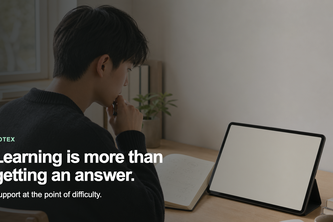
NOTEX is a self-reported iPad-based notebook application that integrates handwriting with AI support, aiming to deliver AI-generated answers directly within the user's handwritten notes — without interrupting their workflow by leaving the page or device.
What changed
The project evolved from an ambitious vision of gesture-triggered AI assistance and inline answer writing into a minimal prototype with UI elements in place but not yet functional. The core AI interaction is currently disabled, and real-world integration remains untested.
Single most important open question
Is there a viable path to making the AI button functional and delivering meaningful, context-aware answers that improve learning outcomes — or is this an idea that cannot be practically realized within current constraints?
What The Product Actually Is
The description states:
- NOTEX is a landscape iPad notebook app built with SwiftUI and PencilKit.
- It supports handwriting input, erasing, undo/redo, and local saving.
- A single AI button exists in the UI but is not yet wired up to trigger an AI response.
- The backend uses Python, Supabase-authenticated WebSockets, and OpenAI Codex for test contracts and logic enforcement.
- It currently ships with one synthetic example and does not upload or process real course material.
- The system handles duplicate requests cleanly and includes a contract-based backend for verifying inputs.
Inference The app is designed to be private and local-first, with no external data transmission beyond the AI request mechanism (which is not yet active). It appears to be a proof-of-concept prototype rather than a production-ready product.
Positioning & Claim Evolution
The description states:
- The inspiration was to interrupt the habit of reaching for a phone when stuck mid-problem.
- The goal is to keep the question from ever leaving the page — not just answer it, but integrate the answer into the user’s own handwriting style.
- Originally, they aimed for a gesture-triggered system ("-❔") and inline answers, but this was not implemented due to time constraints.
- They landed on a single AI button as a fallback, though it is not yet functional.
Inference The positioning has shifted from an ambitious, integrated solution to a minimal prototype with UI elements in place but no working functionality. The original vision of seamless integration remains unfulfilled.
Target Customer & ICP
The description states:
- NOTEX targets users who write by hand on an iPad, particularly those studying or solving problems where they get stuck and might otherwise reach for a phone.
- It is designed for students or learners using handwritten notes in educational contexts.
Inference There is no explicit segmentation beyond the general use case of handwritten note-taking in learning environments. The ICP appears to be early-stage learners or students who value uninterrupted focus and private, local note-taking.
Business Model & Pricing Evidence
The description states:
- No pricing information, business model, or monetization strategy is provided.
- The app does not upload real course material or handle external data.
- It is a hackathon project submitted to OpenAI 2026.
Inference There is no evidence of any commercial model or pricing structure at this stage. The product is described as a prototype, not a commercial offering.
Technical & Delivery Signals
The description states:
- Built with SwiftUI and PencilKit for frontend; Python backend with Supabase-authenticated WebSockets.
- Uses OpenAI Codex to generate test contracts and logic enforcement.
- GPT-5.6 Terra and Sol were used for implementation, architecture, and safety checks.
- Backend tests pass (100/100), Swift UI tests pass (96/96), and simulator-based responses are functional.
- Local persistence is implemented and private to the app.
- Device-level testing shows Supabase auth and WSS connection work in theory, but real provider integration failed safely.
Inference The technical stack is solid for a prototype, with strong emphasis on privacy and local-first design. However, the AI interaction layer remains unimplemented, and real-world functionality has not been demonstrated.
Traction & Maturity Signals
The description states:
- The app supports basic handwriting functions (write, erase, undo/redo).
- It handles duplicate requests cleanly and excludes AI-generated ink from future input.
- A synthetic example is bundled, but no real course material or live AI responses are supported.
- The AI button UI exists but is not connected.
- No real-world testing with actual users or providers has occurred.
Inference There is no evidence of traction, adoption, or user feedback. The project is at a very early stage — a functional prototype with UI elements in place but no working AI integration.
Competitive Context
The description states:
- No mention of competitors or existing solutions.
- The app is described as a hackathon submission to OpenAI 2026.
- It aims to solve the problem of phone-based interruptions during study, which other tools like chatbots and note-taking apps may already address.
Inference No competitive analysis is provided. The project appears to be an experimental idea with no known market presence or direct competitors at this stage.
Open Questions & Risks
The description states:
- The AI button is not yet functional.
- Real-world integration with AI providers has failed safely, without silent breakage.
- No real course material or live AI responses are supported.
- The gesture-based trigger and inline answer features are still ahead of implementation.
- It is a hackathon project with no commercial traction or revenue.
Inference The core functionality is not yet implemented, and the project may not be able to deliver on its central promise. The lack of real-world testing and integration raises significant risk that the idea cannot scale beyond prototype status.
Questions the description leaves open
- What are the specific technical challenges preventing the AI button from being wired up?
- How do you plan to validate whether users actually benefit from having answers appear inline in their handwriting?
- Are there any plans to integrate with real educational content or AI providers beyond the synthetic example?
- What is your roadmap for moving from prototype to a functional product that delivers on the original vision?
- How do you intend to monetize this product, if at all?
Overall Assessment
The description states:
- NOTEX is a hackathon project submitted to OpenAI 2026.
- It is not yet a commercial product or offering.
- No revenue, customers, or traction data are provided.
Inference At this stage, the project is an idea with UI elements in place but no working AI integration. There is no evidence of commercial viability, traction, or a clear path to monetization. It is not ready for investment or partnership consideration. The original vision remains unfulfilled, and the core functionality is not yet implemented.
User Stories BotA demo video on every pull request
Get a demo video on every new feature
GitHub App that watches your pull requests and records a narrated, captioned demo.
Save time on demo prep and make informed decisions faster with a video walkthrough of every new feature.
Source
Submitted to the OpenAI 2026 hackathon on Devpost. Project home on Devpost. Back to the full gallery on Devpost.
This competitive analysis was produced by top-founders.com (opens in a new tab)
Generated by a language model from this project's public Devpost page — its tagline, the author's own write-up and any built-with tags listed there — as captured in August 2026. Short quotations are the author's words. It is an opinion on the idea as a business, not on the people behind it, and it reflects the description as published then. If the project has moved on, request a correction below. The analysis is not independent research and contains no verified traction, revenue or customer data.
An independent guide by KFG International LLC — not affiliated with, endorsed by, or connected to Devpost or OpenAI.