

Archive position — measured, not model output
1 like on Devpost
505 of the 7,850 archived projects have more likes, and 1,758 share exactly 1 — so this project's #1,548 place in the like-ranked listing is a tie-break inside that group, not a ranking.
Projects (log scale)
Likes on Devpost. ▲ marks this project's group.
Show the figures
| Likes | Projects | Share of archive |
|---|---|---|
| 0 | 5,587 | 71.2% |
| 1 | 1,758 | 22.4% |
| 2 | 284 | 3.6% |
| 3–4 | 132 | 1.7% |
| 5–9 | 75 | 1.0% |
| 10+ | 14 | 0.2% |
 User Stories BotA demo video on every pull request
Get a demo video on every new feature
GitHub App that watches your pull requests and records a narrated, captioned demo.
Save time on demo prep and make informed decisions faster with a video walkthrough of every new feature.
Executive Summary
What the company appears to be
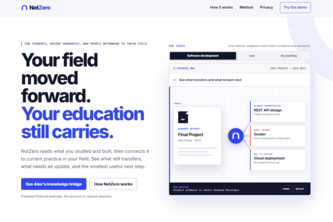
NotZero is a self-reported tool that claims to help recent graduates bridge their academic knowledge to current professional expectations by analyzing curriculum, project files, and target roles using AI.
What changed
The author states that NotZero was built for the OpenAI 2026 hackathon. It is described as an MVP with no revenue or customer data. There is no evidence of prior traction or commercial activity beyond this submission.
Single most important open question
Is there any evidence of user adoption, feedback, or product-market fit beyond the author's own description? The self-reported nature of the write-up and lack of external validation make it impossible to assess whether NotZero has real utility or traction.
What The Product Actually Is
The description states that NotZero analyzes a user’s curriculum, academic materials, project files, target role, and location. It identifies what remains current, what transfers, what needs a small bridge, what appears missing, and what cannot yet be concluded. It then provides evidence, prioritized next steps, and a concrete upgrade challenge.
- Claimed functionality: Analysis of user inputs (curriculum, materials, etc.) to map academic knowledge to professional expectations.
- Output type: Evidence-based recommendations with actionable next steps.
- Methodology: Uses AI models like GPT-5.6, structured outputs, schema validation, and progressive disclosure.
Inference The product is described as a knowledge mapping tool for recent graduates, using AI to assess gaps between education and job requirements.
Positioning & Claim Evolution
The author states that NotZero helps graduates see they are not starting from zero — their existing knowledge can become a practical bridge to current work.
- Positioning claim: A tool that reduces the perceived gap between academic learning and professional expectations.
- Evolution of claims: From a hackathon MVP to a potential multi-disciplinary platform (e.g., law, accounting, nursing).
Inference The positioning is centered on reducing graduate anxiety by showing transferable skills. The evolution suggests ambition beyond a single-use tool.
Target Customer & ICP
The description states that NotZero is for recent graduates who are transitioning into the workforce and need to understand how their academic knowledge maps to current job requirements.
- Target customer: Recent software graduates (initially), with plans to expand to other disciplines.
- ICP (Ideal Customer Profile): Recent graduates, especially in technical fields, who are uncertain about how their education applies to real-world roles.
Inference The ICP is likely early-career professionals seeking clarity on skill relevance and next steps. No evidence of segmentation or targeting beyond this.
Business Model & Pricing Evidence
The description does not state anything about pricing, monetization, or a business model.
- Monetization: Not evidenced.
- Pricing: Not evidenced.
- Business model: Not evidenced.
Inference There is no evidence of any revenue-generating mechanism beyond the hackathon submission.
Technical & Delivery Signals
The project was built using:
- Tools: Codex, GPT-5.6, TypeScript, OpenAI API integration
- Frameworks/Stack: React, Flask, Cloudflare Workers, D1, Zod, Pandas, Scikit-learn, Vite, Vinext
- Features: Bounded file uploads, staged analysis, structured outputs, evidence locators, schema validation, checkpointed retries, progressive disclosure
Inference The product uses a hybrid of AI and structured engineering to deliver a user-facing tool with traceability and error handling.
Traction & Maturity Signals
The description states that this was built for the OpenAI 2026 hackathon. It is described as an MVP, with no mention of users, revenue, or adoption beyond the author’s own account.
- Traction: Not evidenced.
- Maturity: MVP-level product; no evidence of scaling or production use.
- User feedback: Not evidenced.
Inference The project has not demonstrated any real-world usage or impact beyond a hackathon submission.
Competitive Context
The description does not mention any competitors. It is unclear whether similar tools exist in the market for helping graduates bridge academic and professional knowledge.
- Competitive landscape: Not evidenced.
- Differentiation: Not evidenced.
Inference No evidence of competitive analysis or awareness of existing solutions in this space.
Open Questions & Risks
- No traction or revenue: The project is described as an MVP with no evidence of adoption or monetization.
- Unverified claims: All claims are self-reported and unverified.
- Limited scope: Only one team member, a single founder (Cesar Reyes), suggests limited capacity for execution.
- AI dependency: Heavy reliance on GPT-5.6 and OpenAI APIs may create scalability or cost risks.
- No user feedback loop: No evidence of iterative improvement based on user input.
Inference The lack of external validation, revenue, or users raises significant concerns about product-market fit and viability.
Questions the description leaves open
- What specific feedback have you received from recent graduates who used the tool?
- How do you plan to validate that your AI outputs are accurate and actionable?
- Have you tested the tool with actual users beyond yourself or your team?
- What is your roadmap for expanding into other disciplines (law, accounting, etc.)?
- Do you have any plans for monetization or user onboarding beyond the MVP?
Overall Assessment
The description states that NotZero was built as a hackathon submission and is currently an MVP with no evidence of traction, revenue, or users.
- Investment potential: Not evidenced.
- Partnership opportunity: Not evidenced.
- Commercial viability: Not evidenced.
Inference Based on the self-reported nature of the description and lack of external validation, there is insufficient evidence to support a conclusion about investment or partnership potential. The project appears to be in early-stage development with no demonstrated commercial traction.
User Stories BotA demo video on every pull request
Get a demo video on every new feature
GitHub App that watches your pull requests and records a narrated, captioned demo.
Save time on demo prep and make informed decisions faster with a video walkthrough of every new feature.
Source
Submitted to the OpenAI 2026 hackathon on Devpost. Project home on Devpost. Back to the full gallery on Devpost.
This competitive analysis was produced by top-founders.com (opens in a new tab)
Generated by a language model from this project's public Devpost page — its tagline, the author's own write-up and any built-with tags listed there — as captured in August 2026. Short quotations are the author's words. It is an opinion on the idea as a business, not on the people behind it, and it reflects the description as published then. If the project has moved on, request a correction below. The analysis is not independent research and contains no verified traction, revenue or customer data.
An independent guide by KFG International LLC — not affiliated with, endorsed by, or connected to Devpost or OpenAI.