

Archive position — measured, not model output
1 like on Devpost
505 of the 7,850 archived projects have more likes, and 1,758 share exactly 1 — so this project's #1,501 place in the like-ranked listing is a tie-break inside that group, not a ranking.
Projects (log scale)
Likes on Devpost. ▲ marks this project's group.
Show the figures
| Likes | Projects | Share of archive |
|---|---|---|
| 0 | 5,587 | 71.2% |
| 1 | 1,758 | 22.4% |
| 2 | 284 | 3.6% |
| 3–4 | 132 | 1.7% |
| 5–9 | 75 | 1.0% |
| 10+ | 14 | 0.2% |
 User Stories BotA demo video on every pull request
Get a demo video on every new feature
GitHub App that watches your pull requests and records a narrated, captioned demo.
Save time on demo prep and make informed decisions faster with a video walkthrough of every new feature.
Executive Summary
What the company appears to be: A self-developed personal memory and map tool named My Life Memory, built by a single developer (kaki Wang) for individual use. The product allows users to record places, routes, photos, and notes on a searchable map, with an integrated AI layer called MCP (Memory Control Protocol) that enables read-only access to the user’s own archive through structured queries.
What changed: The project evolved from a personal tool designed for the founder's own needs—particularly managing ADHD-related spatial anxiety—to a more general-purpose application that supports private memory organization and retrieval via AI. It was submitted as part of an OpenAI hackathon, indicating a shift toward public exposure and potential broader utility.
Single most important open question: Is there any evidence of user adoption or traction beyond the founder’s own use? The description does not indicate whether others are using the product or if it has gained users outside of the developer's personal network.
Note
This analysis is based entirely on self-reported information provided by the author. No external verification, revenue data, customer base, or independent sources were included. All claims are stated by the author and not independently confirmed.
What The Product Actually Is
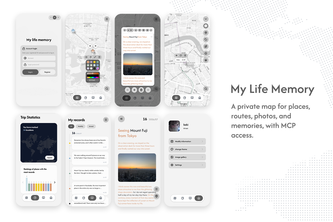
The description states that My Life Memory is a private map and memory-recording tool. Users can:
- Save places directly on a map.
- Create new places by importing photos with GPS metadata.
- Organize locations using differently colored stars.
- Attach photos, written memories, and related information to each place.
- Record routes.
- Access personal memory lists, location statistics, and account management features.
- Generate MCP access tokens within the app for AI interaction.
The system integrates these elements into a single interface where users can revisit experiences through various views (AI conversation, coordinates, map overviews, dates, content-based).
Claim: The product is described as a private memory atlas that connects places, routes, photos, and notes into a searchable map.
Evidence: Yes — from the tagline and project write-up.
Inference: It functions as both a personal organizer and an AI-enhanced retrieval system.
Label: Inferred from description.
Positioning & Claim Evolution
The author positions My Life Memory as a tool for preserving and revisiting personal life experiences, with a focus on reducing cognitive load through instrumental rationality and emotional design. It is described as:
- A private memory atlas
- Designed to help users remember faster and easier
- Built around the idea that a place or memory is not isolated, but connected to routes, events, and other memories
- Intended for individuals with spatial anxiety (e.g., those with AuDHD)
- A tool that supports both practical organization and emotional recall
The positioning evolved from a personal solution to a potential public utility, especially after its submission to the OpenAI Build Week hackathon.
Claim: The product aims to reduce cognitive load and make remembering easier.
Evidence: Yes — stated in the write-up under “Inspiration” and “What it does”.
Inference: It is positioned as a hybrid of practical tooling and emotional memory support.
Label: Inferred from description.
Target Customer & ICP
The author describes the initial target as themselves, specifically someone with AuDHD, who struggles with spatial awareness and anxiety in unfamiliar environments. The product was built to address their own needs first.
Later, the author notes that others in technology, travel blogging, and content creation have shown interest, suggesting a possible expansion beyond the original use case.
Claim: The primary user is someone with AuDHD or similar spatial challenges.
Evidence: Yes — stated under “Inspiration”.
Inference: There may be broader appeal to people interested in personal memory tracking.
Label: Inferred from description.
Claim: Some users outside the founder’s circle have expressed interest.
Evidence: Yes — mentioned in “Accomplishments that we’re proud of”.
Business Model & Pricing Evidence
There is no evidence of a business model or pricing structure in the provided description. The product is described as a personal tool, and there is no mention of monetization, subscriptions, or paid features.
Claim: No business model or pricing information is provided.
Evidence: Not evidenced — the description does not include any financial or commercial details.
Technical & Delivery Signals
The application uses:
- Frontend: React 19, TypeScript, Vite 6, Tailwind CSS 4
- Maps: Leaflet, MapLibre GL JS, OpenStreetMap
- Backend: Supabase Auth, PostgreSQL, Deno Edge Functions
- AI Integration: MCP (Memory Control Protocol), GPT-5.6 for review and planning
- Storage: IndexedDB, private storage via Supabase
- Deployment: GitHub Pages (frontend), Supabase (backend)
Key technical features include:
- Read-only MCP access
- Structured search using public geography, date constraints, personal-place relationships, event targets, nearby scope, route intent
- Strict ambiguity handling (supported, ambiguous, not-found, candidate-review)
- Row-level security to isolate user data
- Local and cloud MCP transports with shared tool manifest
Claim: The system uses a read-only MCP protocol.
Evidence: Yes — stated in “What it does”.
Claim: The backend avoids embeddings, vector databases, or paid APIs.
Evidence: Yes — explicitly mentioned.
Inference: The architecture is designed for privacy and user control.
Label: Inferred from description.
Traction & Maturity Signals
There is no evidence of traction beyond the founder’s own use. The author mentions:
- Positive feedback from themselves and some users
- People in tech, travel blogging, and content creation saving or contacting them
- No mention of revenue, customers, or user base size
Claim: No traction data is provided.
Evidence: Not evidenced — the description does not include metrics or adoption indicators.
Competitive Context
The author does not reference competitors or similar tools. The project appears to be a personal innovation rather than part of an existing marketplace or product category.
Claim: No competitive context is given.
Evidence: Not evidenced — no mention of competing products or market positioning.
Open Questions & Risks
- Single-person development: The entire project was built by one person, raising concerns about scalability and long-term maintenance.
- No commercial traction: No evidence of users beyond the founder’s circle.
- Limited external validation: While some people showed interest, there is no indication of real-world usage or feedback loops.
- Self-reported nature: All claims are unverified; no third-party data or audits exist.
Claim: Risk of limited scalability due to single developer.
Evidence: Yes — stated in “Challenges we ran into”.
Claim: Lack of commercial traction is an open question.
Evidence: Not evidenced — but implied by absence of metrics or user base.
Questions the description leaves open
- What specific user needs drove the development of MCP? Was this feature added early or late in the process?
- How many users are currently using the product outside of your own use?
- Have you considered how to scale beyond a single developer?
- What is the long-term vision for monetization or commercialization?
- Can you describe any real-world feedback from users beyond the ones who contacted you?
- Are there plans to expand beyond personal memory tracking into shared or collaborative features?
Overall Assessment
There is no evidence of revenue, customers, or traction beyond the founder’s own use and limited interest from others in related fields.
The project is described as a personal tool, built by one developer, with no indication of commercial viability or market demand.
Claim: No investment or partnership opportunity based on available evidence.
Evidence: Not evidenced — no financials, users, or commercial indicators present.
User Stories BotA demo video on every pull request
Get a demo video on every new feature
GitHub App that watches your pull requests and records a narrated, captioned demo.
Save time on demo prep and make informed decisions faster with a video walkthrough of every new feature.
Source
Submitted to the OpenAI 2026 hackathon on Devpost. Project home on Devpost. Back to the full gallery on Devpost.
This competitive analysis was produced by top-founders.com (opens in a new tab)
Generated by a language model from this project's public Devpost page — its tagline, the author's own write-up and any built-with tags listed there — as captured in August 2026. Short quotations are the author's words. It is an opinion on the idea as a business, not on the people behind it, and it reflects the description as published then. If the project has moved on, request a correction below. The analysis is not independent research and contains no verified traction, revenue or customer data.
An independent guide by KFG International LLC — not affiliated with, endorsed by, or connected to Devpost or OpenAI.