

Archive position — measured, not model output
0 likes on Devpost
2,263 of the 7,850 archived projects have more likes, and 5,587 share exactly 0 — so this project's #5,427 place in the like-ranked listing is a tie-break inside that group, not a ranking.
Projects (log scale)
Likes on Devpost. ▲ marks this project's group.
Show the figures
| Likes | Projects | Share of archive |
|---|---|---|
| 0 | 5,587 | 71.2% |
| 1 | 1,758 | 22.4% |
| 2 | 284 | 3.6% |
| 3–4 | 132 | 1.7% |
| 5–9 | 75 | 1.0% |
| 10+ | 14 | 0.2% |
 User Stories BotA demo video on every pull request
Get a demo video on every new feature
GitHub App that watches your pull requests and records a narrated, captioned demo.
Save time on demo prep and make informed decisions faster with a video walkthrough of every new feature.
Executive Summary
What the company appears to be
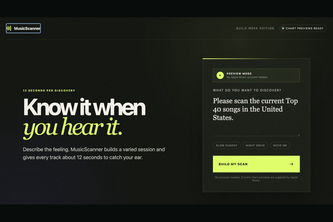
MusicScanner is a self-reported web application that allows users to passively discover music through short audio previews, mimicking the behavior of a traditional radio scan button. It is built using JavaScript, Node.js, HTML, and CSS, with integration into Apple Music via API and use of GPT-5.6 for interpreting user requests.
What changed
The project description states that this is a “Build Week Edition” submitted to the OpenAI 2026 hackathon. It represents an implementation of an idea first conceptualized in 2012, using AI tools like Codex and GPT-5.6 to build a working prototype.
Single most important open question
Is there any evidence of traction, revenue, or customer adoption beyond the author’s own development efforts?
What The Product Actually Is
The description states that MusicScanner is a web-based application designed to play short audio previews (approximately 12 seconds) continuously until a user finds something they like. Once selected, the full song plays and then scanning resumes automatically.
It integrates with Apple Music for preview playback and uses GPT-5.6 to interpret natural language queries into search terms for playlists or artist catalogs. The app supports controls such as pause/resume, forward/backward, and returning to a previous chart position after exploring an artist's catalog.
The system includes server-side integrations with Apple Music and OpenAI’s Responses API, with structured outputs used to validate GPT responses. It also features deterministic fallbacks for scenarios where credentials or network access are unavailable.
Evidence
- The author describes the core functionality as playing short samples continuously until a user selects a song.
- Integration with Apple Music is described through token signing and preview URL delivery.
- Use of GPT-5.6 to convert natural language into structured search terms.
- Controls like pause, resume, artist scanning, and return-to-chart path are detailed.
Inference The product appears to be a minimal viable prototype built for demonstration purposes rather than production use.
Positioning & Claim Evolution
The author claims that MusicScanner reimagines the “Scan button” concept from car radios into a digital music discovery tool. The idea was first conceived in 2012 and refined through multiple development attempts before being realized using AI tools like Codex and GPT-5.6.
It positions itself as an alternative to traditional swipe-and-search interfaces, aiming for low-interaction music exploration while driving or browsing.
Evidence
- The author explicitly states the inspiration came from a car radio scan button.
- The goal is to reduce time spent searching and skipping songs.
- The app supports natural language input ("give me a workout scan") and returns playlist or catalog matches based on those inputs.
Inference The positioning reflects a niche audience interested in passive music discovery, particularly during travel or multitasking scenarios.
Target Customer & ICP
The description implies that the target customer is someone who values passive music discovery, especially while driving or engaged in other activities where interaction with a device is limited. Users may be looking for new music without actively seeking it out.
There is no explicit mention of specific personas or segmentation beyond general interest in music exploration.
Evidence
- The author mentions the experience being useful “while driving.”
- The app supports natural language queries, suggesting ease-of-use for casual listeners.
- No demographic data or user segmentation provided.
Inference The ICP likely includes early adopters of AI-enhanced tools, music enthusiasts who prefer discovery over curation, and individuals seeking low-effort listening experiences.
Business Model & Pricing Evidence
There is no evidence in the description of a business model or pricing strategy. The app uses Apple Music previews without requiring an account for basic functionality, but full playback requires an Apple Music subscription.
The author notes that GPT-5.6 is used to interpret user requests and generate search terms, but does not indicate any monetization of this feature.
Evidence
- Preview mode works without an Apple Music account.
- Full song playback requires authorization via Apple Music.
- No mention of subscriptions, freemium tiers, or monetization strategies.
Inference The app appears to be a proof-of-concept with no stated commercial intent at this stage.
Technical & Delivery Signals
The project is built using JavaScript, Node.js, HTML, and CSS. It integrates with Apple Music via API and uses GPT-5.6 through OpenAI’s Responses API with strict structured outputs for validation.
Codex played a significant role in building the application, including architectural decisions, implementation, testing, documentation, and even video editing.
Evidence
- Built from scratch using Node.js, HTML, CSS, JavaScript.
- Uses Apple Music API for previews and metadata.
- GPT-5.6 integrated via OpenAI Responses API with structured outputs.
- Codex assisted in design, implementation, testing, and documentation.
- Includes automated tests (21 total), build logs, and version control.
Inference The technical stack suggests a lightweight, web-based prototype built quickly using modern tooling and AI assistance. The presence of validation layers indicates attention to safety and correctness.
Traction & Maturity Signals
There is no evidence of revenue, customers, or adoption beyond the author’s own development efforts. The project was submitted as part of a hackathon and is described as a prototype built for demonstration purposes.
Evidence
- Submitted to OpenAI 2026 hackathon.
- Described as a “Build Week Edition.”
- No mention of users, sales, or usage metrics.
- No product roadmap or market traction data provided.
Inference This is a pre-product prototype with no evidence of real-world usage or commercial viability.
Competitive Context
The author mentions that the concept of a scan button for music was not previously implemented, and they asked people on Reddit about it in 2012. However, there is no mention of existing competitors or market analysis.
Evidence
- The author states that no similar app existed at the time.
- No comparison to other music discovery platforms (Spotify, Apple Music, etc.) is made.
- No indication of competitive landscape or differentiation strategy.
Inference The lack of competitive context makes it difficult to assess whether this idea addresses a real market gap or overlaps with existing solutions.
Open Questions & Risks
Several risks and open questions are present in the self-reported description:
- No commercial traction: No evidence of revenue, customers, or adoption.
- Limited scope: The app is described as a prototype built for a hackathon.
- Dependency on AI tools: Heavy reliance on Codex and GPT-5.6 may not scale or be sustainable long-term.
- Lack of clarity on monetization: No business model or pricing strategy is evident.
- No third-party validation: The entire description is self-reported, with no external verification.
Evidence
- No revenue, customer, or adoption data provided.
- Prototype built for a hackathon.
- Heavy dependence on AI tools that may not be available in production.
- No mention of monetization plans.
Inference The project lacks commercial viability indicators and is likely not ready for market entry without further development and validation.
Questions the description leaves open
- What is the expected timeline to move from prototype to a full product?
- Are there any plans to monetize or generate revenue from this product?
- How do you plan to handle scalability and performance issues as more users engage with the app?
- What are your thoughts on integrating with other music platforms beyond Apple Music?
- Have you considered how user privacy and data handling will be managed, especially given AI integration?
- Is there any intention to build a native mobile version (iOS/Android)?
- How do you plan to differentiate this from existing music discovery tools?
Overall Assessment
Not evidenced.
The description provides no information regarding financials, traction, or customer data that would support an investment or partnership decision. The project is described as a prototype built for a hackathon and lacks any indication of commercial readiness.
Confidence Level Low This analysis is based entirely on self-reported information with no external validation or evidence of real-world performance or market demand.
User Stories BotA demo video on every pull request
Get a demo video on every new feature
GitHub App that watches your pull requests and records a narrated, captioned demo.
Save time on demo prep and make informed decisions faster with a video walkthrough of every new feature.
Source
Submitted to the OpenAI 2026 hackathon on Devpost. Project home on Devpost. Back to the full gallery on Devpost.
This competitive analysis was produced by top-founders.com (opens in a new tab)
Generated by a language model from this project's public Devpost page — its tagline, the author's own write-up and any built-with tags listed there — as captured in August 2026. Short quotations are the author's words. It is an opinion on the idea as a business, not on the people behind it, and it reflects the description as published then. If the project has moved on, request a correction below. The analysis is not independent research and contains no verified traction, revenue or customer data.
An independent guide by KFG International LLC — not affiliated with, endorsed by, or connected to Devpost or OpenAI.