

Archive position — measured, not model output
1 like on Devpost
505 of the 7,850 archived projects have more likes, and 1,758 share exactly 1 — so this project's #1,503 place in the like-ranked listing is a tie-break inside that group, not a ranking.
Projects (log scale)
Likes on Devpost. ▲ marks this project's group.
Show the figures
| Likes | Projects | Share of archive |
|---|---|---|
| 0 | 5,587 | 71.2% |
| 1 | 1,758 | 22.4% |
| 2 | 284 | 3.6% |
| 3–4 | 132 | 1.7% |
| 5–9 | 75 | 1.0% |
| 10+ | 14 | 0.2% |
 User Stories BotA demo video on every pull request
Get a demo video on every new feature
GitHub App that watches your pull requests and records a narrated, captioned demo.
Save time on demo prep and make informed decisions faster with a video walkthrough of every new feature.
Executive Summary
What the company appears to be
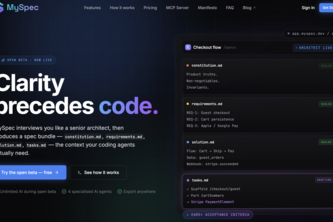
MySpec is a self-reported tool that aims to improve software development planning by turning product ideas and existing codebases into structured, implementation-ready specifications for developers and AI coding agents like Codex. It positions itself as part of a "spec-driven development" approach, integrating AI (specifically GPT-5.6) into the pre-code phase to help teams discover requirements, identify gaps, and produce reusable planning artifacts.
What changed
The author states that MySpec was built during OpenAI Build Week 2026, with a focus on improving how GPT-5.6 and Codex integrate into the planning workflow. The project is described as an actively evolving product, not yet a commercial offering, and is positioned as a tool for teams to improve clarity before implementation begins.
Single most important open question
Is there evidence that MySpec has traction or adoption beyond its author’s own use case? The description contains no data on customers, revenue, usage, or market validation — only claims about intent and process.
What The Product Actually Is
The description states that MySpec is a tool for transforming product ideas and existing codebases into structured, implementation-ready specifications. It supports two workflows:
- Greenfield workflow: For new products, it guides users through an AI-powered discovery process to uncover requirements, generate proposals, architecture, and implementation tasks.
- Brownfield workflow: For existing applications, it analyzes the current codebase before guiding teams through a similar structured planning process.
Once specifications are approved, they can be handed off to AI coding agents like Codex for implementation. The tool is described as combining structured software engineering practices with modern AI reasoning, using GPT-5.6 throughout the planning workflow.
Not evidenced:
- Whether MySpec produces actual executable artifacts or just documentation.
- What format these specifications take (e.g., markdown, JSON, etc.).
- If it integrates with existing development tools or platforms.
- How it handles versioning or synchronization of specs over time.
Positioning & Claim Evolution
The author claims that MySpec addresses a core problem in AI-assisted software development: unclear planning leads to inefficient implementation, even when AI can generate code quickly. The tool is positioned as a way to "create better context before a single line of code is written."
It positions itself as part of a shift toward “spec-driven development,” where the planning phase becomes more collaborative and AI-enhanced rather than static or manual.
The author also states that MySpec was inspired by conversations with developers, product managers, and engineering teams who found that AI-generated code often required rework due to unclear requirements. This suggests a move from "AI-first" to "AI-assisted planning-first."
Inferred:
- The positioning reflects a belief that AI will increasingly be used in tandem with human judgment, not as a replacement.
- MySpec is intended for teams, not individual developers.
Not evidenced:
- No mention of specific competitors or how MySpec differentiates from them.
- No evidence of prior versions or iterations beyond the Build Week prototype.
Target Customer & ICP
The description states that MySpec targets:
- Developers
- Builders
- Founders
- Teams (implying it's aimed at collaborative environments)
It is described as useful for both greenfield and brownfield development, suggesting a broad ICP across different stages of software lifecycle.
Inferred:
- The target audience likely includes product managers, engineering leads, and technical founders who are working with AI tools like Codex.
Not evidenced:
- No specific customer personas or segments.
- No indication of whether it targets enterprise, startups, or individual developers.
- No evidence of pricing tiers or use cases beyond the author’s own experience.
Business Model & Pricing Evidence
The description does not contain any information about:
- Revenue model
- Pricing structure
- Monetization strategy
- Whether MySpec is a freemium, SaaS, or one-time product
- Any paid features or plans
Not evidenced:
- No evidence of commercial viability or monetization path.
Technical & Delivery Signals
The author states that MySpec was built using:
- Technologies: Go, TypeScript, PostgreSQL, Fiber (Go framework), Cloudflare third-party services (Gemini), Anthropic, ChatGPT
- AI models: GPT-5.6, Codex
- Workflow integration: AI is used for requirement discovery, proposal generation, and specification refinement
Inferred:
- The tool likely uses a web interface or CLI to interact with users.
- It may store and manage specification documents in a database.
Not evidenced:
- No details on architecture (e.g., serverless vs. monolithic).
- No evidence of scalability or performance characteristics.
- No mention of API access, extensibility, or developer tooling beyond AI integration.
Traction & Maturity Signals
The description states that MySpec is an "actively evolving product" and was built during OpenAI Build Week 2026. It is described as a prototype with a roadmap for future features.
Not evidenced:
- No evidence of user base, adoption rate, or customer retention.
- No data on usage frequency or engagement metrics.
- No mention of any beta users, pilot programs, or feedback loops.
- No indication of whether it has been released publicly or is in private testing.
Competitive Context
The description does not provide any information about:
- Direct competitors
- Indirect substitutes
- Market positioning relative to other planning tools (e.g., Confluence, Notion, Jira)
- AI-assisted development platforms like GitHub Copilot, Tabnine, or Cursor
Inferred:
- MySpec operates in the space of AI-enhanced software planning and specification tools.
- It likely competes with general-purpose AI coding agents that lack structured planning features.
Not evidenced:
- No competitive analysis or differentiation strategy.
- No evidence of market size or demand for such a tool.
Open Questions & Risks
- Lack of traction: The project is described as an early-stage prototype, with no evidence of adoption or revenue.
- Unproven commercial viability: There is no indication that MySpec has a monetization model or path to profitability.
- Over-reliance on AI models: GPT-5.6 and Codex are central to the product, but their availability and pricing are not discussed.
- Unclear value proposition: While it claims to solve planning inefficiencies, there is no evidence of how this translates into measurable outcomes for teams.
- Single-founder team: With only one member (Vincent Tran), scalability and execution risk may be high.
Questions the description leaves open
- What specific problems do you observe in your own workflow that MySpec addresses?
- How does MySpec ensure consistency between AI-generated specs and human intent?
- Are there any early adopters or users who have provided feedback on the tool?
- What is the current roadmap for product development, and how will it evolve into a commercial offering?
- How do you plan to monetize MySpec, and what pricing model are you considering?
- What are your plans for integrating with existing development platforms (e.g., GitHub, Jira)?
- How does MySpec handle version control or collaboration between multiple stakeholders?
Overall Assessment
The description indicates that MySpec is an early-stage prototype developed during a hackathon and is described as "actively evolving." There is no evidence of commercial traction, revenue, or customer adoption.
Confidence level: Low
This project appears to be a concept or proof-of-concept with strong alignment to current trends in AI-assisted development. However, without any data on usage, market response, or financials, it cannot be evaluated as a viable investment or partnership opportunity at this time.
The author’s own account is the only source of information — no third-party validation, historical performance, or customer insights are available. The tool is described as a speculative solution to a problem that may not yet have widespread market demand.
Inferred:
- If MySpec evolves into a product with real-world adoption and clear value, it could be relevant in the AI-assisted development space.
- As of now, it remains unproven and speculative.
User Stories BotA demo video on every pull request
Get a demo video on every new feature
GitHub App that watches your pull requests and records a narrated, captioned demo.
Save time on demo prep and make informed decisions faster with a video walkthrough of every new feature.
Source
Submitted to the OpenAI 2026 hackathon on Devpost. Project home on Devpost. Back to the full gallery on Devpost.
This competitive analysis was produced by top-founders.com (opens in a new tab)
Generated by a language model from this project's public Devpost page — its tagline, the author's own write-up and any built-with tags listed there — as captured in August 2026. Short quotations are the author's words. It is an opinion on the idea as a business, not on the people behind it, and it reflects the description as published then. If the project has moved on, request a correction below. The analysis is not independent research and contains no verified traction, revenue or customer data.
An independent guide by KFG International LLC — not affiliated with, endorsed by, or connected to Devpost or OpenAI.