

Archive position — measured, not model output
0 likes on Devpost
2,263 of the 7,850 archived projects have more likes, and 5,587 share exactly 0 — so this project's #5,429 place in the like-ranked listing is a tie-break inside that group, not a ranking.
Projects (log scale)
Likes on Devpost. ▲ marks this project's group.
Show the figures
| Likes | Projects | Share of archive |
|---|---|---|
| 0 | 5,587 | 71.2% |
| 1 | 1,758 | 22.4% |
| 2 | 284 | 3.6% |
| 3–4 | 132 | 1.7% |
| 5–9 | 75 | 1.0% |
| 10+ | 14 | 0.2% |
 User Stories BotA demo video on every pull request
Get a demo video on every new feature
GitHub App that watches your pull requests and records a narrated, captioned demo.
Save time on demo prep and make informed decisions faster with a video walkthrough of every new feature.
Executive Summary
What the company appears to be: A self-reported, unverified mobile web application (PWA) named MVP — My Verbal Promises — that captures verbal commitments made during meetings or conversations, processes them with AI to identify who promised what and when, and stores them in a relationship-based semantic search system. It is described as a minimal product built for OpenAI Build Week 2026.
What changed: The author states the project was conceived during OpenAI Build Week 2026, using Codex to build v2 from an initial ChatGPT Work prototype. It is presented as a novel approach in the meeting intelligence space that avoids full meeting recording and instead focuses on capturing only the verbal promise.
Single most important open question: Is there any evidence of traction, revenue, or user adoption beyond the author’s own account? The description contains no data about users, customers, monetization, or product usage.
What The Product Actually Is
The description states that MVP is a zero-build mobile web application with a small Node.js server. It uses:
- GPT-4o-transcribe for voice-to-text conversion
- GPT-5.6 via OpenAI’s Responses API to extract structured commitments
- text-embedding-3-small for semantic search
- localStorage and IndexedDB for local data persistence
- Service workers for PWA capabilities
It is described as a PWA that works offline, supports voice or text input, and stores promises by relationship. It also includes optional personal memory features (e.g., appointments) with calendar integration.
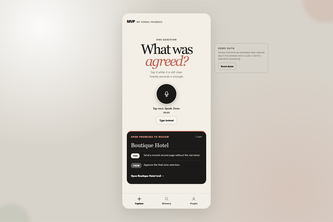
The product asks users to answer one question after a meeting: “What was agreed?” It then separates commitments into categories like You, Them, and Request. The system preserves original audio and transcript alongside AI interpretations.
Inference: This is a self-contained, client-side application that uses AI for structured data extraction but does not appear to have any backend services or APIs beyond local storage and OpenAI.
Positioning & Claim Evolution
The author claims MVP is “a product in the meeting intelligence space”, but one that starts with the opposite constraint: it does not record the meeting at all. Instead, it focuses on capturing verbal commitments immediately after a conversation ends.
It positions itself as an alternative to tools like Otter, Fireflies, and Granola — which are described as full-transcript or summary-based products — by focusing on the commitment, not the meeting.
The name “MVP” is explained as a tension between two meanings: Minimum Viable Product (in product language) and Most Valuable Player (in sport), suggesting that this is the smallest interaction needed to protect what matters most.
Inference: The positioning reflects an attempt to carve out a niche in a crowded space by focusing on a very specific, small unit of value — the verbal promise — rather than broad meeting intelligence.
Target Customer & ICP
The description does not name or define any specific customer segment. It implies that MVP is for people who attend meetings and make verbal commitments, but it does not describe:
- Who those people are (e.g., professionals, students, managers)
- What industries they work in
- What their job functions are
- Whether the product targets individuals or teams
Inference: The target audience appears to be anyone who has meetings and makes verbal commitments, but there is no evidence of segmentation or targeting beyond that.
Business Model & Pricing Evidence
There is no evidence in the description of any business model, pricing strategy, monetization plan, or revenue streams. The project is described as a hackathon submission with no indication of commercial intent or structure.
Inference: No business model or pricing data is evidenced; this remains unknown.
Technical & Delivery Signals
The project is built using:
- JavaScript, HTML, CSS
- Node.js server
- OpenAI APIs (GPT-4o-transcribe, GPT-5.6, text-embedding-3-small)
- PWA technologies (service workers, localStorage, IndexedDB)
- MediaRecorder API for audio capture
- Structured Outputs schema in GPT
It is described as a zero-build application, meaning it was built without traditional development tools or frameworks.
The system supports:
- Local persistence with asynchronous AI enrichment
- Offline capability via PWA
- Semantic search across stored promises
- Installable web app experience
Inference: The technical stack suggests a lightweight, client-side-first approach. There is no evidence of scalability, cloud infrastructure, or enterprise-grade delivery mechanisms.
Traction & Maturity Signals
There is no evidence of any traction, revenue, customer base, or adoption beyond the author’s own account. The project is described as a hackathon submission, and there are no mentions of:
- Users
- Customers
- Product usage metrics
- Revenue
- Market validation
- Product iteration history
Inference: No maturity or traction signals are evident.
Competitive Context
The description mentions three competing products in the meeting intelligence space:
- Otter (full transcription)
- Fireflies (transcription + summarization + analysis)
- Granola (meeting intelligence with bot removal)
It positions MVP as an alternative that does not record meetings, but instead focuses on capturing verbal commitments post-conversation.
Inference: The competitive context is defined by existing tools in the meeting intelligence space, but there is no evidence of market positioning or differentiation beyond the stated approach.
Open Questions & Risks
- No commercial traction or revenue: The project is described as a hackathon submission with no evidence of monetization.
- Unverified claims: All descriptions are self-reported and unverified.
- No user data or feedback: There is no mention of users, customer interviews, or product testing beyond the author’s own experience.
- Limited scope: The product appears to be a minimal prototype focused on one specific interaction (recalling verbal commitments), with no evidence of broader functionality or roadmap.
- AI dependency: Heavy reliance on OpenAI APIs without any indication of fallbacks or alternative models.
Inference: The lack of traction, revenue, and user data makes it difficult to assess viability or scalability. The product is described as minimal and experimental.
Questions the description leaves open
- What was the original problem you were trying to solve, and how did you validate that it existed?
- Have you tested MVP with real users, and if so, what feedback did you get?
- Are there any plans for monetization or commercialization beyond the hackathon?
- How do you plan to scale this product beyond a single-user PWA?
- What are the limitations of the current AI model in extracting commitments accurately?
- Is there any plan to support multiple languages or integrate with other calendar or project management tools?
Overall Assessment
Not evidenced
There is no evidence of revenue, customers, traction, or commercial viability beyond the author’s own description. The product is described as a hackathon submission and lacks any indication of business model, monetization, or market validation.
The project is presented as an experimental idea with no known users or adoption. It is not clear whether it has moved beyond prototype stage or if there are plans for further development or commercial use.
Inference: This is a self-reported, unverified concept with no demonstrated traction or business case. Any investment or partnership decision would require additional evidence of user demand, product-market fit, and commercial potential.
User Stories BotA demo video on every pull request
Get a demo video on every new feature
GitHub App that watches your pull requests and records a narrated, captioned demo.
Save time on demo prep and make informed decisions faster with a video walkthrough of every new feature.
Source
Submitted to the OpenAI 2026 hackathon on Devpost. Project home on Devpost. Back to the full gallery on Devpost.
This competitive analysis was produced by top-founders.com (opens in a new tab)
Generated by a language model from this project's public Devpost page — its tagline, the author's own write-up and any built-with tags listed there — as captured in August 2026. Short quotations are the author's words. It is an opinion on the idea as a business, not on the people behind it, and it reflects the description as published then. If the project has moved on, request a correction below. The analysis is not independent research and contains no verified traction, revenue or customer data.
An independent guide by KFG International LLC — not affiliated with, endorsed by, or connected to Devpost or OpenAI.