

Archive position — measured, not model output
0 likes on Devpost
2,263 of the 7,850 archived projects have more likes, and 5,587 share exactly 0 — so this project's #7,392 place in the like-ranked listing is a tie-break inside that group, not a ranking.
Projects (log scale)
Likes on Devpost. ▲ marks this project's group.
Show the figures
| Likes | Projects | Share of archive |
|---|---|---|
| 0 | 5,587 | 71.2% |
| 1 | 1,758 | 22.4% |
| 2 | 284 | 3.6% |
| 3–4 | 132 | 1.7% |
| 5–9 | 75 | 1.0% |
| 10+ | 14 | 0.2% |
 User Stories BotA demo video on every pull request
Get a demo video on every new feature
GitHub App that watches your pull requests and records a narrated, captioned demo.
Save time on demo prep and make informed decisions faster with a video walkthrough of every new feature.
Executive Summary
What the company appears to be
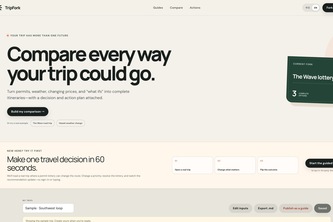
TripFork is a self-reported uncertainty-aware travel planning tool that compares complete itineraries side by side, allowing travelers to see real tradeoffs and switch between branches when uncertainties resolve.
What changed
The author states this began as a personal problem with trip planning — specifically, how to handle changing conditions like permit results or weather — and evolved into a product that preserves multiple viable routes while making tradeoffs visible.
Single most important open question
Is there evidence of any real-world usage or traction beyond the author's own trips? The description contains no data on customers, revenue, or adoption.
Note: This analysis is based entirely on self-reported information from the project description. No external verification or historical data is available. All claims are attributed to the author’s own account and should be treated as unverified.
What The Product Actually Is
The description states that TripFork is an uncertainty-aware travel planner that compares complete itineraries instead of returning one generic answer. It allows users to input constraints such as dates, budget, starting city, fixed bookings, must-see stops, transportation preferences, and uncertain events (e.g., permit results or weather changes). The system then generates two or three complete branches and compares them across multiple criteria including cost, time, fatigue, booking complexity, and experience coverage.
Users can adjust their priorities—such as balancing, saving money, taking it easy, saving time, or seeing more—and observe how each feasible route gets rescored. When an uncertainty resolves, TripFork switches the recommendation without deleting alternatives.
Each plan includes an interactive map and a concrete action checklist, with all original inputs remaining editable. Completed trips can be published as reusable guides that others can fork into new editable trips.
The product is seeded with ten field-tested She Leaves Notes routes but is designed for every traveler to publish and fork their own.
Inference: The tool appears to model travel planning as a decision graph rather than a single itinerary, according to the author’s own account. This is an inferred interpretation of how the system works based on its stated functionality.
Positioning & Claim Evolution
The author positions TripFork as a solution for travelers who face uncertainty in trip planning — particularly those dealing with changing conditions like permit lotteries or weather fluctuations. The core claim is that most trips have more than one good plan, and TripFork enables users to compare these plans side by side.
It evolved from the idea: “what if a planner preserved every viable route, made the tradeoffs visible, and activated the right branch when reality changed?”
The positioning emphasizes:
- Comparison of complete itineraries
- Handling uncertainty in real-time
- Preservation of decision history
- Reusability through forking
Claim: The author claims TripFork is a usable product rather than a one-shot AI demo. This is a self-assessment, not independently verified.
Target Customer & ICP
The description does not clearly define a specific customer segment or ideal customer profile (ICP). However, it implies that the primary users are travelers who:
- Plan trips with uncertain elements (e.g., permits, weather)
- Value flexibility and comparison of multiple options
- Want to preserve and reuse past trip knowledge
- Are comfortable using digital tools for planning
It also suggests a broader audience beyond just individual travelers — since completed trips can be published as guides that others can fork.
Inference: Based on the author's own experience, the ICP likely includes frequent travelers or those who plan complex multi-day journeys involving logistics and uncertainties. This is inferred from the examples given (Hawaii Big Island, Southwest loop).
Business Model & Pricing Evidence
There is no evidence in the description of a business model or pricing structure. The author mentions that the product has a no-sign-in, no-typing guided trial for first-time visitors, but does not describe monetization strategies.
Not evidenced: No mention of revenue streams, pricing tiers, subscriptions, or commercial use cases.
Technical & Delivery Signals
The project is built using:
- Frontend: React 19, Next.js 16, TypeScript
- Backend: Cloudflare Workers, D1 with Drizzle ORM
- AI Integration: OpenAI Codex (for development), GPT-5.6 via OpenAI Responses API
- Data Modeling: Zod-backed Structured Outputs to parse inputs into fixed commitments, movable items, must-haves, optional experiences, constraints, and uncertainty
- Maps: Leaflet with OpenStreetMap
- Languages: English and Chinese
The application supports:
- Interactive maps
- Persistence of trips
- Public guides
- Bilingual copy
- No-login demo experience
A deterministic fallback ensures functionality even if live model requests fail.
Inference: The use of structured outputs and AI for parsing inputs suggests a sophisticated approach to handling complex travel data. However, this is based on the author’s own account and not independently validated.
Traction & Maturity Signals
There is no evidence of traction or maturity beyond the author's personal experience and the fact that it was submitted to an OpenAI hackathon. The description does not include:
- Customer numbers
- Revenue figures
- User engagement metrics
- Product adoption data
- Any form of market validation
The only signal of product maturity is that the author states the tool now feels like a usable product rather than a demo.
Not evidenced: No data on usage, retention, or customer feedback.
Competitive Context
The description does not provide any information about competitors or competitive positioning. It does not mention existing tools in the travel planning space or how TripFork differentiates from them.
Not evidenced: No competitive landscape analysis or differentiation strategy provided.
Open Questions & Risks
Several potential risks and open questions are present:
- No traction evidence: The product is described only as a personal tool, with no indication of real-world usage.
- Unverified AI claims: The author states that Codex helped build the system and that GPT-5.6 is used for processing — but there is no verification of these technical claims or performance data.
- Limited scalability assumptions: The product seems built around a single developer, which raises questions about long-term maintainability and growth.
- Unclear monetization path: No business model or pricing strategy is described.
- Self-reported usability: The author says the tool feels usable, but this is subjective and unvalidated.
Inference: The lack of independent validation makes it difficult to assess whether TripFork truly delivers on its promises or remains a prototype.
Questions the description leaves open
- What specific user feedback have you received about usability or functionality?
- Have you tested the product with actual travelers outside your own experience?
- How do you plan to scale beyond a single developer?
- Is there any data on how often users switch between branches or make changes after uncertainties resolve?
- What are your thoughts on integrating live data sources (e.g., prices, weather, permits)?
- Can you describe the process for publishing and forking trips in more detail?
- How do you envision monetizing this product?
- Are there any plans to support additional languages or regions beyond English and Chinese?
Overall Assessment
There is no evidence of traction, revenue, or customer adoption beyond the author’s own use cases. The description is self-reported and unverified, and lacks any data on market validation or commercial viability.
Assessment: Not enough evidence to support a conclusion about investment or partnership potential. The project appears to be an early-stage prototype with strong conceptual clarity but no demonstrated product-market fit or scalability.
User Stories BotA demo video on every pull request
Get a demo video on every new feature
GitHub App that watches your pull requests and records a narrated, captioned demo.
Save time on demo prep and make informed decisions faster with a video walkthrough of every new feature.
Source
Submitted to the OpenAI 2026 hackathon on Devpost. Project home on Devpost. Back to the full gallery on Devpost.
This competitive analysis was produced by top-founders.com (opens in a new tab)
Generated by a language model from this project's public Devpost page — its tagline, the author's own write-up and any built-with tags listed there — as captured in August 2026. Short quotations are the author's words. It is an opinion on the idea as a business, not on the people behind it, and it reflects the description as published then. If the project has moved on, request a correction below. The analysis is not independent research and contains no verified traction, revenue or customer data.
An independent guide by KFG International LLC — not affiliated with, endorsed by, or connected to Devpost or OpenAI.