

Archive position — measured, not model output
0 likes on Devpost
2,263 of the 7,850 archived projects have more likes, and 5,587 share exactly 0 — so this project's #3,464 place in the like-ranked listing is a tie-break inside that group, not a ranking.
Projects (log scale)
Likes on Devpost. ▲ marks this project's group.
Show the figures
| Likes | Projects | Share of archive |
|---|---|---|
| 0 | 5,587 | 71.2% |
| 1 | 1,758 | 22.4% |
| 2 | 284 | 3.6% |
| 3–4 | 132 | 1.7% |
| 5–9 | 75 | 1.0% |
| 10+ | 14 | 0.2% |
 User Stories BotA demo video on every pull request
Get a demo video on every new feature
GitHub App that watches your pull requests and records a narrated, captioned demo.
Save time on demo prep and make informed decisions faster with a video walkthrough of every new feature.
Executive Summary
What the company appears to be
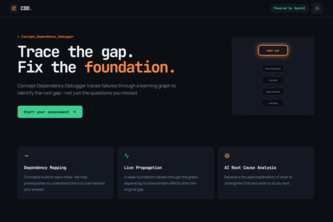
The author describes a diagnostic tool called Concept Dependency Debugger (CDD) that uses concept dependency graphs to trace root causes of student learning failures in STEM subjects. It is built as a web application using React, Node.js, and GPT-OSS-120b for explanation generation.
What changed
This is a self-reported project submitted to the OpenAI 2026 hackathon. No prior version or evolution is described; it appears to be an initial prototype or proof-of-concept.
Single most important open question
Is there any evidence of real-world usage, adoption, or traction by students or educators? The description states no revenue, customers, or user data are available beyond the author’s account.
What The Product Actually Is
The description states that CDD treats a subject as a dependency graph — for example, “Arrays → Linked Lists → Stacks & Queues → Trees → Graphs” — where each concept builds on previous ones. It uses a propagation engine to trace weaknesses upstream and adjusts scores accordingly.
It visualizes these dependencies using React Flow, and generates explanations via GPT-OSS-120b.
The system currently supports six subjects: Data Structures, Math, DBMS, Computer Networks, OOP, and Web Development.
Evidence
- The author describes how the product works.
- It uses a propagation engine that traces weaknesses up the dependency chain.
- It shows a live dependency graph with root cause visually distinguished from downstream effects.
- GPT-OSS-120b is used for generating explanations.
- The system supports six subjects.
Inference The tool is designed to help students identify foundational knowledge gaps rather than just surface-level test failures.
Positioning & Claim Evolution
The author claims that traditional tests only tell users what they got wrong, while CDD tells them why — tracing failures through a concept dependency graph to find the true root cause.
They also state that it diagnoses actual gaps, not symptoms, and provides transparency in its scoring adjustments.
Evidence
- “Most tests tell you what you got wrong. CDD tells you why.”
- “Our propagation engine traces weaknesses Upstream.”
- “The result is shown on a live dependency graph...with the root cause visually distinguished.”
Inference This positions CDD as a diagnostic tool for learning, not just an assessment platform.
Target Customer & ICP
The author states that CDD targets students who struggle with foundational concepts in STEM subjects. It is intended to help them understand where their understanding breaks down and how to improve.
It also mentions potential future expansion into teacher/educator views, implying a shift toward institutional or classroom use.
Evidence
- “Every student has felt this...”
- “We wanted to build something that diagnoses the actual gap, not just the symptom on top of it.”
- “What’s next for Concept Dependency Debugger: adding a faculty/teacher view for classroom-wide diagnostics”
Inference The primary ICP is likely individual learners or students in STEM education. Secondary may be educators or institutions looking to support student learning.
Business Model & Pricing Evidence
Not evidenced.
Evidence No mention of pricing, monetization strategy, or business model in the description.
Inference Given that this is a hackathon submission and no revenue data exists, it's unclear whether any commercial model has been developed or tested.
Technical & Delivery Signals
The project was built using:
- Frontend: React + Vite, TailwindCSS, React Flow
- Backend: Node.js + Express
- AI Layer: GPT-OSS-120b (used for explanation generation)
- Tools: Codex, OpenAI APIs, Groq, Google Fonts
It includes features like:
- Deterministic propagation engine
- Visual dependency graph with root cause highlighting
- Transparency panel showing raw vs adjusted scores
- Adaptive quiz mode planned
Evidence
- Tech stack listed in detail.
- Mention of specific tools used (e.g., Codex, React Flow).
- Description of how the AI layer functions separately from the core logic.
Inference The architecture suggests a web-based SaaS-like product with some AI integration and interactive UI components.
Traction & Maturity Signals
Not evidenced.
Evidence There is no mention of users, customers, usage metrics, or any form of traction beyond the author’s own account.
Inference This appears to be a prototype or proof-of-concept, not a mature product with real-world adoption.
Competitive Context
Not evidenced.
Evidence No information about competitors, market size, or competitive landscape is provided.
Inference The author does not reference existing tools in the educational diagnostics space, nor do they describe how CDD compares to them.
Open Questions & Risks
- Unproven commercial viability: No evidence of revenue, customers, or monetization.
- Limited scope: Only six subjects supported; unclear if this is scalable or generalizable.
- AI dependency risk: Reliance on GPT-OSS-120b for explanations may create opacity or inconsistency in outputs.
- Design complexity: The need to maintain functional UI elements (like color-coded nodes) independent of theme changes suggests technical challenges.
- Hackathon origin: This is a hackathon project, which often lacks long-term development plans or product-market fit validation.
Evidence
- No traction or revenue data.
- No mention of competitors or market positioning.
- The tool is described as a prototype built in one hackathon event.
Questions the description leaves open
- Has the propagation engine been validated with real student data?
- How does the system handle edge cases like students who skip multiple concepts?
- What are the plans for expanding to new subjects or domains beyond the current six?
- Are there any partnerships or pilot programs with schools or educational institutions?
- What is the long-term vision for monetization and scaling?
- Can you provide examples of how the system adjusts scores in practice?
Overall Assessment
Not evidenced.
Evidence There is no indication of funding, investor interest, or partnership discussions.
Inference This appears to be an early-stage idea or prototype with no clear path to investment or commercialization at this time. The lack of traction and business model makes it difficult to assess its viability for either investment or strategic partnership.
User Stories BotA demo video on every pull request
Get a demo video on every new feature
GitHub App that watches your pull requests and records a narrated, captioned demo.
Save time on demo prep and make informed decisions faster with a video walkthrough of every new feature.
Source
Submitted to the OpenAI 2026 hackathon on Devpost. Project home on Devpost. Back to the full gallery on Devpost.
This competitive analysis was produced by top-founders.com (opens in a new tab)
Generated by a language model from this project's public Devpost page — its tagline, the author's own write-up and any built-with tags listed there — as captured in August 2026. Short quotations are the author's words. It is an opinion on the idea as a business, not on the people behind it, and it reflects the description as published then. If the project has moved on, request a correction below. The analysis is not independent research and contains no verified traction, revenue or customer data.
An independent guide by KFG International LLC — not affiliated with, endorsed by, or connected to Devpost or OpenAI.