

Archive position — measured, not model output
0 likes on Devpost
2,263 of the 7,850 archived projects have more likes, and 5,587 share exactly 0 — so this project's #3,465 place in the like-ranked listing is a tie-break inside that group, not a ranking.
Projects (log scale)
Likes on Devpost. ▲ marks this project's group.
Show the figures
| Likes | Projects | Share of archive |
|---|---|---|
| 0 | 5,587 | 71.2% |
| 1 | 1,758 | 22.4% |
| 2 | 284 | 3.6% |
| 3–4 | 132 | 1.7% |
| 5–9 | 75 | 1.0% |
| 10+ | 14 | 0.2% |
 User Stories BotA demo video on every pull request
Get a demo video on every new feature
GitHub App that watches your pull requests and records a narrated, captioned demo.
Save time on demo prep and make informed decisions faster with a video walkthrough of every new feature.
Executive Summary
What the company appears to be
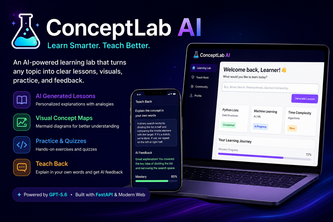
ConceptLab AI is a self-reported educational platform built as a lightweight web application using GPT-5.6, designed to guide learners through a structured learning cycle: Learn → Test → Teach Back → Share. It generates lessons with explanations, analogies, diagrams, experiments and quizzes, then evaluates learner explanations via a "Teach Back" mechanism. Learners can publish reusable community Learning Cards.
What changed
The author states that this is an MVP submitted to the OpenAI 2026 hackathon. The project does not appear to have moved beyond this stage or demonstrated any traction, revenue, or customer base.
Single most important open question
Is there evidence of a viable business model or path to monetization beyond the hackathon submission? The description contains no information about pricing, customers, or commercial viability.
What The Product Actually Is
The description states that ConceptLab AI is a lightweight web application built with FastAPI and vanilla HTML/CSS/JS. It uses GPT-5.6 for generating learning labs and evaluating learner explanations through Teach Back. The platform includes:
- A concise explanation of a concept
- An intuitive analogy
- A Mermaid concept diagram
- A safe Python experiment
- A short formative quiz
After completing the lesson, learners explain the concept in their own words. GPT-5.6 evaluates the explanation, identifies misconceptions, estimates mastery, and provides feedback. Learners can then publish a Learning Card to share with the community.
Evidence
- The author describes how it works step-by-step.
- It is built using FastAPI, JavaScript, Python, and OpenAI API.
- GPT-5.6 is used for lesson generation and Teach Back evaluation.
Inference The product appears to be a prototype or MVP focused on demonstrating an educational workflow rather than a production-ready tool.
Positioning & Claim Evolution
The author claims that most AI learning tools are good at explaining concepts but fail to assess true understanding. The solution is to use the Teach Back method, supported by GPT-5.6, to evaluate comprehension and encourage active learning.
The platform positions itself as an AI learning partner that supports a full learning cycle — from explanation to mastery demonstration to knowledge sharing — rather than just content generation.
Evidence
- The author explicitly states the inspiration behind the idea.
- The goal is described as building an AI platform that doesn't stop after producing content but guides learners through an entire process.
Inference This suggests a shift from passive consumption to active engagement in learning, which may appeal to educators or self-directed learners seeking feedback mechanisms.
Target Customer & ICP
The description does not identify specific target customers or personas. It implies that the platform is for learners who want to understand concepts deeply and demonstrate mastery through explanation.
It also mentions a community aspect where users can publish Learning Cards, suggesting potential use by educators, mentors, or learners in collaborative environments.
Evidence
- The author refers to teaching and mentoring as personal motivations.
- There's mention of community sharing and reuse of learning artifacts.
Inference The ICP likely includes individuals or groups interested in active learning, feedback-driven education, or those who value peer knowledge exchange. No explicit segmentation is provided.
Business Model & Pricing Evidence
There is no evidence of a business model or pricing strategy in the description. The author does not mention any monetization plans, subscriptions, or revenue streams.
Evidence
- No pricing information.
- No mention of paid features, user tiers, or commercial partnerships.
- The project was submitted to a hackathon and has no indication of being live or generating income.
Inference The platform is currently conceptualized as a prototype with no clear path to monetization. Any future business model would need to be inferred from the stated vision or roadmap.
Technical & Delivery Signals
The application is built using FastAPI, vanilla HTML/CSS/JS frontend, and integrates OpenAI's API via Python SDK. GPT-5.6 is used for core functionality including lesson generation and Teach Back evaluation.
Codex was used during development as an engineering assistant to review code, identify bugs, and improve integration.
Evidence
- Built with FastAPI, JavaScript, Python.
- Uses OpenAI API and GPT-5.6.
- Codex was used for code review and debugging.
Inference The technical stack is minimalistic and focused on rapid prototyping. The use of Codex indicates iterative development practices, but no production deployment or scalability signals are evident.
Traction & Maturity Signals
There is no evidence of traction, adoption, or user engagement beyond the hackathon submission. No customers, users, or usage metrics are mentioned.
Evidence
- The project is described as an MVP submitted to a hackathon.
- No mention of live users, feedback loops, or performance data.
- No revenue or funding information.
Inference The product has not progressed beyond the prototype stage and lacks any signs of real-world usage or market validation.
Competitive Context
The description does not provide any information about competitors or existing solutions in the educational AI space. It does not reference other platforms, tools, or methodologies used in education technology.
Evidence
- No mention of competing products.
- No comparison with existing learning platforms or AI tools.
Inference Without competitive context, it is unclear whether ConceptLab AI addresses a unique gap or overlaps with existing offerings. This makes assessing differentiation difficult.
Open Questions & Risks
Several key risks and open questions emerge from the lack of evidence:
- No commercial viability: No pricing model, revenue stream, or monetization strategy.
- No traction or user base: The project is described as an MVP with no indication of adoption or engagement.
- Unproven scalability: The platform is built on a lightweight stack and lacks any mention of infrastructure scaling or reliability features.
- Unclear differentiation: No clear competitive advantage or unique value proposition beyond the idea of Teach Back.
- Limited scope: The MVP focuses only on one learning loop; no roadmap for expanding functionality.
Evidence
- No mention of users, customers, or revenue.
- No indication of scalability or infrastructure planning.
- No discussion of how the platform would scale beyond a single developer’s prototype.
Inference The project is at a very early stage and lacks any evidence of commercial readiness or sustainable growth potential.
Questions the description leaves open
- What is your plan for monetization? Are you considering subscription models, enterprise licensing, or freemium options?
- How do you intend to validate the effectiveness of the Teach Back method in real-world learning scenarios?
- Have you considered how the platform will evolve beyond the MVP, particularly around user accounts, data persistence, and community features?
- What are your thoughts on integrating with existing LMS or educational platforms?
- How do you plan to ensure consistent AI outputs across different topics and learner inputs?
- Is there any interest from educators or institutions in piloting this tool?
Overall Assessment
Not evidenced.
The description provides no information about the company’s financials, traction, or investment history. There is no indication of a viable business model, revenue, or customer base beyond the hackathon submission.
This project appears to be an early-stage prototype with no evidence of commercial viability or strategic direction beyond its initial concept.
Confidence level Low — based solely on self-reported information without any external validation or data points.
User Stories BotA demo video on every pull request
Get a demo video on every new feature
GitHub App that watches your pull requests and records a narrated, captioned demo.
Save time on demo prep and make informed decisions faster with a video walkthrough of every new feature.
Source
Submitted to the OpenAI 2026 hackathon on Devpost. Project home on Devpost. Back to the full gallery on Devpost.
This competitive analysis was produced by top-founders.com (opens in a new tab)
Generated by a language model from this project's public Devpost page — its tagline, the author's own write-up and any built-with tags listed there — as captured in August 2026. Short quotations are the author's words. It is an opinion on the idea as a business, not on the people behind it, and it reflects the description as published then. If the project has moved on, request a correction below. The analysis is not independent research and contains no verified traction, revenue or customer data.
An independent guide by KFG International LLC — not affiliated with, endorsed by, or connected to Devpost or OpenAI.