

Archive position — measured, not model output
1 like on Devpost
505 of the 7,850 archived projects have more likes, and 1,758 share exactly 1 — so this project's #1,502 place in the like-ranked listing is a tie-break inside that group, not a ranking.
Projects (log scale)
Likes on Devpost. ▲ marks this project's group.
Show the figures
| Likes | Projects | Share of archive |
|---|---|---|
| 0 | 5,587 | 71.2% |
| 1 | 1,758 | 22.4% |
| 2 | 284 | 3.6% |
| 3–4 | 132 | 1.7% |
| 5–9 | 75 | 1.0% |
| 10+ | 14 | 0.2% |
 User Stories BotA demo video on every pull request
Get a demo video on every new feature
GitHub App that watches your pull requests and records a narrated, captioned demo.
Save time on demo prep and make informed decisions faster with a video walkthrough of every new feature.
Executive Summary
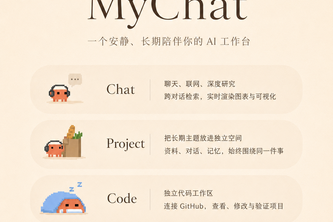
What the company appears to be: MyChat Code is a mobile-first AI programming platform that allows users to build and ship real software from a phone, without requiring a computer. The author states it enables people without regular access to a computer to use an AI coding agent in a browser-based environment, with isolated cloud sandboxes for execution.
What changed: The project was built during OpenAI Build Week, where the author used Codex and GPT-5.6 Sol to extend and harden the system into a more credible path from mobile intent to real software delivery. Prior to this, it existed as a working chat product with an early mobile Code workflow.
Single most important open question: Is there evidence of traction or adoption beyond the author's own development? The description contains no data on users, revenue, customers, or usage metrics — only self-reported claims about intent and architecture.
What The Product Actually Is
The description states that MyChat Code is a mobile-first AI workspace that gives people without regular access to a computer a practical AI programming experience. From a mobile browser, users can:
- Connect GitHub and choose an existing repository or describe a new project;
- Explain desired results in natural language;
- Let the agent inspect codebases, edit files, run commands and tests inside isolated cloud sandboxes;
- Follow durable progress even after switching apps, refreshing the page, or losing network temporarily;
- Review security-sensitive actions before they happen;
- Approve real commits, Pull Requests, or supported deployments.
It is not a remote desktop or a squeezed desktop IDE. The user expresses intent and makes important decisions; the cloud runtime performs the heavy work normally requiring a computer.
The system includes features like multimodal conversation, search, media generation, file processing, memory, Markdown/LaTeX rendering, and custom OpenAI-compatible model endpoints — but Code is its defining experience.
Evidence: Self-reported by author. No third-party verification or data on actual use.
Positioning & Claim Evolution
The author states that MyChat Code began with the question:
"Could someone go from an idea to tested, published software using only a phone, an internet connection, and their own judgment?"
This positions the product as solving a barrier to entry in programming — specifically, lack of access to a computer. It is not about replacing professional workstations but making the first meaningful steps of software creation accessible, especially for learners and creators who cannot afford or depend on having a laptop.
The author also notes that MyChat does not claim to replace every professional workstation; rather, it aims to make “a computer should be useful for programming” — not a price of admission.
Evidence: Self-reported. No evidence of market positioning beyond the author’s own narrative.
Target Customer & ICP
The description states that MyChat Code is designed for people whose primary device is a phone, especially:
- Learners
- Creators
- People who cannot afford a computer
- People who cannot depend on having one available
It does not claim to replace professional developers or full-time builders. Instead, it focuses on those with limited access to computing resources.
Evidence: Self-reported. No evidence of customer segmentation, personas, or actual user data.
Business Model & Pricing Evidence
There is no evidence in the description of a business model or pricing structure. The author does not mention monetization strategies, subscription tiers, usage-based billing, or any commercial framework.
The project appears to be a hackathon submission and/or personal development effort with no indication of how it would generate revenue.
Evidence: Not evidenced.
Technical & Delivery Signals
The system is built using:
- Frontend: Next.js 16, React 19, TypeScript
- Backend: Supabase (authentication, PostgreSQL data, Row Level Security), PostgreSQL schema
- Execution Environment: E2B sandboxes
- AI Integration: OpenAI API, Codex, GPT-5.6 Sol
- GitHub Integration: Source of truth for publishing changes
Key technical design decisions include:
- Durable state management across mobile interruptions
- Lease-based job coordination with fencing and checkpoints
- Isolated execution environments
- Security boundaries including path validation, scoped credentials, server-side ownership checks, private media validation
- Human confirmation at trust boundaries before consequential publication
The author emphasizes that the system handles fragile mobile connections by ensuring work continues safely even if a browser page disappears.
Evidence: Self-reported. No external verification or performance data.
Traction & Maturity Signals
There is no evidence of traction, adoption, or user engagement beyond the author’s own development. The description does not include:
- Customer numbers
- Revenue figures
- Usage metrics
- Product adoption rates
- Feedback from users or testers
The project was submitted to an OpenAI hackathon and appears to be a prototype or early-stage product.
Evidence: Not evidenced.
Competitive Context
There is no evidence in the description of competitive landscape analysis, including:
- Direct competitors
- Indirect substitutes
- Market positioning relative to other AI coding tools
- Differentiation from existing platforms like GitHub Copilot, Cursor, Replit, etc.
The author does not reference or compare against similar offerings.
Evidence: Not evidenced.
Open Questions & Risks
Several risks and open questions are implied by the self-reported nature of the description:
- No traction or validation: The product is described as a hackathon submission with no evidence of real-world usage.
- Unproven scalability: The architecture is described in detail, but there’s no indication of how it scales beyond one developer or prototype-level use.
- Security assumptions: While security features are mentioned (e.g., isolated execution, confirmation gates), no evidence exists that these have been tested or validated at scale.
- Dependency on AI models: Reliance on GPT-5.6 Sol and Codex implies potential dependency risks if those services change or become unavailable.
- Mobile-first assumption: The product assumes a mobile-first workflow, but there is no evidence of how well it performs in real-world conditions outside of controlled development.
Inference: These are risks based on the lack of evidence for performance, adoption, or scalability — not stated facts.
Questions the description leaves open
- What is the actual user base beyond the author?
- How does the system handle failures during execution in a mobile environment?
- Are there any known limitations or edge cases in sandboxed execution?
- Has the product been tested with real users who lack access to computers?
- What are the long-term plans for monetization and sustainability?
- How is the security model validated, especially around isolated execution and credential handling?
- Is there a plan to support more than one AI provider or model type?
Overall Assessment
Not evidenced.
There is no evidence of revenue, customers, traction, or commercial viability beyond the author’s own description. The project appears to be a hackathon submission or personal prototype with no indication of whether it has moved beyond concept stage into product-market fit or scalable operation.
The author states that the system was hardened during OpenAI Build Week but provides no data on performance, user feedback, or business outcomes.
Confidence Level: Low. The description is entirely self-reported and unverified, with no external validation or evidence of commercial progress.
User Stories BotA demo video on every pull request
Get a demo video on every new feature
GitHub App that watches your pull requests and records a narrated, captioned demo.
Save time on demo prep and make informed decisions faster with a video walkthrough of every new feature.
Source
Submitted to the OpenAI 2026 hackathon on Devpost. Project home on Devpost. Back to the full gallery on Devpost.
This competitive analysis was produced by top-founders.com (opens in a new tab)
Generated by a language model from this project's public Devpost page — its tagline, the author's own write-up and any built-with tags listed there — as captured in August 2026. Short quotations are the author's words. It is an opinion on the idea as a business, not on the people behind it, and it reflects the description as published then. If the project has moved on, request a correction below. The analysis is not independent research and contains no verified traction, revenue or customer data.
An independent guide by KFG International LLC — not affiliated with, endorsed by, or connected to Devpost or OpenAI.