

Archive position — measured, not model output
0 likes on Devpost
2,263 of the 7,850 archived projects have more likes, and 5,587 share exactly 0 — so this project's #5,340 place in the like-ranked listing is a tie-break inside that group, not a ranking.
Projects (log scale)
Likes on Devpost. ▲ marks this project's group.
Show the figures
| Likes | Projects | Share of archive |
|---|---|---|
| 0 | 5,587 | 71.2% |
| 1 | 1,758 | 22.4% |
| 2 | 284 | 3.6% |
| 3–4 | 132 | 1.7% |
| 5–9 | 75 | 1.0% |
| 10+ | 14 | 0.2% |
 User Stories BotA demo video on every pull request
Get a demo video on every new feature
GitHub App that watches your pull requests and records a narrated, captioned demo.
Save time on demo prep and make informed decisions faster with a video walkthrough of every new feature.
Executive Summary
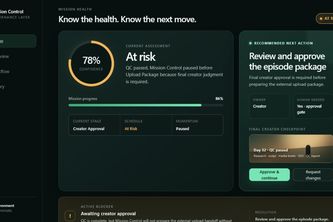
Mission Control is a self-reported workflow orchestration tool for AI-powered content creation, built as a hackathon project by one developer (Steph X). The system claims to govern multi-stage AI workflows with human checkpoints and traceable decision-making. It is described as a deterministic engine that manages execution across specialized roles, tools, and approvals — pausing at key points for human review before continuing.
The most important open question: What is the actual commercial viability of this approach? The project shows no evidence of traction, revenue, or customer adoption beyond its own demo. It is unclear whether the described governance model would scale or be adopted by creators or teams outside of a hackathon context.
This analysis is based entirely on self-reported information from the author’s submission to the OpenAI 2026 hackathon. No third-party verification, funding, or market data are available.
What The Product Actually Is
The description states that Mission Control is a system that turns one creator command into a governed, traceable workflow across specialized AI roles, tool adapters, and accountable human decisions.
It includes:
- A source-controlled contract defining stages, executors, dependencies, progress weights, approval policy, and artifacts.
- A deterministic engine that completes one eligible stage at a time, pauses after QC, and resumes only after approval.
- Browser persistence to preserve the approved mission after refresh.
- A responsive dashboard rendering engine state directly without a separate fake progress model.
It is built using:
- Codex
- GPT-5.6
- HTML, CSS, JavaScript
- Playwright
- LocalStorage
The system is described as pausing at 86% during QC and requiring human approval before proceeding to Upload Package, which then completes only after a decision is recorded.
Inference: The product appears to be a prototype workflow engine designed for AI content creation, with an emphasis on traceability and human control. It does not appear to integrate with external tools or APIs beyond its own deterministic adapters.
Positioning & Claim Evolution
The author claims that:
- AI can generate individual pieces of work, but coordination remains a problem.
- The missing layer is not another chatbot — it’s one place that knows the objective, owns the critical path, explains responsibility, remembers decisions, and keeps execution moving.
This positioning suggests an intent to solve workflow complexity in AI-assisted content creation by introducing structure, accountability, and human oversight.
The project evolved from a hackathon submission with a focus on:
- Deterministic adapters presented as inspectable contracts.
- Real approval boundaries (not decorative).
- A demo showing how the system pauses at QC and waits for human input before continuing.
Inference: The positioning is focused on governance and control in AI workflows, not on automation or tool integration. It positions itself as a solution to the lack of coordination in AI-generated content rather than a general-purpose workflow engine.
Target Customer & ICP
The description states that Mission Control is intended for creators who need to coordinate prompts, tools, failures, approvals, and handoffs — particularly those working with long-running AI workflows like YouTube video production.
It mentions:
- A “creator” as the end user.
- A workflow involving stages such as Research, Script, Devotional, Voice, Visual, Thumbnail, SEO, QC, and Upload Package.
- The system prepares a creator-controlled handoff, not an external publish.
Inference: The primary target is likely individual content creators or small teams who are already using AI tools for content creation but struggle with coordination and decision-making in multi-step workflows. It does not appear to be aimed at enterprise or large-scale teams.
Business Model & Pricing Evidence
There is no evidence of pricing, monetization strategy, or business model in the description.
The project is described as a hackathon submission with no mention of:
- Revenue streams
- Subscription models
- Licensing
- Paid features
- Customer acquisition plans
Inference: No commercial business model is evident from the self-reported description.
Technical & Delivery Signals
The system uses:
- Codex and GPT-5.6 for development and testing.
- HTML, CSS, JavaScript for frontend.
- Playwright for browser automation.
- LocalStorage for persistence.
- A deterministic engine with source-controlled contracts.
It includes:
- 12 deterministic tests
- Browser verification passes with zero console errors
- No mobile overflow issues
- A demo video showing the system in action
Inference: The project is a lightweight, frontend-heavy prototype built for demonstration purposes. It does not appear to be production-ready or scalable beyond its own demo.
Traction & Maturity Signals
There is no evidence of traction, adoption, or usage beyond the hackathon submission:
- No customers
- No revenue
- No user feedback
- No public deployment
- No growth metrics
The project is described as a demo for a hackathon with no indication of real-world use.
Inference: The system has not been tested in production or used by anyone outside its own author. It is at the prototype stage.
Competitive Context
There is no evidence of competitors or market positioning beyond the self-reported description.
The project does not reference:
- Similar tools
- Market analysis
- Competitive landscape
- Prior art
Inference: No competitive context is provided, making it difficult to assess how Mission Control would fit into existing AI workflow or content creation platforms.
Open Questions & Risks
Key risks and open questions include:
- The system is a hackathon prototype with no evidence of real-world use.
- It uses deterministic adapters, not live integrations — limiting its practicality.
- No pricing, monetization, or business model is described.
- The author is a single person (Steph X), suggesting limited team capacity.
- No third-party validation or user testing.
Inference: The project lacks commercial viability and scalability. It may not be suitable for real-world adoption without significant development and market validation.
Questions the description leaves open
- What is the actual use case you are solving for? Is this a problem that creators face today?
- How would this system scale to larger teams or more complex workflows?
- What are your plans for integrating with real AI tools (e.g., OpenAI, Midjourney)?
- Do you have any feedback from users beyond the demo?
- What is the long-term vision for this product? Is it a standalone tool or part of a larger platform?
- How do you plan to monetize this solution?
Overall Assessment
There is no evidence of traction, revenue, or customer adoption. The project is described as a hackathon demo with no indication of commercial viability or scalability.
Assessment: Not ready for investment or partnership at this stage. It is a prototype that shows potential in concept but lacks real-world validation, business model, or team capacity to move beyond the demo phase.
User Stories BotA demo video on every pull request
Get a demo video on every new feature
GitHub App that watches your pull requests and records a narrated, captioned demo.
Save time on demo prep and make informed decisions faster with a video walkthrough of every new feature.
Source
Submitted to the OpenAI 2026 hackathon on Devpost. Project home on Devpost. Back to the full gallery on Devpost.
This competitive analysis was produced by top-founders.com (opens in a new tab)
Generated by a language model from this project's public Devpost page — its tagline, the author's own write-up and any built-with tags listed there — as captured in August 2026. Short quotations are the author's words. It is an opinion on the idea as a business, not on the people behind it, and it reflects the description as published then. If the project has moved on, request a correction below. The analysis is not independent research and contains no verified traction, revenue or customer data.
An independent guide by KFG International LLC — not affiliated with, endorsed by, or connected to Devpost or OpenAI.