

Archive position — measured, not model output
0 likes on Devpost
2,263 of the 7,850 archived projects have more likes, and 5,587 share exactly 0 — so this project's #5,341 place in the like-ranked listing is a tie-break inside that group, not a ranking.
Projects (log scale)
Likes on Devpost. ▲ marks this project's group.
Show the figures
| Likes | Projects | Share of archive |
|---|---|---|
| 0 | 5,587 | 71.2% |
| 1 | 1,758 | 22.4% |
| 2 | 284 | 3.6% |
| 3–4 | 132 | 1.7% |
| 5–9 | 75 | 1.0% |
| 10+ | 14 | 0.2% |
 User Stories BotA demo video on every pull request
Get a demo video on every new feature
GitHub App that watches your pull requests and records a narrated, captioned demo.
Save time on demo prep and make informed decisions faster with a video walkthrough of every new feature.
Executive Summary
What the company appears to be
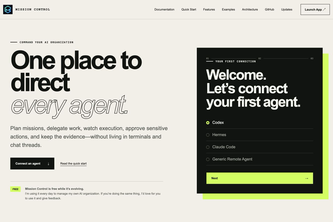
Mission Control is described as a command center for managing teams of AI agents. The author, Shawn Wollenberg, states that it allows users to give an objective to Mission Control and have it organize work among agents, track progress, review evidence, and intervene only when human judgment is required.
What changed
The project evolved from a personal hackathon experiment into a live application with public documentation, onboarding, and support for locally running agents. It now supports real-world use cases such as managing AI teams across multiple tools (e.g., Claude Code, Codex, Hermes) and includes features like event sourcing, mission planning, risk detection, and approval workflows.
Single most important open question
Is there a genuine market need for an executive layer that coordinates AI agent teams, or is this a solution in search of a problem?
Note: This analysis is based solely on the self-reported project description provided by the author. No external verification, traction data, revenue figures, or customer information are available.
What The Product Actually Is
The description states:
- Mission Control is a command center for managing teams of AI agents.
- It allows users to give an objective and see how the work is organized.
- It creates a mission plan, breaks objectives into tasks, tracks progress, surfaces risks, and pauses when human judgment is required.
- The system uses event sourcing, where every meaningful action is recorded as an event.
- It provides a single control plane to supervise agent activity while coordinating specialized agents.
Inferred:
- Mission Control functions as a mission management platform for AI teams.
- It is built using technologies like Next.js, React, TypeScript, and Hermes orchestration.
- It supports both local and remote agent execution, with a focus on transparency and auditability through event logs.
The product is described as a system that coordinates AI agents rather than being one itself.
Positioning & Claim Evolution
The author claims:
- Mission Control is designed to organize AI teams in the same way a human manager would organize engineers.
- It aims to provide visibility, accountability, and control over agent-driven workflows.
- The system is not about managing prompts but managing outcomes.
- It evolved from an idea of “managing agents like a team” to becoming a structured executive layer for AI organizations.
Inferred:
- The positioning has shifted from a personal productivity tool to a platform for organizing autonomous AI teams.
- The author frames it as a response to the growing complexity of managing multiple AI tools and agents simultaneously.
The evolution shows a move from a hackathon prototype to a more mature, structured system focused on coordination and governance.
Target Customer & ICP
The description states:
- The primary user is someone who works with multiple AI agents across different platforms (e.g., Claude Code, Codex, Hermes).
- It targets individuals or teams managing AI-driven projects, especially those working in developer tooling, DeFi, or business automation.
- The author identifies himself as a former engineering team leader and current solo operator managing multiple tools.
Inferred:
- The ICP likely includes technical founders, solo operators, and small teams who are building AI-powered systems but lack centralized oversight.
- Potential users may include AI product builders, DeFi developers, or automation engineers who want to manage complex agent workflows without manual coordination.
No explicit customer list or segmentation is provided. The target audience appears to be self-defined by the author.
Business Model & Pricing Evidence
Not evidenced.
The description does not mention:
- Any pricing model
- Revenue streams
- Monetization strategy
- Subscription tiers or usage-based billing
There is no evidence of a business model or pricing structure in the provided description.
Technical & Delivery Signals
The description states:
- Built with Next.js 16, React 19, TypeScript
- Uses canonical event sourcing and durable append-only event storage
- Implements projection-based UI architecture
- Integrates with Hermes orchestration, Codex-powered workflows
- Supports local agent execution
- Designed to be trustworthy, avoiding simulated results or misleading interfaces
Inferred:
- The architecture emphasizes reliability, auditability, and deterministic state.
- It is built for scalability across agents and workflows.
- The system prioritizes transparency over polish, ensuring that users can verify what happened.
The technical stack suggests a focus on robustness and traceability rather than speed or aesthetics.
Traction & Maturity Signals
The description states:
- Mission Control started as a hackathon demo and has since grown into a live application.
- It includes public documentation, guided onboarding, and personal workspaces.
- A developer can create an account, connect an agent, launch a mission, and supervise progress through a single control plane.
Inferred:
- The product is in a beta or early-stage release.
- There is evidence of user-facing features and basic adoption (e.g., personal workspaces).
- It has moved beyond prototype to a functional tool used by the author and potentially others.
No data on user base, retention, or revenue is available.
Competitive Context
Not evidenced.
The description does not:
- Mention competitors
- Describe existing solutions in the market
- Compare Mission Control to other tools or platforms
There is no competitive landscape described. The author does not reference similar products or markets.
Open Questions & Risks
Inferred risks and open questions:
- Lack of external validation: No third-party users, customers, or revenue data.
- Highly personal use case: The product seems tailored to one individual’s workflow rather than a broader market need.
- Unclear scalability: While it supports local agents, there is no evidence of integration with enterprise systems or large-scale deployment.
- Unproven demand: The author states he is “planning on continuing this process,” suggesting the product may not yet have traction or proven utility beyond personal use.
The lack of measurable outcomes or market validation raises questions about commercial viability.
Questions the description leaves open
- What specific problems do you observe in managing AI agent teams today, and how does Mission Control solve them?
- How many users are currently using the platform, and what feedback have they given?
- Are there any partnerships or integrations with existing AI agents or platforms (e.g., Hermes, Codex)?
- What is your monetization strategy, and when do you expect to generate revenue?
- How do you plan to scale beyond a single developer’s use case?
- Can you demonstrate how Mission Control handles real-world mission failures or misalignments between agents?
These questions aim to uncover whether the product addresses a real market need and has potential for growth.
Overall Assessment
Not evidenced.
The description does not provide:
- Financials
- Revenue or ARR
- Funding history
- Market size or TAM
- Strategic fit for investors or partners
Without any commercial data, no investment or partnership assessment can be made. The product appears to be in an early stage with limited evidence of traction or scalability.
User Stories BotA demo video on every pull request
Get a demo video on every new feature
GitHub App that watches your pull requests and records a narrated, captioned demo.
Save time on demo prep and make informed decisions faster with a video walkthrough of every new feature.
Source
Submitted to the OpenAI 2026 hackathon on Devpost. Project home on Devpost. Back to the full gallery on Devpost.
This competitive analysis was produced by top-founders.com (opens in a new tab)
Generated by a language model from this project's public Devpost page — its tagline, the author's own write-up and any built-with tags listed there — as captured in August 2026. Short quotations are the author's words. It is an opinion on the idea as a business, not on the people behind it, and it reflects the description as published then. If the project has moved on, request a correction below. The analysis is not independent research and contains no verified traction, revenue or customer data.
An independent guide by KFG International LLC — not affiliated with, endorsed by, or connected to Devpost or OpenAI.