

Archive position — measured, not model output
0 likes on Devpost
2,263 of the 7,850 archived projects have more likes, and 5,587 share exactly 0 — so this project's #5,342 place in the like-ranked listing is a tie-break inside that group, not a ranking.
Projects (log scale)
Likes on Devpost. ▲ marks this project's group.
Show the figures
| Likes | Projects | Share of archive |
|---|---|---|
| 0 | 5,587 | 71.2% |
| 1 | 1,758 | 22.4% |
| 2 | 284 | 3.6% |
| 3–4 | 132 | 1.7% |
| 5–9 | 75 | 1.0% |
| 10+ | 14 | 0.2% |
 User Stories BotA demo video on every pull request
Get a demo video on every new feature
GitHub App that watches your pull requests and records a narrated, captioned demo.
Save time on demo prep and make informed decisions faster with a video walkthrough of every new feature.
Executive Summary
What the company appears to be
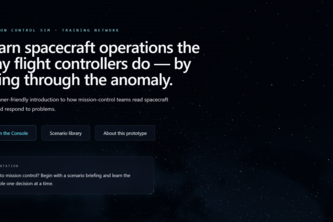
Mission Control Sim is a browser-based educational prototype that introduces beginners to basic spacecraft mission-control concepts through simplified telemetry, guided scenarios, and decision-based learning. It was built as part of a hackathon project by a single developer (Void Monk) with no verified revenue, customers, or traction.
What changed
The author states this is an early educational prototype, not a commercial product. It emerged from prior work on a lab simulation and was adapted for spacecraft mission control within a short timeframe. The project does not claim to be a professional training tool but rather an accessible first step into technical education.
Single most important open question
Is there evidence of intent or capability to evolve this prototype into a scalable, educational platform with broader reach or monetization potential?
What The Product Actually Is
The description states that Mission Control Sim is a browser-based educational web prototype. It allows users to:
- Monitor simplified spacecraft telemetry (power, thermal, attitude, communications)
- Identify abnormal telemetry conditions
- Respond to simulated mission anomalies
- Make operational decisions
- Observe how those decisions affect system conditions
- Follow structured recovery guidance
- Review decisions and consequences through a mission debrief
It is described as an interactive, scenario-based simulation designed for beginners. The goal is not to replace real-world mission control but to provide an approachable first experience in monitoring systems, recognizing anomalies, and learning from consequences.
The prototype uses technologies like React, TypeScript, Three.js, Tailwind CSS, and Vite, and was built using AI tools such as OpenAI Codex and GPT-5.6 for development support.
Inference This is a proof-of-concept simulation intended to teach foundational concepts in spacecraft operations through hands-on interaction. It lacks full fidelity or realism but aims to be accessible to users without prior access to real-world environments.
Positioning & Claim Evolution
The author positions Mission Control Sim as an educational prototype aimed at making high-end scientific and technical fields more accessible to people who lack institutional or physical access. The project is framed as a response to personal barriers in accessing advanced research environments.
Key claims from the description:
- It provides an approachable first experience of mission control reasoning.
- It avoids pretending to be a professional training tool.
- It focuses on teaching core skills like telemetry monitoring, anomaly detection, and decision-making.
- It uses AI-assisted development to iterate quickly within time constraints.
Inference The positioning is centered around accessibility and democratization of technical education. The project does not claim to be a replacement for real-world training or a commercial product — it's an early-stage experiment in educational simulation design.
Target Customer & ICP
The description states that the target audience includes beginners who want to explore spacecraft mission control concepts but do not have access to real facilities. The author notes they themselves come from a village and had limited access to advanced research labs, suggesting a focus on underserved learners or self-taught individuals.
There is no explicit mention of specific customer segments beyond "beginners" or "educators." No indication of institutional buyers, schools, or formal learning platforms are referenced.
Inference The ICP appears to be self-directed learners, particularly those from non-traditional educational backgrounds who seek exposure to complex technical domains. There is no evidence of a defined market segment beyond this general category.
Business Model & Pricing Evidence
There is no evidence in the description of any business model or pricing structure. The project is described as an educational prototype, not a commercial offering. No mention of monetization, licensing, subscriptions, or paid features is present.
Inference The project is currently non-commercial and likely intended for personal or educational use only. There is no indication that it has moved beyond the prototype stage toward a revenue-generating model.
Technical & Delivery Signals
The prototype was built using:
- Frontend stack: React, TypeScript, Tailwind CSS, Three.js, Vite
- Development tools: OpenAI Codex, GPT-5.6
- Implementation approach: Iterative process involving research, planning, coding, testing, auditing, and refinement
The author notes that the project was developed under tight time constraints (halfway through a hackathon) and that domain knowledge in spacecraft operations was limited. As a result, the simulation focuses on simplified telemetry behavior and authored scenarios, rather than physics-accurate or full-fidelity models.
Inference The technical delivery reflects a rapid prototyping approach using AI-assisted development. The project is clearly experimental and not intended for production-level use or scalability.
Traction & Maturity Signals
There is no evidence of traction, customers, or adoption beyond the author’s own account. The project is described as an early prototype, built in a single hackathon event, with no mention of user feedback, usage metrics, or engagement data.
The author explicitly states that it is not a professional training tool and does not attempt to implement full orbital mechanics or realistic spacecraft dynamics.
Inference This is a very early-stage project with no demonstrated traction. It has not progressed beyond the prototype phase and lacks any evidence of market validation or user engagement.
Competitive Context
There is no evidence of competitors in the description. The author does not reference existing educational simulations, mission control training platforms, or similar tools. The focus is on creating a new type of accessible simulation for specialized fields, rather than competing with established players.
The project appears to be unique in its approach to combining AI-assisted development with educational simulation design for niche technical domains.
Inference No competitive landscape is described. This may indicate either a lack of awareness of existing tools or that the author is targeting an underserved niche where few direct competitors exist.
Open Questions & Risks
- Lack of domain expertise: The prototype avoids deep technical accuracy due to limited knowledge in spacecraft operations.
- No commercial viability: No evidence of monetization, business model, or scalability plans.
- Single-person development: The entire project was built by one individual (Void Monk), raising questions about future growth and maintenance.
- Prototype-only status: No indication that the project will evolve beyond its current form.
- AI dependency: Heavy reliance on AI tools for implementation raises concerns about long-term sustainability and reproducibility.
Inference The project is highly experimental, lacks commercial ambition, and depends on a single developer. It may not be suitable for investment or partnership unless there is a clear path to maturation and expansion.
Questions the description leaves open
- What are the key educational outcomes you expect from users of this simulation?
- Are there any plans to expand beyond spacecraft mission control into other technical domains?
- How do you intend to validate or improve the accuracy of the telemetry and scenario logic?
- Is there a plan to engage with educators, institutions, or subject matter experts for feedback?
- What would constitute a successful evolution from prototype to product?
- Do you have any interest in partnering with educational organizations or platforms?
Overall Assessment
The project is an early-stage educational prototype with no evidence of traction, revenue, or commercial intent. It was built by one person using AI tools and is not positioned as a commercial product.
There is no basis for investment or partnership at this stage. The project shows potential in terms of accessibility and innovation but lacks the maturity, scalability, or business model to justify further due diligence or financial commitment.
Inference This is an experimental idea with possible future value, but it is not ready for commercialization or strategic investment. It would require significant development, domain validation, and a clear path to monetization before becoming viable.
User Stories BotA demo video on every pull request
Get a demo video on every new feature
GitHub App that watches your pull requests and records a narrated, captioned demo.
Save time on demo prep and make informed decisions faster with a video walkthrough of every new feature.
Source
Submitted to the OpenAI 2026 hackathon on Devpost. Project home on Devpost. Back to the full gallery on Devpost.
This competitive analysis was produced by top-founders.com (opens in a new tab)
Generated by a language model from this project's public Devpost page — its tagline, the author's own write-up and any built-with tags listed there — as captured in August 2026. Short quotations are the author's words. It is an opinion on the idea as a business, not on the people behind it, and it reflects the description as published then. If the project has moved on, request a correction below. The analysis is not independent research and contains no verified traction, revenue or customer data.
An independent guide by KFG International LLC — not affiliated with, endorsed by, or connected to Devpost or OpenAI.