

Archive position — measured, not model output
0 likes on Devpost
2,263 of the 7,850 archived projects have more likes, and 5,587 share exactly 0 — so this project's #7,305 place in the like-ranked listing is a tie-break inside that group, not a ranking.
Projects (log scale)
Likes on Devpost. ▲ marks this project's group.
Show the figures
| Likes | Projects | Share of archive |
|---|---|---|
| 0 | 5,587 | 71.2% |
| 1 | 1,758 | 22.4% |
| 2 | 284 | 3.6% |
| 3–4 | 132 | 1.7% |
| 5–9 | 75 | 1.0% |
| 10+ | 14 | 0.2% |
 User Stories BotA demo video on every pull request
Get a demo video on every new feature
GitHub App that watches your pull requests and records a narrated, captioned demo.
Save time on demo prep and make informed decisions faster with a video walkthrough of every new feature.
Executive Summary
What the company appears to be
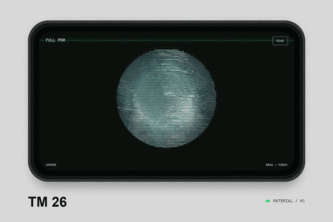
TM 26 is a self-reported mobile-first app that enables visual creators to capture real-world textures via smartphone camera and convert them into 3D PBR materials, 2D vector patterns, and digital brushes — all processed locally on device. The project was built as a hackathon submission by one person (Xi Ling), using vanilla web technologies and AI tools for design and code generation.
What changed
The author describes TM 26 as an experiment in tactile mobile interface design, inspired by physical instruments like synthesizers and industrial design principles from Dieter Rams. It is positioned as a tool that bridges the gap between real-world texture and digital creative workflows.
Single most important open question
Is there evidence of traction or commercial viability beyond this single-person hackathon prototype?
What The Product Actually Is
The description states that TM 26 is a mobile-first material digitization app. It allows users to point their smartphone camera at any surface and generate:
- 3D PBR assets (Albedo, Depth, Gloss channels)
- 2D vector patterns (SVG)
- Code & brushes for Procreate and Photoshop
The app processes these inputs locally, using:
- Three.js for 3D rendering
- WebRTC for camera capture
- HTML5 Canvas for image luminance filtering
It uses AI tools like GPT-5.6, Codex, and Cursor to assist in product architecture and implementation.
Inference The app is described as a lightweight frontend application with no backend or third-party dependencies.
Positioning & Claim Evolution
The author positions TM 26 as:
“A smartphone tool that feels like a precise, physical instrument—a synthesizer, but for real-world textures.”
This suggests an emphasis on tactile UX, physicality of interaction, and creative empowerment through mobile hardware.
It also claims to be:
“Inspired by classic, tactile industrial equipment from designers like Dieter Rams and playful instruments from Teenage Engineering.”
These references imply a design philosophy focused on aesthetic minimalism, ergonomics, and user-centered physical interaction.
There is no indication of prior positioning or evolution beyond this single prototype. The description does not mention any previous versions, product iterations, or market feedback loops.
Target Customer & ICP
The author states that TM 26 targets:
- Digital artists
- 3D creators
- Designers
These are described as users who want to capture inspiration directly from the physical world and turn it into usable digital assets.
No further segmentation or persona details are provided. The description does not indicate whether this is a B2C or B2B offering, nor does it describe specific buyer personas beyond general creative professionals.
Business Model & Pricing Evidence
There is no evidence of any business model or pricing strategy in the description.
The project is presented as a hackathon prototype with no mention of monetization, licensing, subscriptions, or sales channels.
Technical & Delivery Signals
The app is built using:
- Vanilla HTML5, CSS3, JavaScript
- Three.js via CDN for 3D rendering
- WebRTC MediaDevices API for camera access
- Local image processing via HTML5 Canvas
- AI tools (GPT-5.6, Codex, Cursor) for design and code generation
Key technical challenges mentioned include:
- 3D sphere clipping and texture seams
- Cross-material evaluation for consistent depth fields
- High-density mobile layout constraints
- AI model instability during development
The author notes that the prototype achieved low-latency local image conversion, which they consider a major accomplishment.
Inference The app is designed to run entirely in-browser with no server-side processing, suggesting a lightweight, self-contained delivery mechanism.
Traction & Maturity Signals
There is no evidence of traction or maturity beyond the hackathon submission. No customer data, usage metrics, revenue figures, or adoption indicators are provided.
The project is explicitly described as:
“a highly responsive, deeply tactile user experience that feels like a premium pocket gadget rather than a flat webpage.”
But this is an assertion about UX quality, not product traction or market validation.
Competitive Context
There is no evidence of competitive analysis or awareness of existing solutions in the space. The description does not reference competitors, similar tools, or market positioning relative to others.
The author focuses on their own design philosophy and technical execution rather than market context.
Open Questions & Risks
- Single-person development: The entire project was built by one individual (Xi Ling), raising questions about scalability, long-term maintenance, and team capacity.
- Prototype-only status: No public launch, beta, or production-ready version is mentioned. All evidence points to a hackathon prototype.
- Unverified claims: The author makes strong assertions about UX quality and performance without independent verification.
- AI dependency: Heavy reliance on AI tools like GPT-5.6 and Codex introduces risks related to instability, regressions, and lack of control over output consistency.
- No monetization strategy: No indication of how the product would generate revenue or sustain itself commercially.
Questions the description leaves open
- What is the current status of TM 26 beyond the hackathon prototype? Is there a working beta or public release?
- How does the app handle different lighting conditions and surface types in real-world usage?
- Are there plans to expand beyond mobile-first, such as desktop or web-based versions?
- Has the team considered how to monetize this tool, if at all?
- What are the limitations of local processing on older devices or under constrained hardware?
- How was the AI integration managed during development? Was it stable enough for iterative builds?
Overall Assessment
Not evidenced.
There is no evidence of revenue, customers, traction, or commercial viability beyond a single-person hackathon prototype.
The project is described as a creative experiment in mobile UX and texture digitization, but lacks any indication of market readiness, scalability, or business model.
Given the absence of financials, customer data, or product-market fit signals, this is not a viable candidate for investment or partnership at this stage. Any commercial potential remains speculative and unproven.
User Stories BotA demo video on every pull request
Get a demo video on every new feature
GitHub App that watches your pull requests and records a narrated, captioned demo.
Save time on demo prep and make informed decisions faster with a video walkthrough of every new feature.
Source
Submitted to the OpenAI 2026 hackathon on Devpost. Project home on Devpost. Back to the full gallery on Devpost.
This competitive analysis was produced by top-founders.com (opens in a new tab)
Generated by a language model from this project's public Devpost page — its tagline, the author's own write-up and any built-with tags listed there — as captured in August 2026. Short quotations are the author's words. It is an opinion on the idea as a business, not on the people behind it, and it reflects the description as published then. If the project has moved on, request a correction below. The analysis is not independent research and contains no verified traction, revenue or customer data.
An independent guide by KFG International LLC — not affiliated with, endorsed by, or connected to Devpost or OpenAI.