

Archive position — measured, not model output
0 likes on Devpost
2,263 of the 7,850 archived projects have more likes, and 5,587 share exactly 0 — so this project's #3,381 place in the like-ranked listing is a tie-break inside that group, not a ranking.
Projects (log scale)
Likes on Devpost. ▲ marks this project's group.
Show the figures
| Likes | Projects | Share of archive |
|---|---|---|
| 0 | 5,587 | 71.2% |
| 1 | 1,758 | 22.4% |
| 2 | 284 | 3.6% |
| 3–4 | 132 | 1.7% |
| 5–9 | 75 | 1.0% |
| 10+ | 14 | 0.2% |
 User Stories BotA demo video on every pull request
Get a demo video on every new feature
GitHub App that watches your pull requests and records a narrated, captioned demo.
Save time on demo prep and make informed decisions faster with a video walkthrough of every new feature.
Executive Summary
What the company appears to be
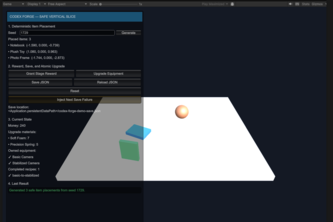
Codex Forge: Unity Production Toolkit is a self-reported project that describes itself as an AI-assisted development toolkit for Unity game engines. It claims to integrate Codex (presumably OpenAI's model) and other tools into a production workflow within a real, long-running Unity project. The author states it was built during the OpenAI Build Week hackathon.
What changed
The description indicates that this is an experimental extension of an existing stealth exploration game. It introduces systems for data-driven content generation, editor tools, validation workflows, and documentation using AI-assisted development practices. The author emphasizes a human-in-the-loop approach where AI generates code and documentation, but all final decisions remain under human control.
The single most important open question
Is there evidence of traction, revenue, or adoption beyond this one self-reported hackathon project? The description contains no data on customers, usage, monetization, or product-market fit beyond the author’s own account.
What The Product Actually Is
The description states that Codex Forge is a Unity production toolkit built using C# and Unity. It includes:
- Editor tools for inspecting scene objects and configuration issues
- Data-driven systems for item placement, equipment shops, loadout management
- Save-data migration, validation, rollback, and atomic transactions
- ScriptableObject catalogs for equipment, materials, recipes, sound effects
- GitHub PR workflows and verification guides
- In-stage investigation inventory and risk previews
It was developed during a hackathon event (OpenAI Build Week) as an extension of an existing first-person stealth exploration game.
Inference The product appears to be a set of tools designed to reduce manual work in Unity development by automating parts of the workflow using AI. However, there is no evidence that this has been used beyond one demonstration project.
Positioning & Claim Evolution
The author positions Codex Forge as an AI-powered engineering partner for Unity developers. It claims to transform repetitive tasks into structured, data-driven workflows and supports integration with GitHub PRs and documentation.
Key claims include:
- AI can be used not only for code generation but also as a practical engineering partner in real projects.
- The system enables a repeatable human-AI workflow involving natural-language design decisions, testing, feedback loops, and documentation.
- It reduces context switching between design, implementation, debugging, documentation, and source control.
Inference This positioning suggests that the author sees potential for scaling AI-assisted workflows in game development environments. However, no evidence exists of market traction or product adoption beyond this one project.
Target Customer & ICP
The description does not explicitly state who the target customer is. It implies a Unity developer working on long-running projects, particularly those involving:
- Solo developers
- Game studios with complex production pipelines
- Teams seeking to reduce manual labor in repetitive tasks
It also suggests use cases for:
- Data-driven content creation
- Editor tooling and validation
- Save-data management and rollback systems
Inference The ICP likely centers around Unity-based game developers who want to streamline their development process using AI. However, no evidence of actual users or customer segments is provided.
Business Model & Pricing Evidence
There is no evidence in the description of any business model or pricing strategy. The project is described as a hackathon submission and not as a commercial product.
Inference No information is available on whether this will be sold, licensed, or offered as a service. The author does not indicate plans for monetization or distribution beyond personal development.
Technical & Delivery Signals
The project was built using:
- Unity engine
- C#
- ScriptableObjects
- Editor windows and validators
- GitHub PR workflows
- GPT-5.6 and Codex (presumably OpenAI models)
- Anthropic Claude for limited support
Development process involved:
- Natural-language design decisions
- AI-generated code and documentation
- Manual testing in Unity
- Iterative feedback loops
- Commit history, pull requests, and verification documents
Inference The technical stack and delivery approach suggest a focus on AI-assisted development with strong human oversight, emphasizing traceability and safety. However, no evidence of scalability or production deployment beyond one hackathon project.
Traction & Maturity Signals
The description states that the project was built during a single hackathon event (OpenAI Build Week). There is no mention of:
- Revenue
- Customers
- Product adoption
- Market traction
- Post-hackathon development or commercialization
The author notes that this is an extension of an existing project and that the submission excludes proprietary content.
Inference The project shows no signs of traction or maturity beyond a prototype built in a short timeframe. No evidence of ongoing use, user feedback, or product evolution exists.
Competitive Context
The description does not provide any information about competitors or market positioning. It does not reference:
- Other AI-assisted development tools
- Unity plugin ecosystems
- Game development automation platforms
- Similar workflows in the industry
Inference Without competitive analysis, it is impossible to assess how Codex Forge fits into the broader landscape of AI-powered development tools.
Open Questions & Risks
Key risks and open questions based on the description:
- No traction or revenue: The project is described only as a hackathon submission with no evidence of adoption.
- Unproven scalability: There is no indication that this approach would scale beyond one developer working on one project.
- Limited scope: The demonstration excludes purchased assets and unreleased content, suggesting the full product may not be represented.
- No commercialization plan: No mention of monetization or market entry strategy.
- Dependency on AI tools: Reliance on specific models (e.g., GPT-5.6) raises concerns about availability and cost.
Inference The project is experimental and lacks any signs of commercial viability or product-market fit.
Questions the description leaves open
- What is the current status of the underlying game project? Is it still being developed?
- How many developers are currently using or planning to use Codex Forge?
- Are there any plans for monetization or commercial release?
- Has the AI-assisted workflow been tested with larger teams or more complex projects?
- What are the limitations of the current implementation, and how does the team plan to address them?
- How is data privacy handled in the AI workflows?
- Is there a roadmap for expanding beyond Unity or C#?
Overall Assessment
The description indicates that Codex Forge is an experimental hackathon project with no evidence of traction, revenue, or adoption. It is not yet a product or service, but rather a proof-of-concept built in a short timeframe.
Assessment Not ready for investment or partnership at this stage. The project lacks commercial viability and shows no signs of market demand or scalability beyond one developer’s experience. Further evidence of traction, user feedback, or product development would be required to assess potential value.
User Stories BotA demo video on every pull request
Get a demo video on every new feature
GitHub App that watches your pull requests and records a narrated, captioned demo.
Save time on demo prep and make informed decisions faster with a video walkthrough of every new feature.
Source
Submitted to the OpenAI 2026 hackathon on Devpost. Project home on Devpost. Back to the full gallery on Devpost.
This competitive analysis was produced by top-founders.com (opens in a new tab)
Generated by a language model from this project's public Devpost page — its tagline, the author's own write-up and any built-with tags listed there — as captured in August 2026. Short quotations are the author's words. It is an opinion on the idea as a business, not on the people behind it, and it reflects the description as published then. If the project has moved on, request a correction below. The analysis is not independent research and contains no verified traction, revenue or customer data.
An independent guide by KFG International LLC — not affiliated with, endorsed by, or connected to Devpost or OpenAI.