

Archive position — measured, not model output
0 likes on Devpost
2,263 of the 7,850 archived projects have more likes, and 5,587 share exactly 0 — so this project's #7,303 place in the like-ranked listing is a tie-break inside that group, not a ranking.
Projects (log scale)
Likes on Devpost. ▲ marks this project's group.
Show the figures
| Likes | Projects | Share of archive |
|---|---|---|
| 0 | 5,587 | 71.2% |
| 1 | 1,758 | 22.4% |
| 2 | 284 | 3.6% |
| 3–4 | 132 | 1.7% |
| 5–9 | 75 | 1.0% |
| 10+ | 14 | 0.2% |
 User Stories BotA demo video on every pull request
Get a demo video on every new feature
GitHub App that watches your pull requests and records a narrated, captioned demo.
Save time on demo prep and make informed decisions faster with a video walkthrough of every new feature.
Executive Summary
What the company appears to be
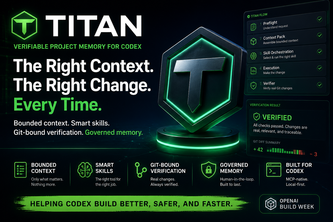
Titan is a self-reported local-first project-memory and verification layer for Codex, built during OpenAI Build Week. The author states it compiles bounded context packs, selects implementation skills, verifies Git changes, and requires human review before durable knowledge is exported.
What changed
The description indicates a focus on solving scattered decision-making in long-running AI coding projects by introducing structured memory governance, skill orchestration, and verification workflows within Codex. It evolved from a personal problem into a tool for managing project context and change integrity.
Single most important open question
Is there evidence of real usage or integration with Codex beyond the author’s own testing? The description lacks any mention of external users, customers, or adoption — only internal validation during Build Week.
What The Product Actually Is
The description states that Titan is a local-first project-memory and verification layer for Codex. It includes:
- Bounded context compilation from project knowledge;
- Skill selection mechanisms;
- Obsidian vault import/export;
- Git-bound change observation and verification;
- Human review requirements before memory export;
- Auto Mode preflight and completion workflows.
It was built using:
- TypeScript and Node.js backend;
- SQLite persistence and full-text search;
- An MCP server with 18 global tools;
- Windows x64 portable installer bundled with Node.js.
The author describes Titan as a system that integrates into Codex sessions to provide context, verify changes, and govern memory — but does not indicate whether it is an extension, plugin, or standalone tool.
Inference Based on the tech stack and integration points (Codex hooks, Git, Obsidian), Titan likely operates as a middleware or agent within the Codex workflow rather than a full IDE or platform.
Positioning & Claim Evolution
The author positions Titan as a solution to problems arising in long-running AI coding projects where decisions become scattered across chats, notes, and code. The core claim is that:
- AI agents lack bounded memory;
- Important project constraints are forgotten;
- Changes may be reported without strong evidence;
- Durable knowledge can be rewritten without human oversight.
The evolution of the product appears to have started with a personal pain point and evolved into a structured tool for managing context, skill selection, and verification within Codex. The author emphasizes:
- Avoiding overclaiming by distinguishing between observed and claimed changes;
- Requiring human review before memory approval or export;
- Using deterministic testing and validation during Build Week.
Claim vs Fact
These are self-reported claims about intent and design — not evidence of traction, revenue, or customer adoption.
Target Customer & ICP
The description does not name specific customers or personas. However, it implies a target audience of:
- Developers working with AI coding agents like Codex;
- Teams managing long-running projects where context and change integrity matter;
- Users who rely on Obsidian or similar note-taking tools for project documentation.
The author notes that Titan supports three context scopes:
- Registered workspace — global memory plus project-specific Vault memory.
- Unregistered project — global skills plus bounded local inspection and Git evidence.
- No project detected — global context only.
This suggests a flexible ICP based on project complexity and integration needs.
Not evidenced No explicit customer segments, personas, or use cases beyond the author’s own workflow.
Business Model & Pricing Evidence
There is no mention of pricing, monetization strategy, or business model in the description. The author focuses entirely on technical implementation and validation during Build Week.
Not evidenced No indication of how Titan would be sold, licensed, or consumed commercially.
Technical & Delivery Signals
The project includes:
- TypeScript/Node.js backend;
- SQLite database with full-text search;
- MCP server with 18 global tools;
- Obsidian import/export capabilities;
- Git-bound verification logic;
- Codex integration hooks for preflight and completion checks;
- Windows x64 portable installer.
It also features:
- Deterministic test fixtures (e.g., 2,515-note stress fixture);
- Auto Mode activation with correlation between session IDs, turn IDs, context packs, and hook events;
- Mismatch detection between declared and observed Git changes;
- Zero automatic memory approval or export.
Inference The tool is designed for local execution and integrates deeply with Codex via hooks. It emphasizes traceability and verification over automation.
Traction & Maturity Signals
The description states that the final Build Week release includes:
- 402/402 backend tests passing;
- 18 global Titan MCP tools;
- 9 bounded public Atlas tools;
- Git mismatch detection;
- Auto Mode preflight and completion verification;
- A portable Windows installer tested with a clean temporary profile;
- Zero automatic memory approval or export.
It also mentions:
- Validation of Auto Mode through live demonstration;
- Preservation of failed trials instead of hiding them;
- Explicit warnings for mismatches rather than false passes.
However, there is no evidence of external adoption, user feedback, revenue, or market traction beyond the author’s own testing and submission to a hackathon.
Competitive Context
The description does not reference competitors directly. However, it implies alignment with:
- AI coding agents (e.g., Codex);
- Project memory systems;
- Context management tools;
- Git verification platforms;
- Developer tooling for knowledge governance.
Given the focus on bounded context and verification within AI workflows, Titan may compete with or complement tools in the AI agent orchestration, developer experience, and project documentation spaces.
Not evidenced No competitive landscape analysis, no mention of existing solutions, no differentiation from similar tools.
Open Questions & Risks
- No external validation or usage: The product is described only as a Build Week prototype with internal testing.
- Single-person team: The author states the team size is 1, raising questions about scalability and long-term maintenance.
- Limited commercialization strategy: No pricing, monetization, or go-to-market plan is evident.
- High technical complexity without proven adoption: While the architecture is detailed, there’s no evidence of real-world deployment or user feedback.
- Self-reported success metrics: All results are from internal testing and validation — not independent verification.
Questions the description leaves open
- What specific Codex workflows does Titan integrate with? How does it hook into the agent?
- Has Titan been tested in real-world scenarios beyond Build Week?
- Are there any users or early adopters who have provided feedback?
- What is the plan for scaling beyond a single developer’s use case?
- How does Titan handle conflicts between different sources of project knowledge (e.g., Git, Obsidian)?
- Is there an intention to commercialize this tool? If so, what is the business model?
- What are the limitations of Auto Mode in practice, and how often do mismatches occur?
Overall Assessment
The description presents Titan as a technical prototype built during OpenAI Build Week, focused on solving project memory and verification issues within Codex workflows. It is not evidenced to have traction, revenue, or customer adoption.
Confidence Level Low — based entirely on self-reported authorship and internal validation.
Assessment Titan shows promise as a concept for managing AI agent context and change integrity in developer workflows. However, due to the lack of external evidence, no commercial viability, or user feedback, it cannot be evaluated for investment or partnership potential at this time.
It may represent an interesting early-stage idea with room for development, but current evidence does not support any conclusion about its readiness for market entry or commercialization.
User Stories BotA demo video on every pull request
Get a demo video on every new feature
GitHub App that watches your pull requests and records a narrated, captioned demo.
Save time on demo prep and make informed decisions faster with a video walkthrough of every new feature.
Source
Submitted to the OpenAI 2026 hackathon on Devpost. Project home on Devpost. Back to the full gallery on Devpost.
This competitive analysis was produced by top-founders.com (opens in a new tab)
Generated by a language model from this project's public Devpost page — its tagline, the author's own write-up and any built-with tags listed there — as captured in August 2026. Short quotations are the author's words. It is an opinion on the idea as a business, not on the people behind it, and it reflects the description as published then. If the project has moved on, request a correction below. The analysis is not independent research and contains no verified traction, revenue or customer data.
An independent guide by KFG International LLC — not affiliated with, endorsed by, or connected to Devpost or OpenAI.