

Archive position — measured, not model output
0 likes on Devpost
2,263 of the 7,850 archived projects have more likes, and 5,587 share exactly 0 — so this project's #3,379 place in the like-ranked listing is a tie-break inside that group, not a ranking.
Projects (log scale)
Likes on Devpost. ▲ marks this project's group.
Show the figures
| Likes | Projects | Share of archive |
|---|---|---|
| 0 | 5,587 | 71.2% |
| 1 | 1,758 | 22.4% |
| 2 | 284 | 3.6% |
| 3–4 | 132 | 1.7% |
| 5–9 | 75 | 1.0% |
| 10+ | 14 | 0.2% |
 User Stories BotA demo video on every pull request
Get a demo video on every new feature
GitHub App that watches your pull requests and records a narrated, captioned demo.
Save time on demo prep and make informed decisions faster with a video walkthrough of every new feature.
Executive Summary
What the company appears to be
The project described is a self-contained workflow engine for designing and applying developer desktop themes in Codex, using local Chromium DevTools Protocol access. It is built by one individual (jiarong sun), who describes it as a "reversible workflow engine" that allows safe, modular personalization of the Codex environment without modifying the official app.
What changed
The author states that the project evolved from an initial idea for a cyberpunk cat-themed interface into a safer workflow engine for designing, applying, debugging and restoring Codex desktop themes. It is not described as having moved beyond prototype or production stages.
Single most important open question — the commercial due-diligence read
Is there evidence of traction, revenue, or adoption by users beyond the single developer who built it? The description contains no claims about customers, usage metrics, or monetization.
What The Product Actually Is
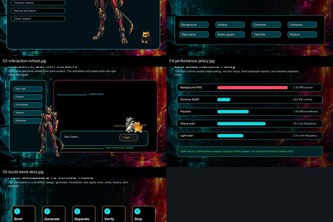
The description states that Codex Dream Skin Workflow Engine turns a visual brief into a structured, reversible Codex desktop theme. It includes:
- A cyberpunk cockpit-style background
- Original Image2-generated cyber-mecha cat character art
- A small orange hacker-cat sidebar badge
- Pet-inspired semantic UI icons
- Glass-style composer, sidebar, and right panel surfaces
- A collision retreat system so decorative characters move away from text and panels
- A manual table-flip cat animation that loads only when clicked
It is described as not just a static CSS skin but a modular workflow for safe developer-environment personalization.
The engine uses:
theme.jsonfor palette, assets, safe areas, characters, and module switchesruntime-modules.jsonfor module policy, payload groups, event policy, and budgetstheme.cssfor stable visual surfacesrenderer-inject.jsfor DOM markers, collision retreat, manual animation lifecycle, cleanup, and restoreinjector.mjsfor CDP discovery, content-hash caching, one-shot apply, verification, and screenshots
It is built around a local, reversible runtime architecture that does not modify the official Codex desktop app.
Claim
The product is a workflow engine for safe, modular theming in Codex.
Evidence Author's own description.
Positioning & Claim Evolution
The author states that the project started as a cyberpunk cat-themed interface idea, then evolved into a safer workflow engine for designing, applying, debugging, and restoring Codex desktop themes.
It is positioned as a solution to common problems in developer theming:
- Broken layouts
- Unreadable text
- Hidden controls
- High GPU usage
- Patching signed desktop apps
The project is described as not just generating a theme but using Codex and GPT-5.6 throughout the design and engineering loop, including for diagnostics, asset generation, refactoring, and regression checks.
Claim
The product evolved from a visual concept to a safe theming engine.
Evidence Author's own description.
Target Customer & ICP
The author states that developers spend long hours inside the same work surface and wanted to make Codex feel more personal and energizing, without sacrificing safety or performance.
It targets users of Codex, a desktop application for developers. The engine is designed to be used by those who want to personalize their developer environment in a safe, modular way.
Claim
The target customer is developers using Codex.
Evidence Author's own description.
Business Model & Pricing Evidence
There is no evidence of pricing or business model in the description. The project is described as a personal hackathon submission by one developer and does not mention any monetization, licensing, or commercial offering.
Claim
No pricing or business model is evident.
Evidence Not evidenced.
Technical & Delivery Signals
The project uses:
- Local Chromium DevTools Protocol access on 127.0.0.1
- Bash, JavaScript, Node.js, CSS, Electron, and other developer tools
- A modular runtime architecture with independent asset groups
- Runtime verification, performance gates, and clean restore path
- Asset caching and one-shot apply mechanisms
It avoids unnecessary runtime load by:
- Not resident backdrop blur or wallpaper layers
- Not idle animations
- Not resident injector daemons
The project is described as not patching the official app or modifying its core files.
Claim
The product uses a local, reversible runtime architecture with modular components.
Evidence Author's own description.
Traction & Maturity Signals
There is no evidence of traction, adoption, or user feedback beyond the author’s own account. The project is described as a hackathon submission and not as having moved into production or commercial use.
Claim
No traction or maturity signals are evident.
Evidence Not evidenced.
Competitive Context
The description does not mention any competitors or existing solutions in the developer theming space. It is unclear whether similar tools exist, nor how this project would compare to them.
Claim
No competitive context is provided.
Evidence Not evidenced.
Open Questions & Risks
- The product is described as a single-person hackathon submission with no evidence of traction or commercial viability.
- It does not modify the official Codex app, but it may be limited to local use or specific environments.
- No pricing, monetization, or business model is evident.
- The author uses GPT-5.6 in development, which raises questions about whether this is a prototype or a scalable solution.
Claim
Risks include lack of traction, no business model, and unproven scalability.
Evidence Inferred from description.
Questions the description leaves open
- What is the actual use case for this engine beyond personal development?
- Has anyone else used or tested this engine outside of the author’s own environment?
- Is there a plan to monetize or scale this product beyond the current prototype?
- How does it integrate with other developer tools or environments?
- Are there any technical limitations or dependencies that would prevent broader adoption?
Inference These questions are necessary due to lack of evidence on adoption, scalability, and commercialization.
Overall Assessment
There is no evidence of revenue, customers, or traction beyond the author’s own description. The project is described as a hackathon submission by one developer and does not indicate any commercial viability or market demand.
Claim
No investment or partnership case is evident.
Evidence Not evidenced.
User Stories BotA demo video on every pull request
Get a demo video on every new feature
GitHub App that watches your pull requests and records a narrated, captioned demo.
Save time on demo prep and make informed decisions faster with a video walkthrough of every new feature.
Source
Submitted to the OpenAI 2026 hackathon on Devpost. Project home on Devpost. Back to the full gallery on Devpost.
This competitive analysis was produced by top-founders.com (opens in a new tab)
Generated by a language model from this project's public Devpost page — its tagline, the author's own write-up and any built-with tags listed there — as captured in August 2026. Short quotations are the author's words. It is an opinion on the idea as a business, not on the people behind it, and it reflects the description as published then. If the project has moved on, request a correction below. The analysis is not independent research and contains no verified traction, revenue or customer data.
An independent guide by KFG International LLC — not affiliated with, endorsed by, or connected to Devpost or OpenAI.