

Archive position — measured, not model output
0 likes on Devpost
2,263 of the 7,850 archived projects have more likes, and 5,587 share exactly 0 — so this project's #3,380 place in the like-ranked listing is a tie-break inside that group, not a ranking.
Projects (log scale)
Likes on Devpost. ▲ marks this project's group.
Show the figures
| Likes | Projects | Share of archive |
|---|---|---|
| 0 | 5,587 | 71.2% |
| 1 | 1,758 | 22.4% |
| 2 | 284 | 3.6% |
| 3–4 | 132 | 1.7% |
| 5–9 | 75 | 1.0% |
| 10+ | 14 | 0.2% |
 User Stories BotA demo video on every pull request
Get a demo video on every new feature
GitHub App that watches your pull requests and records a narrated, captioned demo.
Save time on demo prep and make informed decisions faster with a video walkthrough of every new feature.
Executive Summary
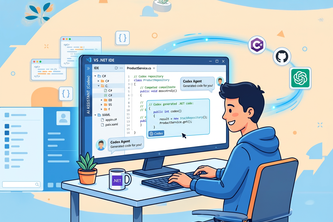
The company appears to be a single-person project, Codex for Visual Studio, an extension that integrates the Codex CLI app server into Microsoft’s Visual Studio IDE for .NET developers on Windows. The author states this as a response to the lack of native Codex integration in Visual Studio compared to other editors like VS Code. It is presented as a hackathon submission with no evidence of revenue, customers or traction.
What changed: The project was submitted to the OpenAI 2026 hackathon and describes itself as an extension that runs the Codex CLI inside Visual Studio, offering chat-based interaction and workspace context features. No commercial activity or product launch is evidenced.
The single most important open question: Is there any evidence of a working product beyond the author’s own development efforts? The description does not confirm whether this has been released to users or tested in real-world scenarios.
What The Product Actually Is
- The description states that Codex for Visual Studio is an extension for Visual Studio that runs the Codex CLI app server locally within the IDE.
- It surfaces Codex as a chat tool window, accessible via “View > Other Windows > Codex”.
- Features include:
- Streaming chat with reasoning blocks and virtualized transcript.
- Slash commands (e.g., /model, /reasoning, /review).
- Workspace context support including file mentions and attachments.
- Usage and limits panel showing freshness scoped to connection generation.
Inference: The product is described as a Visual Studio extension, not a standalone application or SaaS offering. It integrates with the local Codex CLI via an app-server protocol, but does not appear to be a commercial product yet.
Positioning & Claim Evolution
- The author claims that Codex CLI exists but lives in a terminal window next to Visual Studio, requiring alt-tabbing and context switching.
- They state that VS Code and other editors already had first-class agent integrations, while Visual Studio lacked such support for Codex.
- The project is positioned as a solution for .NET developers on Windows, aiming to reduce friction in using Codex within their primary IDE.
Inference: This is a developer tooling product, likely targeting enterprise or professional .NET developers who use Visual Studio. It is framed as filling a gap in the ecosystem, not as a new platform or service.
Target Customer & ICP
- The description states that the project targets .NET developers on Windows.
- It also mentions C++ and enterprise work, suggesting a focus on enterprise development teams using Visual Studio.
- The author notes that Visual Studio is still the daily driver for a huge amount of .NET, C++, and enterprise work.
Inference: The ICP appears to be professional developers working in enterprise environments, particularly those using Visual Studio for .NET/C++ projects. No evidence of specific customer segments or personas beyond this generalization.
Business Model & Pricing Evidence
- There is no evidence of pricing, monetization or business model.
- The project is described as a hackathon submission and not a commercial product.
- No mention of subscriptions, licensing fees, or usage-based models.
Inference: The business model is not evidenced, though the author implies it could be a developer tool extension with potential for monetization if released more broadly.
Technical & Delivery Signals
- The project is built using:
- .NET
- C#
- Codex CLI
- Visual Studio Extension (VSIX)
- It uses the OOP extension model, which the author notes is hard to implement.
- The build process is described as:
- Cloning a public repo
- Running
dotnet restoreanddotnet build
- Challenges mentioned include:
- Difficulty with OOP extension model
- Rendering in Visual Studio Extension panel
- Uncertainty about which Codex CLI version to use
Inference: The technical implementation is developer-focused, using standard .NET tooling. It suggests a low-level integration approach, but no evidence of scalability or production-ready delivery.
Traction & Maturity Signals
- The project was submitted to the OpenAI 2026 hackathon, indicating it is in early development.
- The team size is listed as 1 person (KAMEGAWA Kazushi).
- No evidence of:
- Customers
- Revenue
- Product adoption
- Market traction
- Public release or distribution
Inference: This is a pre-product, pre-commercial stage effort. There is no evidence of real-world usage or market validation.
Competitive Context
- The author states that VS Code and other editors already had first-class agent integrations, implying a competitive landscape where such tools are already available.
- Codex CLI itself is referenced as an existing tool, but not as a commercial product.
- No mention of direct competitors or market positioning against similar tools.
Inference: The project exists in a competitive space where AI agents and IDE integrations are already being offered. It is unclear whether it competes with or complements existing tools like VS Code extensions or Codex CLI itself.
Open Questions & Risks
- Single-person team: No evidence of scaling or support beyond one developer.
- Hackathon submission: No indication of commercial viability or long-term development plans.
- No public release or user feedback: The product is not yet available to users, and no real-world testing is evidenced.
- Technical limitations: The author notes challenges with OOP extension model and rendering — suggesting potential scalability issues.
- Lack of SDK support: The author states that a .NET SDK for Codex does not exist, which could hinder future development or adoption.
Inference: The project faces high risk of non-delivery, limited commercial viability, and dependence on external tooling (Codex CLI) without native SDK support.
Questions the description leaves open
- Is this extension currently available for download or use by developers?
- Have you tested it with real-world .NET/C++ projects, and what feedback have you received?
- What is the plan for supporting additional Codex features beyond the current scope?
- Are there any plans to release a commercial version or monetize this tool?
- How do you intend to address the lack of a .NET SDK for Codex?
Overall Assessment
- The project is not evidenced as a commercial product or offering.
- It is described as a hackathon submission, with no evidence of traction, revenue, or customer adoption.
- The author states that this is an early-stage effort to integrate Codex CLI into Visual Studio.
- No evidence suggests that the project has moved beyond prototype or developer testing.
Assessment: Not ready for investment or partnership consideration. The project lacks commercial viability, market validation, and product maturity. It is a pre-product concept, not a product in the market.
User Stories BotA demo video on every pull request
Get a demo video on every new feature
GitHub App that watches your pull requests and records a narrated, captioned demo.
Save time on demo prep and make informed decisions faster with a video walkthrough of every new feature.
Source
Submitted to the OpenAI 2026 hackathon on Devpost. Project home on Devpost. Back to the full gallery on Devpost.
This competitive analysis was produced by top-founders.com (opens in a new tab)
Generated by a language model from this project's public Devpost page — its tagline, the author's own write-up and any built-with tags listed there — as captured in August 2026. Short quotations are the author's words. It is an opinion on the idea as a business, not on the people behind it, and it reflects the description as published then. If the project has moved on, request a correction below. The analysis is not independent research and contains no verified traction, revenue or customer data.
An independent guide by KFG International LLC — not affiliated with, endorsed by, or connected to Devpost or OpenAI.