

Archive position — measured, not model output
0 likes on Devpost
2,263 of the 7,850 archived projects have more likes, and 5,587 share exactly 0 — so this project's #5,339 place in the like-ranked listing is a tie-break inside that group, not a ranking.
Projects (log scale)
Likes on Devpost. ▲ marks this project's group.
Show the figures
| Likes | Projects | Share of archive |
|---|---|---|
| 0 | 5,587 | 71.2% |
| 1 | 1,758 | 22.4% |
| 2 | 284 | 3.6% |
| 3–4 | 132 | 1.7% |
| 5–9 | 75 | 1.0% |
| 10+ | 14 | 0.2% |
 User Stories BotA demo video on every pull request
Get a demo video on every new feature
GitHub App that watches your pull requests and records a narrated, captioned demo.
Save time on demo prep and make informed decisions faster with a video walkthrough of every new feature.
Executive Summary
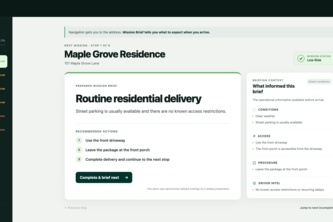
The company appears to be a solo developer project submitted to an OpenAI hackathon. The author describes Mission Brief as an AI-powered tool that generates operational briefings for field workers before they arrive at a destination, aiming to reduce surprises and improve efficiency by identifying risks, access issues, navigation challenges, and recommended actions.
The project is self-reported, unverified, and lacks any evidence of revenue, customers, or traction. It was built as a hackathon MVP using React, TypeScript, Vite, and OpenAI's GPT-5.6 and Codex tools. The author states the goal is to provide better information before arrival rather than just navigation.
The single most important open question
Is there any evidence of real-world adoption or product-market fit beyond this hackathon submission?
What The Product Actually Is
The description states that Mission Brief "generates a concise operational briefing that prepares workers before they reach a destination." It highlights:
- Operational risks
- Access considerations
- Navigation warnings
- Recommended actions
- Context-specific notes
It is described as an AI-generated briefing tool, not a navigation app or logistics platform.
Evidence The author's own write-up describes the product's functionality and outputs.
Inference This is a pre-arrival intelligence tool for field workers, likely intended to be integrated into existing workflows or platforms.
Positioning & Claim Evolution
The author states that Mission Brief was inspired by personal experience as a courier encountering "surprises" at job sites — such as missing gate codes, incorrect entrances, construction, and security procedures — which cause delays. The tool aims to solve this by providing AI-generated briefings before arrival.
Evidence The inspiration and problem statement are self-reported.
Inference The positioning evolved from a personal pain point (courier inefficiency) to a broader solution for field workers needing operational intelligence.
Target Customer & ICP
The description states that Mission Brief is intended for "field workers" who need better information before arrival at job sites. It does not specify which industries or roles within field work, nor does it define a specific ICP beyond "field workers."
Evidence The author mentions couriers as an example but does not elaborate on other potential users.
Inference The target customer is likely any worker who travels to locations where operational conditions can change unexpectedly — e.g., delivery drivers, service technicians, construction crews, etc.
Business Model & Pricing Evidence
Not evidenced. The description does not mention pricing, monetization strategy, or business model.
Evidence No information provided about how the product would be sold or who pays for it.
Technical & Delivery Signals
The project was built using:
- React
- TypeScript
- Vite
- GPT-5.6 (for concept refinement and UX decisions)
- Codex (for code generation, debugging, interface iteration)
It uses deterministic sample data to demonstrate the workflow and is described as an MVP.
Evidence The author's own write-up details the tech stack and development process.
Inference The tool is built with modern frontend technologies and leverages AI for both design and implementation. It is not production-ready but demonstrates a working prototype.
Traction & Maturity Signals
Not evidenced. There is no mention of users, customers, revenue, or product adoption beyond the hackathon submission.
Evidence The project is described as an MVP built in a hackathon environment with sample data.
Competitive Context
Not evidenced. No information about existing competitors or market landscape is provided.
Evidence The description does not reference other tools or platforms addressing similar needs for field workers' operational intelligence.
Open Questions & Risks
- Solo developer project: A single-person team raises questions about scalability, long-term maintenance, and execution capability.
- No traction or revenue: The product exists only as a hackathon MVP with no evidence of real-world usage or adoption.
- Unverified claims: All statements are self-reported and unverified; there is no third-party validation.
- Limited scope: The current version uses sample data and does not integrate with live systems or external APIs.
Inference Without real-world testing, user feedback, or product-market fit, the project may not translate into a viable commercial offering.
Questions the description leaves open
- What specific field worker roles are you targeting, and how did you identify those needs?
- Have you validated your concept with actual users beyond yourself?
- How do you plan to integrate live data (traffic, weather, etc.) into the briefings?
- What is your roadmap for moving from MVP to a scalable product?
- Are there any partnerships or integrations planned with logistics or mapping platforms?
Overall Assessment
Not evidenced. No financials, funding history, or investment interest are mentioned.
Evidence The project is described as a hackathon submission with no indication of commercial viability or investor interest.
Inference As a solo developer hackathon project with no traction, revenue, or customer base, it does not appear to be a viable investment or partnership opportunity at this stage.
User Stories BotA demo video on every pull request
Get a demo video on every new feature
GitHub App that watches your pull requests and records a narrated, captioned demo.
Save time on demo prep and make informed decisions faster with a video walkthrough of every new feature.
Source
Submitted to the OpenAI 2026 hackathon on Devpost. Project home on Devpost. Back to the full gallery on Devpost.
This competitive analysis was produced by top-founders.com (opens in a new tab)
Generated by a language model from this project's public Devpost page — its tagline, the author's own write-up and any built-with tags listed there — as captured in August 2026. Short quotations are the author's words. It is an opinion on the idea as a business, not on the people behind it, and it reflects the description as published then. If the project has moved on, request a correction below. The analysis is not independent research and contains no verified traction, revenue or customer data.
An independent guide by KFG International LLC — not affiliated with, endorsed by, or connected to Devpost or OpenAI.