

Archive position — measured, not model output
0 likes on Devpost
2,263 of the 7,850 archived projects have more likes, and 5,587 share exactly 0 — so this project's #7,302 place in the like-ranked listing is a tie-break inside that group, not a ranking.
Projects (log scale)
Likes on Devpost. ▲ marks this project's group.
Show the figures
| Likes | Projects | Share of archive |
|---|---|---|
| 0 | 5,587 | 71.2% |
| 1 | 1,758 | 22.4% |
| 2 | 284 | 3.6% |
| 3–4 | 132 | 1.7% |
| 5–9 | 75 | 1.0% |
| 10+ | 14 | 0.2% |
 User Stories BotA demo video on every pull request
Get a demo video on every new feature
GitHub App that watches your pull requests and records a narrated, captioned demo.
Save time on demo prep and make informed decisions faster with a video walkthrough of every new feature.
Executive Summary
What the company appears to be
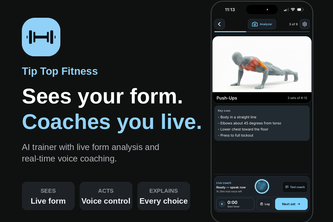
Tip Top Fitness is a self-reported AI personal trainer app built by a certified trainer who cannot code, using OpenAI Codex as its development tool. The app claims to offer live voice coaching, on-device pose tracking for form analysis, workout planning and adaptation, and safety handling—all without uploading raw video.
What changed
The project description indicates that this was an extension of pre-existing work (prior to Build Week) into a fully integrated, device-tested system. It connects previously separate features—such as AI coaching, form analysis, and workout programming—into one continuous loop: Plan. Coach. Analyze. Adapt.
The single most important open question
Is the author's claim that they built this with only Codex and no engineering team accurate? If so, how does that affect the scalability, maintainability, or long-term viability of the product?
Note: This analysis is based entirely on the self-reported description provided by the project author. No independent verification or third-party data exists for any aspect of Tip Top Fitness.
What The Product Actually Is
The description states that Tip Top Fitness is an AI personal trainer app designed to simulate a real coach through voice interaction, live form feedback, and adaptive workout programming. It includes:
- Native on-device pose tracking using VisionCamera and MediaPipe.
- Live two-way speech-to-speech coaching via OpenAI Realtime API over WebRTC.
- Workout planning adapted from NASM-OPT periodization principles.
- Safety mechanisms that respond to pain reports deterministically.
- A text-based coach as an alternative to voice.
- An “Analyzer” module for real-time form correction and rep counting.
The app is built natively for iOS (with Android support mentioned) using Expo, React Native, and various OpenAI tools including Codex.
Claim: The product integrates AI coaching with live video analysis and adaptive programming.
Evidence: Author describes how the system uses MediaPipe for pose detection, Codex for code generation, and OpenAI APIs for voice coaching and text explanations.
Inference: The app appears to be a hybrid of AI reasoning, deterministic action handling, and on-device perception.
Positioning & Claim Evolution
The author positions Tip Top Fitness as an alternative to generic fitness apps that feel like "content libraries with a chatbot stapled on." Instead, it aims to deliver a coaching brain that reasons like a trainer, using camera and voice as the interface for interaction.
Key claims include:
- It sees your form.
- Coaches you live by voice.
- Programs training like a real coach.
- Explains every decision.
- Adapts safely.
- Remembers athletes.
- Adds corrective work when needed.
- Works quietly too (text coach).
- Supports human coaching.
Claim: The app is positioned as a tool—not a replacement for certified trainers.
Evidence: The description explicitly says “Tip Top Fitness is positioned as a tool, not a replacement for a professional.”
Inference: This suggests the product is intended to complement rather than replace human coaches, possibly in a hybrid model.
Target Customer & ICP
The author identifies their target audience as:
- Post-injury or older adults.
- People who need someone watching their form and adjusting workouts mid-set.
- Individuals seeking personalized coaching without a live trainer.
They also note that most of their clients are those who don’t just want a workout list—they need explanation, safety, and continuity.
Claim: The primary customer is a certified trainer who cannot code but wants to build an AI-powered coaching tool.
Evidence: The author states they are a NASM-certified personal trainer and built the app by directing Codex.
Inference: This implies that while the end-user may be older adults or post-injury clients, the actual developer is a trainer with no technical background.
Business Model & Pricing Evidence
No explicit business model or pricing information is provided in the description. The author mentions:
- Subscription-based access via RevenueCat.
- A “Coach Check-In” feature where users can request paid calls with certified trainers.
- No mention of direct consumer pricing, freemium tiers, or monetization strategy beyond subscriptions and optional check-ins.
Claim: There is a subscription model supported by RevenueCat.
Evidence: Mentioned in the "How we built it" section as part of the backend infrastructure.
Inference: The app likely offers tiered access to features, but no details are given about pricing or revenue streams.
Technical & Delivery Signals
The system is described as:
- Built with Expo and React Native for iOS/Android.
- Uses VisionCamera and MediaPipe for on-device pose tracking.
- Employs OpenAI Realtime API for voice coaching.
- Runs full pose analysis locally without uploading raw video.
- Implements deterministic logic for actions, safety ladders, and navigation.
- Separates AI conversation from deterministic action handling.
Claim: The app runs pose detection fully on-device.
Evidence: “Native iOS beta is the primary judge experience...runs pose processing fully on-device.”
Inference: This suggests strong privacy controls and performance optimization.
Traction & Maturity Signals
The author reports:
- A public TestFlight beta available for judges without an account or access code.
- Multiple signed builds released during Build Week (iOS TestFlight build 74).
- Real-device testing and debugging cycles completed.
- Over 200 registered exercise demonstrations.
However, there is no evidence of:
- Revenue
- Customer base
- User engagement metrics
- Adoption data
- Product usage statistics
Claim: The app has shipped a public beta.
Evidence: “The native iOS beta is the primary judge experience and has been approved for external TestFlight testing.”
Inference: This indicates early-stage maturity, but no traction or user feedback data.
Competitive Context
No direct competitors are named in the description. However, the author contrasts Tip Top Fitness with generic fitness apps that feel like content libraries with chatbots.
Claim: The app aims to differentiate itself from traditional fitness apps.
Evidence: “Most fitness apps feel like content libraries with a chatbot stapled on.”
Inference: This suggests a niche market focused on personalized coaching and safety, rather than broad content delivery.
Open Questions & Risks
Several potential risks or open questions are implied:
- The author claims to have built the entire app alone using Codex—this raises questions about scalability, maintainability, and long-term viability.
- No evidence of revenue, customers, or product-market fit.
- The app relies heavily on AI for interaction; if the AI fails to understand context or misinterprets commands, it could lead to unsafe outcomes.
- Lack of clear monetization strategy beyond subscriptions and optional check-ins.
Claim: The author built the entire product alone using only Codex.
Evidence: “Throughout this writeup, ‘we’ means me and Codex—there is no team behind this.”
Inference: This raises concerns about sustainability, future development, and technical debt.
Questions the description leaves open
- How did you validate the accuracy of the AI coaching behavior during development?
- What specific safety rules or pain handling logic were implemented, and how are they tested?
- Can you explain how the deterministic action handling works in practice—especially around navigation and logging?
- Is there any plan to expand beyond iOS or add more advanced features like integration with wearables?
- How do you intend to scale beyond a single developer's capacity?
- What is your long-term vision for monetization beyond subscriptions and optional check-ins?
Overall Assessment
Not evidenced.
There is no evidence of revenue, customer traction, or financial performance. The project appears to be an early-stage prototype built by one person using AI tools, with limited commercial validation.
Claim: This is a prototype with no demonstrated traction.
Evidence: No mention of users, sales, or product-market fit.
Inference: While technically impressive, the lack of real-world usage makes it difficult to assess investment potential or partnership value.
User Stories BotA demo video on every pull request
Get a demo video on every new feature
GitHub App that watches your pull requests and records a narrated, captioned demo.
Save time on demo prep and make informed decisions faster with a video walkthrough of every new feature.
Source
Submitted to the OpenAI 2026 hackathon on Devpost. Project home on Devpost. Back to the full gallery on Devpost.
This competitive analysis was produced by top-founders.com (opens in a new tab)
Generated by a language model from this project's public Devpost page — its tagline, the author's own write-up and any built-with tags listed there — as captured in August 2026. Short quotations are the author's words. It is an opinion on the idea as a business, not on the people behind it, and it reflects the description as published then. If the project has moved on, request a correction below. The analysis is not independent research and contains no verified traction, revenue or customer data.
An independent guide by KFG International LLC — not affiliated with, endorsed by, or connected to Devpost or OpenAI.