

Archive position — measured, not model output
1 like on Devpost
505 of the 7,850 archived projects have more likes, and 1,758 share exactly 1 — so this project's #1,415 place in the like-ranked listing is a tie-break inside that group, not a ranking.
Projects (log scale)
Likes on Devpost. ▲ marks this project's group.
Show the figures
| Likes | Projects | Share of archive |
|---|---|---|
| 0 | 5,587 | 71.2% |
| 1 | 1,758 | 22.4% |
| 2 | 284 | 3.6% |
| 3–4 | 132 | 1.7% |
| 5–9 | 75 | 1.0% |
| 10+ | 14 | 0.2% |
 User Stories BotA demo video on every pull request
Get a demo video on every new feature
GitHub App that watches your pull requests and records a narrated, captioned demo.
Save time on demo prep and make informed decisions faster with a video walkthrough of every new feature.
Executive Summary
What the company appears to be
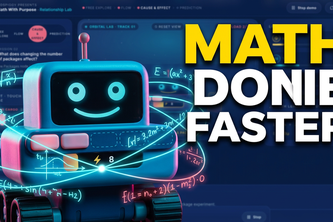
Math With Purpose is an interactive educational tool designed for children, built as a standalone React/TypeScript application. It presents mathematical relationships through a "delivery robot" world where learners manipulate one variable (number of packages) and observe how it affects energy consumption, trip time, and delivery cost across four synchronized views: Robot World, Relationship Map, Graph View, and Math Lens.
What changed
The project description states that the team built this during a hackathon (Build Week), separating it from prior work on the broader KidsPiggy platform. It was developed using AI tools like GPT-5.6 and Codex for ideation and engineering workflows but does not make runtime model calls.
Single most important open question
Is there evidence of traction, adoption or revenue beyond the prototype? The description is entirely self-reported and unverified; no data on users, customers, usage metrics, or monetization exists.
What The Product Actually Is
The description states that Math With Purpose is an interactive Relationship Lab built around a single world — a delivery robot carrying packages. It includes:
- Four synchronized views of one system:
- Robot World
- Relationship Map
- Graph View
- Math Lens (symbolic equation)
- Three missions:
- Flow: exploring what changes when the number of packages changes.
- Cause & Effect: investigating which change caused a specific outcome.
- Prediction: predicting outcomes before revealing results.
- A deterministic Reasoning Review Engine that prompts learners with next steps based on their actions, not binary correctness.
- The application is implemented in React and TypeScript, with no external dependencies or cloud persistence.
The system presents mathematical relationships such as:
$$
E = 4 + 2p \\
T = 3 + p \\
C = 5 + 1.5p
$$
Where p represents the number of packages.
Evidence Self-reported by author; not independently verified.
Positioning & Claim Evolution
The description states that Math With Purpose aims to change the question from “Solve for (x)” to “What changed, what caused it, and what relationship did you discover?”
It positions itself as an alternative to traditional math tools like calculators or answer-generating chatbots. The goal is not just to teach computation but to help children understand why variables exist and how they relate.
The project also claims to be inspired by the idea that mathematics is the language of relationships, and that learners should experience systems before encountering formal notation.
Inference This suggests a shift from procedural learning toward exploratory, inquiry-based learning. However, no evidence exists about whether this approach has been tested or validated outside of the prototype.
Target Customer & ICP
The description states that Math With Purpose is designed for children, with an interface tailored to be accessible and age-appropriate without appearing childish to older learners.
It includes features such as:
- Large controls, icons, and objects
- Keyboard navigation
- Screen-reader support
- Reduced-motion support
- Responsive layouts for desktop and mobile
Evidence Self-reported; no data on actual target demographics or user testing.
Business Model & Pricing Evidence
There is no evidence of a business model or pricing structure in the description. The project is presented as an educational prototype built during a hackathon, with no mention of monetization, licensing, subscriptions, or sales channels.
Evidence Not evidenced.
Technical & Delivery Signals
The application was built using:
- React
- TypeScript
- Node.js
- Vite
- GitHub
- Codex (for engineering workflow)
- GPT-5.6 (for product ideation)
It includes:
- 22 automated tests
- Linting and production build verification
- Browser checks at multiple viewport sizes
- No accounts, databases, API keys, or external model calls
The system separates the deterministic calculation engine from the UI components, making behavior inspectable and testable.
Evidence Self-reported; no independent technical audit or deployment details provided.
Traction & Maturity Signals
There is no evidence of traction, adoption, or user engagement beyond the prototype. The description mentions:
- A single team member (Kai256ai Kai)
- A hackathon submission
- No revenue, customers, or usage data
The project is described as an MVP that deliberately focuses on one world deeply, with future labs planned.
Evidence Not evidenced.
Competitive Context
The description does not mention any competitors. It positions itself as a new kind of educational tool focused on relationship exploration rather than traditional math instruction tools like calculators or worksheet apps.
It also references prior work on the KidsPiggy platform but does not compare directly to existing platforms in the space.
Evidence Not evidenced.
Open Questions & Risks
- No traction or revenue data: The project is described as a prototype, with no evidence of real-world usage or monetization.
- Unverified claims: All assertions about educational effectiveness, user experience, and impact are self-reported.
- Limited scope: Only one world is developed in the MVP; future expansion is speculative.
- No external validation: No third-party reviews, research studies, or endorsements are mentioned.
- AI dependency: While GPT-5.6 was used for product development, no runtime AI use is described — this may limit scalability or innovation potential.
Inference The lack of measurable outcomes raises questions about whether the concept will translate into a viable product or educational tool beyond the prototype stage.
Questions the description leaves open
- What specific learning outcomes have you observed in children using this system?
- How do you plan to scale beyond one world (delivery robot) into other mathematical domains?
- Have you conducted any usability testing with children or educators?
- Is there a path toward monetization or institutional adoption?
- What are the key assumptions underlying your educational approach, and how might they be validated?
- How do you intend to measure success beyond the prototype?
Overall Assessment
Not evidenced.
There is no evidence of revenue, customers, traction, or commercial viability beyond a hackathon prototype. The description is entirely self-reported and unverified.
The project appears to be an experimental educational tool built by one person during a short development period. It does not demonstrate any clear path to market, product-market fit, or sustainable business model.
Confidence level Low — based on thin evidence and self-reporting only.
User Stories BotA demo video on every pull request
Get a demo video on every new feature
GitHub App that watches your pull requests and records a narrated, captioned demo.
Save time on demo prep and make informed decisions faster with a video walkthrough of every new feature.
Source
Submitted to the OpenAI 2026 hackathon on Devpost. Project home on Devpost. Back to the full gallery on Devpost.
This competitive analysis was produced by top-founders.com (opens in a new tab)
Generated by a language model from this project's public Devpost page — its tagline, the author's own write-up and any built-with tags listed there — as captured in August 2026. Short quotations are the author's words. It is an opinion on the idea as a business, not on the people behind it, and it reflects the description as published then. If the project has moved on, request a correction below. The analysis is not independent research and contains no verified traction, revenue or customer data.
An independent guide by KFG International LLC — not affiliated with, endorsed by, or connected to Devpost or OpenAI.