

Archive position — measured, not model output
0 likes on Devpost
2,263 of the 7,850 archived projects have more likes, and 5,587 share exactly 0 — so this project's #3,378 place in the like-ranked listing is a tie-break inside that group, not a ranking.
Projects (log scale)
Likes on Devpost. ▲ marks this project's group.
Show the figures
| Likes | Projects | Share of archive |
|---|---|---|
| 0 | 5,587 | 71.2% |
| 1 | 1,758 | 22.4% |
| 2 | 284 | 3.6% |
| 3–4 | 132 | 1.7% |
| 5–9 | 75 | 1.0% |
| 10+ | 14 | 0.2% |
 User Stories BotA demo video on every pull request
Get a demo video on every new feature
GitHub App that watches your pull requests and records a narrated, captioned demo.
Save time on demo prep and make informed decisions faster with a video walkthrough of every new feature.
Executive Summary
What the company appears to be
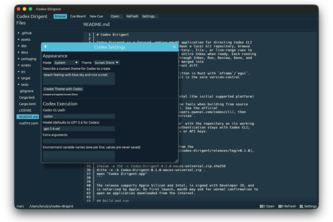
Codex Dirigent is a self-reported macOS-native application built in Rust that acts as a "control room" for Codex CLI. It allows developers to queue multiple tasks (called "Cues"), run them concurrently in isolated Git worktrees, review and refine every diff, and merge approved changes into the main branch. The product is described as a tool designed to make parallel agentic coding safer and more reviewable.
What changed
The project description indicates an evolution from general Codex use to a structured workflow that enforces safety through Git isolation, explicit review gates, and deterministic merge boundaries. It builds on the "Dirigent" concept but reimagines it as a lightweight, native macOS app with a focus on developer control.
Single most important open question
Is there any evidence of actual usage or adoption beyond the author's own development and testing? The description contains no mention of customers, revenue, or product-market fit indicators — only self-reported features and architecture.
What The Product Actually Is
The description states that Codex Dirigent is a native macOS application built in Rust. It functions as a "control room" for Codex CLI, enabling developers to:
- Queue multiple tasks (Cues) in an Inbox.
- Run these Cues concurrently in separate Git worktrees.
- Review and refine each diff explicitly before merging.
- Merge only approved changes into the main branch after conflict detection.
It uses Codex CLI as its AI backend and Git as the version-control backend, with no abstraction layer between them. The UI is built using eframe and egui, and it streams Codex progress into the app while maintaining a clear recovery path even if the application restarts mid-task.
Claim: Codex Dirigent is a tool for managing parallel agentic coding safely.
Evidence: The author describes how Cues move through stages (Inbox → Run → Review → Done → Archive), and that each Cue runs in its own worktree with explicit diff review before merge.
Positioning & Claim Evolution
The project positions itself as a refinement of the original Dirigent workflow, tailored specifically for Codex-native use on macOS. It aims to make parallel agent-based coding feel less like supervising terminals and more like conducting a structured, reviewable process.
Claim: The product reimagines the Dirigent workflow for Codex.
Evidence: The author explicitly mentions being inspired by the original Dirigent workflow and reimaging it as a smaller, native macOS app.
It also positions itself as a safer alternative to unstructured Codex use, where changes can collide or reach main without review. It emphasizes control over what reaches the main branch and safety through Git-based isolation.
Claim: The tool enforces safety rules via domain modeling and Git integration.
Evidence: The description says that safety rules are represented in the domain model, covered by unit and end-to-end tests, and that approval is tied to exact diffs.
Target Customer & ICP
The target customer appears to be developers working with Codex CLI, particularly those who want to manage multiple concurrent tasks safely within a Git-based workflow. The tool is described as being built for "developer control" and "reviewable process".
Claim: The product targets developers using Codex.
Evidence: The description states it’s a "control room" for Codex CLI, and that it integrates directly with Git and Codex.
There is no indication of other personas or verticals beyond individual developers or small teams working in macOS environments.
Claim: No evidence of segmentation or targeting beyond developer users.
Evidence: The description does not mention enterprise customers, non-developer roles, or specific industries.
Business Model & Pricing Evidence
There is no evidence provided about a business model or pricing structure. The project is described as a hackathon submission and appears to be a prototype or proof-of-concept tool.
Claim: No business model or pricing data.
Evidence: The description does not mention any monetization strategy, subscription plans, or paid features.
Technical & Delivery Signals
The product is built in Rust, using eframe and egui for the UI. It integrates directly with Codex CLI and Git, avoiding generic provider abstractions. Key technical elements include:
- Use of Git worktrees to isolate changes.
- Streaming Codex progress into a native UI.
- Atomic persistence of settings and Cue boards via JSON documents.
- Handling of concurrency, cancellation, and restart recovery.
Claim: The tool uses Rust, Git, and Codex CLI directly.
Evidence: The write-up states it was built in Rust using eframe/egui, with Codex CLI as the only AI backend and Git as the version-control backend.
It also claims to support multi-Cue workflows, follow-up refinement, and exact-diff acceptance. It handles complex edge cases like conflict detection and recovery from restarts.
Claim: The tool supports advanced concurrency and recovery mechanisms.
Evidence: The description mentions handling stale messages, cancellation predictability, and durable restart behavior.
Traction & Maturity Signals
There is no evidence of traction or adoption beyond the author’s own development. The project is described as a hackathon submission, and there are no references to users, customers, revenue, or usage metrics.
Claim: No traction or maturity data.
Evidence: The description does not include any mention of real-world usage, customer feedback, or product-market fit indicators.
Competitive Context
The project is described as a refinement of the Dirigent workflow, but no specific competitors are named. It operates in the space of AI-assisted development tools and Git-based workflows, which includes platforms like GitHub Copilot, Tabnine, and various CI/CD or code review tools.
Claim: No direct competitor analysis.
Evidence: The description does not reference existing tools or compare Codex Dirigent to others in the market.
It is positioned as a developer-focused tool that enhances control over AI-generated code, rather than competing with general-purpose AI coding assistants.
Open Questions & Risks
- No evidence of real-world usage: The project is described only as a hackathon submission.
- Limited platform support: Only macOS is mentioned as first-class target; no cross-platform plans.
- Single-person team: The entire product was built by one person (Lars Gregori), which raises questions about scalability and long-term maintenance.
- Prototype nature: The tool is described as a prototype, not yet fully validated in production use.
Inference: If the tool has no users or adoption, it may not have achieved product-market fit.
Evidence: The description does not mention any external validation or user testing beyond the author’s own work.
Questions the description leaves open
- What is the actual usage or feedback from developers who tried this tool?
- How does it handle edge cases like large repositories, long-running tasks, or complex merge conflicts?
- Are there any plans to expand beyond macOS or support other platforms?
- Has the tool been tested in real-world development workflows?
- What is the roadmap for future features and scalability?
Overall Assessment
There is no evidence of traction, revenue, or customer adoption. The project is described as a hackathon submission and appears to be a prototype or proof-of-concept tool.
Claim: No commercial viability or investment potential based on the provided information.
Evidence: The description lacks any indication of product-market fit, revenue, or customer validation.
It may have value as a technical demonstration or developer utility, but there is no evidence that it has reached a stage suitable for investment or partnership discussions. It remains in early-stage development with no external validation.
Inference: If the tool is not being used by developers outside of its creator, it likely lacks commercial traction.
Evidence: The description does not include any mention of users, feedback, or adoption beyond personal use.
User Stories BotA demo video on every pull request
Get a demo video on every new feature
GitHub App that watches your pull requests and records a narrated, captioned demo.
Save time on demo prep and make informed decisions faster with a video walkthrough of every new feature.
Source
Submitted to the OpenAI 2026 hackathon on Devpost. Project home on Devpost. Back to the full gallery on Devpost.
This competitive analysis was produced by top-founders.com (opens in a new tab)
Generated by a language model from this project's public Devpost page — its tagline, the author's own write-up and any built-with tags listed there — as captured in August 2026. Short quotations are the author's words. It is an opinion on the idea as a business, not on the people behind it, and it reflects the description as published then. If the project has moved on, request a correction below. The analysis is not independent research and contains no verified traction, revenue or customer data.
An independent guide by KFG International LLC — not affiliated with, endorsed by, or connected to Devpost or OpenAI.