

Archive position — measured, not model output
0 likes on Devpost
2,263 of the 7,850 archived projects have more likes, and 5,587 share exactly 0 — so this project's #5,244 place in the like-ranked listing is a tie-break inside that group, not a ranking.
Projects (log scale)
Likes on Devpost. ▲ marks this project's group.
Show the figures
| Likes | Projects | Share of archive |
|---|---|---|
| 0 | 5,587 | 71.2% |
| 1 | 1,758 | 22.4% |
| 2 | 284 | 3.6% |
| 3–4 | 132 | 1.7% |
| 5–9 | 75 | 1.0% |
| 10+ | 14 | 0.2% |
 User Stories BotA demo video on every pull request
Get a demo video on every new feature
GitHub App that watches your pull requests and records a narrated, captioned demo.
Save time on demo prep and make informed decisions faster with a video walkthrough of every new feature.
Executive Summary
What the company appears to be
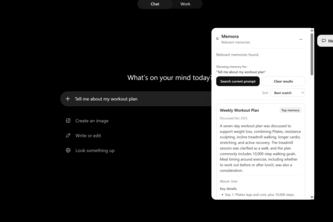
Memora is a self-reported personal AI memory companion built as a local Chrome extension and FastAPI backend. The author states it helps users manage conversation history and document context across ChatGPT sessions by organizing information into MemoryThreads, MemoryFacts, and MemoryBriefs, with temporal reasoning and provenance tracking.
What changed
The project evolved from basic RAG (Retrieval-Augmented Generation) to a more complex architecture involving memory threading, temporal reasoning, correction handling, and synthesis. It was built as a personal solution to the author's own problem of scattered conversations in ChatGPT.
Single most important open question
Is there evidence that Memora has achieved any meaningful traction or adoption beyond the single developer who built it? The self-reported description contains no data on users, revenue, customers, or usage metrics.
Analysis basis
This report is based entirely on the author's own description of Memora. No external verification, archived data, third-party sources or independent corroboration are available. All claims in this document are self-reported and unverified.
What The Product Actually Is
The description states that Memora is:
- A user-controlled companion for ChatGPT
- A local Chrome extension (Manifest V3) that works alongside ChatGPT
- A FastAPI backend that handles retrieval and memory processing
- A SQLite database that stores imported conversations, chunks, embeddings, documents, timestamps, and provenance
The system is described as having a retrieval pipeline that includes:
- Semantic retrieval
- Hybrid reranking
- MemoryThreads
- MemoryFacts
- Temporal reasoning
- MemoryBriefs
- Provenance tracking
It also supports:
- Enhanced and local processing modes
- Recoverable text PDFs and attachments
- A one-command Windows launcher for environment setup, dependencies, extension builds, authentication, and backend startup
Inference The product appears to be a personal tool built for individual use, not a commercial SaaS offering. It is described as local-only with no mention of cloud infrastructure or multi-user support.
Positioning & Claim Evolution
The author states that Memora was built to solve a personal problem:
- "I decided to build Memora because the longer I would use ChatGPT, the more I would have scattered conversations about the same topic everywhere"
- "I wanted access to the most relevant information and control over the different versions of the same topic"
The positioning is:
- Personal AI memory companion
- Not a replacement for LLMs, but a companion that helps users find what from their history actually matters
- User-controlled: "Memora never silently inserts or submits anything. The user reviews the results, selects Use This Context, reviews the updated draft, and sends the message manually."
Inference The product is positioned as a personal productivity tool, not a commercial platform. It evolved from basic RAG to a more sophisticated system that organizes context across time and projects.
Target Customer & ICP
The description states:
- Memora is built for users of ChatGPT
- Specifically, it targets users who have scattered conversations about the same topic
- Users who want control over their AI memory, not just retrieval of past messages
- The author's own use case: "I worked on a project where I had a specific conversation including a specific architecture and after months I decided to redo the entire project with a different architecture"
Inference The target customer is likely technical professionals or developers who use ChatGPT for long-term projects, but there is no evidence of any identified market segment beyond one person's personal experience.
Business Model & Pricing Evidence
The description states:
- Memora is a local-only project
- It requires users to clone a GitHub repository and run commands on a computer
- The author says: "I would like to move from a local only service toward a more accessible product while keeping the same focus on privacy and user control"
Inference There is no evidence of any pricing model, monetization strategy or business model. The author explicitly states that it is not yet a commercial offering.
Technical & Delivery Signals
The description states:
- Built with: api, embeddings, esbuild, fastapi, javascript, manifest-v3, node.js, openai-api, pypdf, python, rag, sqlite, typescript, vector-search
- Uses a three-part architecture: Chrome extension, FastAPI backend, SQLite database
- Retrieval pipeline includes: semantic retrieval → hybrid reranking → MemoryThreads → MemoryFacts → temporal reasoning → MemoryBriefs → provenance
- Supports PDFs and attachments
- Includes a Windows launcher for setup
Inference The technical stack is consistent with personal development tools, not enterprise-grade infrastructure. It is described as local-only, suggesting no cloud or multi-user support.
Traction & Maturity Signals
The description states:
- Built by one person (suheil2004 Almouhassel)
- Submitted to the OpenAI 2026 hackathon
- No mention of users, customers, revenue, or adoption
- The author says: "I am most proud that I was able to take a problem I genuinely had, turn it into a product idea, and build something that actually solves it for me"
- The next step is to make it accessible to anyone, not just local users
Inference There is no evidence of traction or adoption beyond the single developer. No metrics, user data, or customer feedback are provided.
Competitive Context
The description does not mention any competitors or market context. It only states:
- The author started with basic RAG concepts
- Evolved to a more complex system involving MemoryThreads, temporal reasoning, and synthesis
Inference No competitive analysis is evident. The product appears to be unique in its approach but lacks evidence of market positioning or competition.
Open Questions & Risks
- Single-person development: No team or external contributors are mentioned
- No traction or adoption: No users, customers, or revenue data
- Local-only solution: Not scalable for commercial use without major rearchitecture
- Unverified claims: All descriptions are self-reported and unverified
- No pricing or monetization model: Unclear path to commercial viability
Inference The project is in a very early stage, likely a prototype or personal tool. It has no evidence of commercial readiness or scalability.
Questions the description leaves open
- What specific user problems are you solving beyond your own?
- How do you plan to move from a local-only solution to a scalable product?
- Have you tested the product with other users, and what feedback did you get?
- What is your roadmap for monetization or commercial viability?
- Are there any technical limitations that prevent this from being a cloud-based service?
Overall Assessment
Not evidenced.
The description provides no evidence of:
- Revenue
- Customers
- Traction
- Market validation
- Commercial readiness
- Scalability
- Team size beyond one person
Inference This is a personal project, not a commercial venture. It has no demonstrated business model or market traction. The author’s stated goal is to make it accessible to others, but there is no evidence of progress toward that goal.
User Stories BotA demo video on every pull request
Get a demo video on every new feature
GitHub App that watches your pull requests and records a narrated, captioned demo.
Save time on demo prep and make informed decisions faster with a video walkthrough of every new feature.
Source
Submitted to the OpenAI 2026 hackathon on Devpost. Project home on Devpost. Back to the full gallery on Devpost.
This competitive analysis was produced by top-founders.com (opens in a new tab)
Generated by a language model from this project's public Devpost page — its tagline, the author's own write-up and any built-with tags listed there — as captured in August 2026. Short quotations are the author's words. It is an opinion on the idea as a business, not on the people behind it, and it reflects the description as published then. If the project has moved on, request a correction below. The analysis is not independent research and contains no verified traction, revenue or customer data.
An independent guide by KFG International LLC — not affiliated with, endorsed by, or connected to Devpost or OpenAI.