

Archive position — measured, not model output
0 likes on Devpost
2,263 of the 7,850 archived projects have more likes, and 5,587 share exactly 0 — so this project's #5,245 place in the like-ranked listing is a tie-break inside that group, not a ranking.
Projects (log scale)
Likes on Devpost. ▲ marks this project's group.
Show the figures
| Likes | Projects | Share of archive |
|---|---|---|
| 0 | 5,587 | 71.2% |
| 1 | 1,758 | 22.4% |
| 2 | 284 | 3.6% |
| 3–4 | 132 | 1.7% |
| 5–9 | 75 | 1.0% |
| 10+ | 14 | 0.2% |
 User Stories BotA demo video on every pull request
Get a demo video on every new feature
GitHub App that watches your pull requests and records a narrated, captioned demo.
Save time on demo prep and make informed decisions faster with a video walkthrough of every new feature.
Executive Summary
What the company appears to be
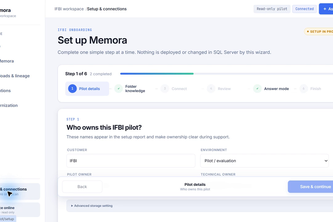
Memora is a self-reported enterprise knowledge layer that transforms legacy and modern data platforms into a trusted AI-powered system for lineage, operations, onboarding, and migration. It claims to build a canonical model of technical artifacts, orchestration jobs, dependencies, and architecture decisions from platform-specific metadata, then uses this to support AI-driven question answering, operational diagnostics, and modernization workflows.
What changed
The project description indicates an evolution from general-purpose data documentation or chatbot tools toward a more structured, enterprise-grade knowledge layer that emphasizes trustworthiness through controlled discovery, human review, and grounding in verified evidence. It positions itself as a tool for teams working with SQL Server and similar platforms, aiming to reduce reliance on tribal knowledge.
Single most important open question
Does Memora have any real-world usage or traction beyond the author's own pilot work? The description contains no evidence of customers, revenue, or adoption outside of internal testing.
What The Product Actually Is
The description states that Memora is a system that:
- Transforms technical artifacts, live metadata, and operational evidence into a connected and explainable knowledge layer.
- Helps teams connect and approve data platform information.
- Builds a canonical knowledge model from platform-specific metadata.
- Explains end-to-end lineage between business workloads and technical components.
- Supports operations by linking failures to relevant tasks, packages, and downstream consumers.
- Accelerates modernization through draft artifacts like mappings, transformation scaffolds, and runbooks.
It uses Python/FastAPI backend with React/TypeScript frontend, integrates with SQL Server via pyODBC and Windows Authentication, and leverages OpenAI GPT-5.6 for AI explanations while relying on deterministic collectors for truth establishment.
Evidence The author’s own write-up describes the architecture, functionality, and use cases in detail.
Inference Memora appears to be a proof-of-concept or pilot-level product focused on enterprise data platforms, particularly SQL Server environments.
Positioning & Claim Evolution
The description states that Memora was built around the principle: “AI should explain verified evidence. It should never invent the system.”
It explicitly rejects building another SQL documentation tool or chatbot over uploaded documents, instead aiming for a trusted knowledge and operations layer across legacy and modern data platforms.
Evidence The author claims this is not just a chatbot but a structured knowledge platform with controlled discovery, human review, and grounding in evidence.
Inference This suggests a shift from generic AI tools toward purpose-built enterprise systems that prioritize trust and explainability over generality.
Target Customer & ICP
The description states:
- Memora targets teams working with legacy and modern data platforms.
- Its first connector focuses on SQL Server, SQL Server Agent, and SSIS.
- It is designed for engineers, support teams, and modernization teams who need to understand complex systems.
- The product supports new engineers during onboarding and helps with impact analysis, failure diagnostics, and migration planning.
Evidence The author identifies specific user roles (engineers, support teams) and use cases (onboarding, failure diagnosis, migration).
Inference The ICP likely includes enterprise data engineering or operations teams in mid-to-large organizations using SQL Server or similar platforms.
Business Model & Pricing Evidence
Not evidenced.
The description does not mention any pricing structure, monetization strategy, or business model. It only describes the product's functionality and architecture.
Technical & Delivery Signals
The description states:
- Backend built with Python, FastAPI, Pydantic, connector framework.
- Frontend built with React, TypeScript, Vite.
- Uses PostgreSQL for control data, Qdrant for vector retrieval, sentence-transformers for embeddings, BM25 for keyword retrieval, NetworkX for lineage.
- LLM layer abstracted via LiteLLM, defaulting to GPT-5.6.
- Includes PowerShell installation scripts, pytest validation, and fail-closed deployment controls.
- Supports file-based pilot mode for restricted environments.
Evidence The author provides a detailed breakdown of the tech stack and delivery mechanisms.
Inference This indicates a modular, enterprise-grade architecture with security and compliance considerations baked in.
Traction & Maturity Signals
Not evidenced.
There is no mention of customers, revenue, usage metrics, or product adoption beyond the author’s own pilot work. The project is described as a hackathon submission.
Competitive Context
Not evidenced.
The description does not reference competitors or market positioning relative to existing tools in the data lineage, metadata management, or AI-powered operations space.
Open Questions & Risks
- No traction: No evidence of customers, revenue, or real-world usage beyond internal testing.
- Unverified claims: The product is described as a hackathon submission; no independent validation exists.
- Limited scope: First connector targets SQL Server only; expansion to other platforms is stated but not demonstrated.
- Single-person team: Only one founder listed (Rif Kash), which may limit execution capacity.
- AI grounding concerns: While the description emphasizes grounding in evidence, it's unclear how this is enforced or measured in practice.
Questions the description leaves open
- What specific enterprise customers have used Memora beyond the pilot?
- How does Memora handle data privacy and access control in multi-tenant environments?
- What are the actual performance characteristics of the system under load?
- How is human approval integrated into the workflow, and what happens when approvals are delayed or rejected?
- Are there any known limitations or blind spots in how Memora handles complex orchestration workflows (e.g., nested jobs)?
- What is the roadmap for expanding connectors beyond SQL Server?
- How does Memora ensure consistency between its canonical knowledge model and platform-specific metadata?
Overall Assessment
Not evidenced.
There is no evidence of funding, valuation, or investment interest in Memora. The project appears to be a hackathon submission with no commercial traction or financial backing reported.
The description makes strong claims about enterprise readiness and trustworthiness but lacks any verifiable data on adoption, performance, or scalability. Given the lack of external validation, revenue, or customer feedback, this is an early-stage concept with significant uncertainty around execution and market fit.
Confidence level Low — based entirely on self-reported information without corroboration.
User Stories BotA demo video on every pull request
Get a demo video on every new feature
GitHub App that watches your pull requests and records a narrated, captioned demo.
Save time on demo prep and make informed decisions faster with a video walkthrough of every new feature.
Source
Submitted to the OpenAI 2026 hackathon on Devpost. Project home on Devpost. Back to the full gallery on Devpost.
This competitive analysis was produced by top-founders.com (opens in a new tab)
Generated by a language model from this project's public Devpost page — its tagline, the author's own write-up and any built-with tags listed there — as captured in August 2026. Short quotations are the author's words. It is an opinion on the idea as a business, not on the people behind it, and it reflects the description as published then. If the project has moved on, request a correction below. The analysis is not independent research and contains no verified traction, revenue or customer data.
An independent guide by KFG International LLC — not affiliated with, endorsed by, or connected to Devpost or OpenAI.