

Archive position — measured, not model output
0 likes on Devpost
2,263 of the 7,850 archived projects have more likes, and 5,587 share exactly 0 — so this project's #5,247 place in the like-ranked listing is a tie-break inside that group, not a ranking.
Projects (log scale)
Likes on Devpost. ▲ marks this project's group.
Show the figures
| Likes | Projects | Share of archive |
|---|---|---|
| 0 | 5,587 | 71.2% |
| 1 | 1,758 | 22.4% |
| 2 | 284 | 3.6% |
| 3–4 | 132 | 1.7% |
| 5–9 | 75 | 1.0% |
| 10+ | 14 | 0.2% |
 User Stories BotA demo video on every pull request
Get a demo video on every new feature
GitHub App that watches your pull requests and records a narrated, captioned demo.
Save time on demo prep and make informed decisions faster with a video walkthrough of every new feature.
Executive Summary
What the company appears to be
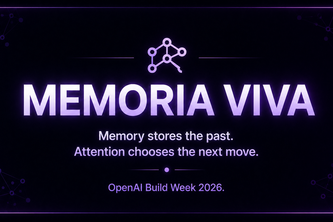
Memoria Viva is a self-reported system designed for founders and small teams to manage attention and commitments in response to external events. It claims to provide a deterministic, traceable decision-making framework that preserves existing commitments, computes new ones based on verified events, and maintains uncertainty as first-class state.
What changed
The project description indicates an evolution from a personal idea rooted in the intersection of economics, art, business, and AI into a structured technical system with deterministic components and GPT-5.6 explanation layers. It was built for the OpenAI 2026 hackathon.
Single most important open question
Does Memoria Viva have any real-world traction or adoption beyond the synthetic demo? The author states no revenue, customers, or usage data exist outside of a public-safe synthetic scenario.
Note
This analysis is based entirely on self-reported information from the project description. No external verification or historical data are available. All claims are treated as stated by the author and not proven.
What The Product Actually Is
The description states that Memoria Viva is:
- A system for managing attention and commitments in response to external events.
- Built for founders and small teams whose commitments are scattered across calendars, messages, and operational systems.
- Designed to transform a verifiable external event into a reproducible before-and-after attention state.
- Capable of:
- Preserving existing commitments
- Creating new commitments when justified by an event
- Computing versioned attention rankings
- Representing dependencies, conflicts, protection, and conditional displacement
- Keeping uncertainty visible instead of inventing certainty
- Identifying decisions requiring human confirmation
- Producing evidence-backed receipts explaining why the state changed
It uses a deterministic engine and a GPT-5.6 explanation layer, where the latter does not alter system outputs but only explains them.
Inference The product is described as a hybrid deterministic-AI system with strong emphasis on traceability and non-decision-making authority of the language model.
Positioning & Claim Evolution
The author states:
- The inspiration came from personal experience with scattered commitments and lack of tools that explain how new opportunities affect existing ones.
- The goal was to move beyond simple task lists or memory storage into a system where "attention should be a traceable decision."
- Memoria Viva is positioned as a tool for managing attention in response to external events, not just storing tasks.
Inference This is a positioning shift from generic productivity tools toward a more structured, evidence-backed approach to attention management. The claim evolution centers on moving away from "remembering" to "understanding and tracing decisions."
Target Customer & ICP
The description states:
- Memoria Viva is built for founders and small teams whose commitments are scattered across calendars, messages, and operational systems.
Inference The initial target customer segment appears to be early-stage entrepreneurs or small team leaders who face complex attention management challenges due to fragmented workflows. No further segmentation or persona details are provided.
Business Model & Pricing Evidence
Not evidenced.
The description does not contain any information about pricing, monetization strategy, revenue model, or commercial viability beyond the fact that it was submitted as a hackathon project.
Finding
No evidence of business model or pricing structure.
Technical & Delivery Signals
The system has two clearly separated layers:
- Deterministic engine:
- Validates sanitized fixtures against canonical JSON schemas
- Builds immutable Snapshot T0 and T1
- Applies one canonical trigger
- Constructs a 21-change GraphDelta
- Generates an immutable RunRecord
- Compares results against three human-authored oracles
- GPT-5.6 explanation layer:
- Does not decide what deserves attention
- Receives only completed, sanitized deterministic answers
- Provides explanations and recommendations without altering system outputs
- Uses strict Structured Outputs validated before display
The project was built using:
- Codex as primary engineering collaborator
- Python, OpenAI API, Streamlit, JSON, Graphviz, GitHub, unittest, schema, SHA-256, responses, codex, GPT-5.6
Inference The architecture shows deliberate separation between decision logic and explanation, with strong emphasis on deterministic replayability and validation.
Traction & Maturity Signals
Not evidenced.
The description mentions:
- A public demo using a reviewed synthetic founder scenario
- 260 passing tests
- No-login deployment
- Public-safe synthetic scenario
- A complete deterministic T0 → trigger → T1 replay
- Three human-authored oracle comparisons passing
- Stable ReplayResult digest
- 21-change GraphDelta across seven semantic categories
However, there is no mention of:
- Real users or customers
- Revenue or monetization
- Adoption metrics
- Product usage data
- Any form of live integration or production use
Finding
No evidence of traction or real-world adoption beyond the synthetic demo.
Competitive Context
Not evidenced.
The description does not reference existing competitors, market positioning relative to other attention management tools, or competitive advantages claimed by the author.
Finding
No evidence of competitive landscape or differentiation strategy.
Open Questions & Risks
- No real-world usage or traction – The entire system is described as a synthetic demo with no live users or adoption.
- Unproven commercial viability – No business model, pricing, or revenue data are provided.
- High technical complexity without clarity on user experience – While the architecture is detailed, it's unclear whether the interface remains accessible to non-technical users.
- Dependency on GPT-5.6 for explanation layer – If the LLM becomes unavailable or returns invalid results, the system may still function but lose its explanatory value.
- Limited scalability assumptions – The system is described as built for small teams and founders; no indication of how it scales to larger organizations.
Inference The project lacks commercial proof-of-concept and real-world validation, which raises concerns about viability beyond the hackathon context.
Questions the description leaves open
- What specific external events does Memoria Viva currently support?
- How is the deterministic engine validated in practice? Are there any known edge cases or failure modes?
- Has the system been tested with actual users, not just synthetic scenarios?
- What are the plans for integrating real-world data sources like calendars and communication platforms?
- Is there a plan to monetize this tool, and if so, what is the proposed business model?
- How does Memoria Viva handle privacy concerns when ingesting sensitive data from users?
- What kind of feedback have you received from potential early adopters or partners?
Overall Assessment
Not evidenced.
There is no indication of investment interest, partnership discussions, or funding status beyond the hackathon submission. No financials, valuation, or investor engagement are mentioned.
Finding
No evidence of investment or partnership activity; the project remains in an exploratory phase.
User Stories BotA demo video on every pull request
Get a demo video on every new feature
GitHub App that watches your pull requests and records a narrated, captioned demo.
Save time on demo prep and make informed decisions faster with a video walkthrough of every new feature.
Source
Submitted to the OpenAI 2026 hackathon on Devpost. Project home on Devpost. Back to the full gallery on Devpost.
This competitive analysis was produced by top-founders.com (opens in a new tab)
Generated by a language model from this project's public Devpost page — its tagline, the author's own write-up and any built-with tags listed there — as captured in August 2026. Short quotations are the author's words. It is an opinion on the idea as a business, not on the people behind it, and it reflects the description as published then. If the project has moved on, request a correction below. The analysis is not independent research and contains no verified traction, revenue or customer data.
An independent guide by KFG International LLC — not affiliated with, endorsed by, or connected to Devpost or OpenAI.