

Archive position — measured, not model output
0 likes on Devpost
2,263 of the 7,850 archived projects have more likes, and 5,587 share exactly 0 — so this project's #5,249 place in the like-ranked listing is a tie-break inside that group, not a ranking.
Projects (log scale)
Likes on Devpost. ▲ marks this project's group.
Show the figures
| Likes | Projects | Share of archive |
|---|---|---|
| 0 | 5,587 | 71.2% |
| 1 | 1,758 | 22.4% |
| 2 | 284 | 3.6% |
| 3–4 | 132 | 1.7% |
| 5–9 | 75 | 1.0% |
| 10+ | 14 | 0.2% |
 User Stories BotA demo video on every pull request
Get a demo video on every new feature
GitHub App that watches your pull requests and records a narrated, captioned demo.
Save time on demo prep and make informed decisions faster with a video walkthrough of every new feature.
Executive Summary
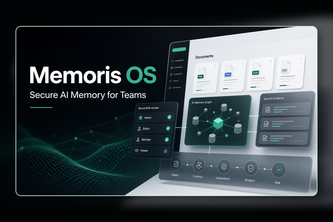
What the company appears to be: Memoris OS is a self-reported enterprise knowledge management and AI assistant platform designed to capture, organize, and retrieve organizational information from documents, meetings, and decisions. It claims to offer secure access control (RBAC), semantic search via vector embeddings, and AI-powered answers with evidence.
What changed: The project was built as part of the OpenAI 2026 hackathon submission. It is a full-stack prototype with a backend-first architecture using Java/Spring Boot, frontend in React/TypeScript, and deployment on AWS EC2 and Vercel. It includes features like document upload, text extraction, chunking, embedding, semantic search, role-based access control (RBAC), and AI query responses with evidence.
Single most important open question: Is there any evidence of real-world usage or traction beyond the hackathon prototype?
Analysis basis: This report is based entirely on the self-reported project description provided by the author. No external verification, revenue data, customer names, or traction metrics are available. All claims in this summary are as stated by the author and not independently confirmed.
What The Product Actually Is
The description states that Memoris OS:
- Captures organizational knowledge from documents, meetings, decisions, action items, and timeline events.
- Allows users to sign in with roles such as Owner, Admin, Manager, Employee, or Guest.
- Supports uploading PDF, DOCX, TXT, MD, and CSV files.
- Uses backend processes including text extraction via Apache PDFBox and POI, chunking, embedding generation, and storage in PostgreSQL with pgvector.
- Enables AI queries through a “Ask Memoris” interface that returns answers with evidence cards.
- Implements RBAC filtering before sending data to the AI service.
Inference: The system appears to be a knowledge management platform integrated with RAG (Retrieval-Augmented Generation) and AI question answering, built for enterprise use cases involving secure document handling and decision tracking.
Evidence: All described functionality is self-reported. No actual product, live demo, or user feedback is provided.
Positioning & Claim Evolution
The description states that Memoris OS was inspired by the problem of buried organizational reasoning — where decisions are made but not easily retrievable later.
It positions itself as:
- A secure enterprise memory layer.
- A tool for finding old decisions, onboarding teammates, tracking project history, and protecting sensitive information.
- An AI assistant that answers questions with evidence instead of guessing.
Inference: The positioning evolved from a general hackathon idea to a specific solution targeting knowledge silos in teams and enterprises. It emphasizes trust, security, and enterprise-grade access control as key differentiators.
Evidence: The narrative is self-reported; no external market positioning or competitor analysis is included.
Target Customer & ICP
The description states that Memoris OS targets:
- Enterprise organizations.
- Teams making important decisions daily.
- Users who need to find answers quickly, such as new employees or managers asking why certain choices were made.
It supports multi-tenant architecture with different user roles (Owner, Admin, Manager, Employee, Guest), implying a focus on internal team collaboration and secure access control.
Inference: The ICP is likely mid-to-large enterprises with structured teams and decision-making processes that require knowledge retention and access control.
Evidence: No explicit customer personas or segmentation data. The target is inferred from the stated use cases and RBAC model.
Business Model & Pricing Evidence
The description does not contain any information about:
- Revenue streams
- Pricing models
- Monetization strategy
- Subscription tiers or usage-based pricing
Inference: There is no evidence of a business model beyond the hackathon prototype. The project is described as a proof-of-concept, not a commercial product.
Evidence: Not evidenced.
Technical & Delivery Signals
The description states:
- Built with a backend-first architecture using Java 21 and Spring Boot.
- Frontend built with React, TypeScript, Vite, Tailwind.
- Authentication handled via Spring Security and JWT.
- Data storage uses Neon PostgreSQL with pgvector.
- Document processing uses Apache PDFBox and POI.
- AI integration supports both Gemini and OpenAI.
- Deployment on AWS EC2 (with Nginx) and Vercel for frontend.
- Uses Codex (GPT-5.6) for development assistance.
Inference: The tech stack indicates a modern, scalable architecture with strong backend focus, vector search capabilities, and AI integration. However, this is a prototype built in a short timeframe.
Evidence: All technical details are self-reported; no production performance or scalability data is available.
Traction & Maturity Signals
The description states:
- This was submitted to the OpenAI 2026 hackathon.
- It has a real backend, authentication, RBAC, database, document upload, text extraction, chunking, embeddings, semantic retrieval, and AI responses.
- The team is small (1 member).
Inference: The project is a functional prototype built in a hackathon setting. There is no evidence of user adoption, revenue, or long-term product development beyond the initial build.
Evidence: Not evidenced.
Competitive Context
The description does not mention:
- Competitors
- Market analysis
- Product differentiation from existing tools like Notion, Confluence, Slack, or enterprise RAG platforms
Inference: While Memoris OS shares some features with knowledge management and AI assistant tools, its competitive positioning is unclear without external context.
Evidence: Not evidenced.
Open Questions & Risks
Key risks and open questions based on the description:
- The project is a hackathon prototype with no evidence of real-world usage or traction.
- Only one team member is listed; lack of scaling capacity for enterprise deployment.
- No mention of data privacy compliance, audit logs, or enterprise security certifications.
- AI integration is limited to Gemini and OpenAI — no indication of multi-model support or fallback strategies.
- The system relies on Codex for development, which may not be a sustainable long-term solution.
Evidence: These are inferred from the lack of real-world data, team size, and absence of enterprise-grade features.
Questions the description leaves open
- What is the current status of the product beyond the hackathon prototype?
- Has there been any user testing or feedback from potential customers?
- Are there plans to expand beyond a single developer and build out a team?
- How does Memoris OS handle data governance, compliance, and audit trails in enterprise settings?
- What are the long-term monetization strategies for this platform?
- How do you plan to scale the AI infrastructure and vector search capabilities?
- Are there any partnerships or integrations with existing enterprise tools (e.g., Slack, Microsoft 365)?
- What is the roadmap for adding features like OCR, email ingestion, and timeline intelligence?
Note: These questions are based on the self-reported nature of the project description and aim to uncover gaps in the current narrative.
Overall Assessment
The description indicates that Memoris OS is a hackathon prototype with a functional backend and frontend, but lacks any evidence of traction, revenue, or real-world adoption. It shows technical capability and alignment with enterprise needs, particularly around secure knowledge management and AI integration.
Assessment: Not ready for investment or partnership at this stage. The project demonstrates potential and early-stage execution, but requires significant development to become a viable product in the market.
Confidence level: Low — based on thin evidence from a single self-reported source.
User Stories BotA demo video on every pull request
Get a demo video on every new feature
GitHub App that watches your pull requests and records a narrated, captioned demo.
Save time on demo prep and make informed decisions faster with a video walkthrough of every new feature.
Source
Submitted to the OpenAI 2026 hackathon on Devpost. Project home on Devpost. Back to the full gallery on Devpost.
This competitive analysis was produced by top-founders.com (opens in a new tab)
Generated by a language model from this project's public Devpost page — its tagline, the author's own write-up and any built-with tags listed there — as captured in August 2026. Short quotations are the author's words. It is an opinion on the idea as a business, not on the people behind it, and it reflects the description as published then. If the project has moved on, request a correction below. The analysis is not independent research and contains no verified traction, revenue or customer data.
An independent guide by KFG International LLC — not affiliated with, endorsed by, or connected to Devpost or OpenAI.