

Archive position — measured, not model output
0 likes on Devpost
2,263 of the 7,850 archived projects have more likes, and 5,587 share exactly 0 — so this project's #7,212 place in the like-ranked listing is a tie-break inside that group, not a ranking.
Projects (log scale)
Likes on Devpost. ▲ marks this project's group.
Show the figures
| Likes | Projects | Share of archive |
|---|---|---|
| 0 | 5,587 | 71.2% |
| 1 | 1,758 | 22.4% |
| 2 | 284 | 3.6% |
| 3–4 | 132 | 1.7% |
| 5–9 | 75 | 1.0% |
| 10+ | 14 | 0.2% |
 User Stories BotA demo video on every pull request
Get a demo video on every new feature
GitHub App that watches your pull requests and records a narrated, captioned demo.
Save time on demo prep and make informed decisions faster with a video walkthrough of every new feature.
Executive Summary
What the company appears to be
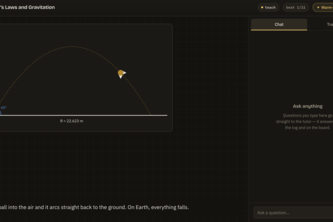
The Board is an AI-powered educational tool that generates interactive diagrams and visual explanations for science and math topics, designed to emulate a teacher’s blackboard tutoring style.
What changed
This is a self-reported project submitted to the OpenAI 2026 hackathon. It describes a prototype built in a short timeframe using AI tools (Codex, OpenAI), with no evidence of prior traction or commercial deployment.
Single most important open question
Is there any evidence that this concept has been tested with real users beyond the author’s personal experience and anecdotal feedback?
What The Product Actually Is
The description states:
- Board is an AI tutor that teaches on a virtual blackboard.
- It draws interactive graphs or diagrams based on user-selected topics.
- It pauses to ask questions, mimicking a good teacher.
- It uses a library of pre-made tools to assemble visuals quickly and accurately.
Inference The product appears to be a prototype that translates text-based science/math content into structured, interactive visual components using an LLM constrained by a custom output format.
Evidence strength
- Evidenced: The author describes how the system works.
- Inferred: That it functions end-to-end as described.
Positioning & Claim Evolution
The description states:
- Board is positioned as an AI tutor that brings the “11 pm blackboard moment” to students.
- It aims to make learning fun with AI, per its tagline.
- The author frames it as a solution to the lack of personalized tutoring in large classrooms.
Inference The positioning evolves from a personal anecdote (the author’s own struggle and his brother’s) into a broader educational tool that could scale beyond individual use cases.
Evidence strength
- Evidenced: The author's framing of the problem and solution.
- Inferred: That this is a scalable idea, not just a one-off tool.
Target Customer & ICP
The description states:
- It targets students preparing for university entrance exams.
- It also mentions teachers as potential users ("students and teachers will love it").
Inference The primary customer segment seems to be high school or pre-university students, with a secondary audience of educators.
Evidence strength
- Evidenced: The author’s own framing of the target user.
- Inferred: That the tool is designed for specific academic contexts (e.g., science and math).
Business Model & Pricing Evidence
The description states:
- No explicit business model or pricing is mentioned.
- The author says it works end-to-end, but does not describe monetization.
Evidence strength
- Not evidenced: No information on how the product would be sold or who pays for it.
Technical & Delivery Signals
The description states:
- Built with Codex, OpenAI, TypeScript, Vercel.
- Uses a custom output format to constrain LLM behavior.
- The LLM outputs instructions in a structured framework, which is then rendered.
- The system avoids freeform generation to ensure reliability.
Inference The technical approach suggests a constrained, reusable architecture that prioritizes consistency over flexibility.
Evidence strength
- Evidenced: The tools used and the method of constraint.
- Inferred: That this approach enables scalability or performance gains.
Traction & Maturity Signals
The description states:
- It is described as “up and running” and already covering a wide variety of topics.
- It works end-to-end, from explanation to diagram to quiz.
- The author mentions accomplishments and learning outcomes from the hackathon.
Inference This is a working prototype, but there is no evidence of real-world usage or adoption beyond the author’s own experience.
Evidence strength
- Evidenced: That it is functional and tested in a limited way.
- Not evidenced: Any user base, revenue, or customer feedback.
Competitive Context
The description states:
- No mention of competitors.
- The author does not reference similar tools or platforms in the education space.
Evidence strength
- Not evidenced: No competitive analysis or positioning relative to existing products.
Open Questions & Risks
- No evidence of real-world testing or user feedback.
- No revenue, customer or traction data.
- The product is described as a hackathon submission, not a commercial product.
- No indication of scalability beyond the prototype level.
- No mention of how it would be monetized or distributed.
Inference The risk is high that this remains a proof-of-concept without a clear path to market traction or adoption.
Questions the description leaves open
- What specific user feedback have you received from students or teachers?
- How do you plan to validate the effectiveness of the learning outcomes?
- Are there any plans for monetization, and how will it be priced?
- What are your plans for scaling beyond the current prototype?
- Have you considered integrating with existing educational platforms or curricula?
Overall Assessment
Not evidenced: There is no evidence of revenue, customers, or traction to support an investment or partnership decision.
Inference:
This appears to be a promising idea in the educational AI space, but it is currently at the prototype stage. Without real-world testing, user validation, or commercial viability, it does not meet the criteria for due-diligence readiness.
Confidence level Low — based on self-reported evidence only, with no external verification or data points.
User Stories BotA demo video on every pull request
Get a demo video on every new feature
GitHub App that watches your pull requests and records a narrated, captioned demo.
Save time on demo prep and make informed decisions faster with a video walkthrough of every new feature.
Source
Submitted to the OpenAI 2026 hackathon on Devpost. Project home on Devpost. Back to the full gallery on Devpost.
This competitive analysis was produced by top-founders.com (opens in a new tab)
Generated by a language model from this project's public Devpost page — its tagline, the author's own write-up and any built-with tags listed there — as captured in August 2026. Short quotations are the author's words. It is an opinion on the idea as a business, not on the people behind it, and it reflects the description as published then. If the project has moved on, request a correction below. The analysis is not independent research and contains no verified traction, revenue or customer data.
An independent guide by KFG International LLC — not affiliated with, endorsed by, or connected to Devpost or OpenAI.