

Archive position — measured, not model output
0 likes on Devpost
2,263 of the 7,850 archived projects have more likes, and 5,587 share exactly 0 — so this project's #5,250 place in the like-ranked listing is a tie-break inside that group, not a ranking.
Projects (log scale)
Likes on Devpost. ▲ marks this project's group.
Show the figures
| Likes | Projects | Share of archive |
|---|---|---|
| 0 | 5,587 | 71.2% |
| 1 | 1,758 | 22.4% |
| 2 | 284 | 3.6% |
| 3–4 | 132 | 1.7% |
| 5–9 | 75 | 1.0% |
| 10+ | 14 | 0.2% |
 User Stories BotA demo video on every pull request
Get a demo video on every new feature
GitHub App that watches your pull requests and records a narrated, captioned demo.
Save time on demo prep and make informed decisions faster with a video walkthrough of every new feature.
Executive Summary
What the company appears to be
Memory Castle is a self-reported educational app that generates interactive memory palaces for adult students and professional learners. The author describes it as a local-first learning game combining verified knowledge, spatial exploration, active recall, deterministic systems, and constrained generative AI assistance.
What changed
The project was submitted as part of the OpenAI 2026 hackathon. It represents an experimental, self-built prototype with no evidence of prior traction or commercialization.
Single most important open question
Is there any evidence that the author has validated the educational effectiveness of this approach with real users beyond their own testing?
What The Product Actually Is
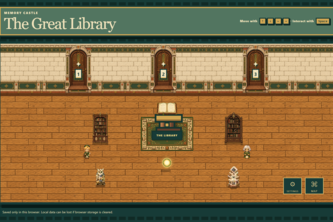
The description states that Memory Castle is a working Next.js and React application built in strict TypeScript. It turns learner-approved study material into an explorable 2D pixel-art castle where users can:
- Create, save, load, rename, and delete memory castles.
- Add question-and-response memories manually or draft them from bounded text, documents, PDFs, images, or spreadsheets.
- Navigate connected rooms using keyboard or on-screen controls.
- Practice active recall through character dialogue.
- Earn in-game prizes based on recall performance.
- Request AI-generated mnemonic rooms that are reviewed before activation.
- View progress on a castle map.
- Save locally and resume later.
It uses browser-local storage for persistence, deterministic fallbacks, and controlled AI generation via OpenAI APIs with structured output and moderation. The app includes accessibility features like keyboard navigation, reduced motion settings, and text synchronization.
Evidence
- Author describes it as a "working Next.js and React application"
- Lists technologies: Next.js 16, React 19, TypeScript, Zod, OpenAI Responses API
- Details UI/UX elements such as pixel-art interface, keyboard controls, NPC interaction, dialogue system
Inference The product is described as a functional prototype but not validated in production or with users beyond the author's own use.
Positioning & Claim Evolution
The description states that Memory Castle was inspired by the desire to combine active recall and memory palace techniques. It positions itself as a tool beyond "flashcards with an AI theme" — aiming for a local-first learning game where verified knowledge, spatial exploration, and generative assistance work together.
Key claims:
- AI-generated content should not become the learner’s source of truth.
- Learner-controlled input remains authoritative.
- AI may propose mnemonic arrangements but cannot rewrite verified responses.
- The experience includes deterministic fallbacks so it works without an API key or when AI fails.
- It creates a complete learning loop: Add knowledge → Review → Enter room → Recall → Explore cues → Track progress → Resume later.
Evidence
- Author explicitly states these principles in the write-up
- Mentions that AI-generated rooms use only controlled memory-object assets and bounded properties
Inference The positioning reflects an attempt to differentiate from generic flashcard apps or AI tools by emphasizing learner control, deterministic behavior, and spatial learning architecture.
Target Customer & ICP
The description states that Memory Castle is designed for adult students, certification candidates, professional learners, and others studying knowledge-heavy material. It addresses a concrete problem: turning factual material into reusable retrieval practice can be tedious, while constructing a traditional memory palace requires substantial setup.
Evidence
- Explicitly targets "adult students", "certification candidates", "professional learners"
- Identifies the core issue as reducing the burden of setting up memory palaces
Inference The target audience appears to be individuals who already engage in structured learning practices and are looking for more engaging or efficient methods to retain large volumes of information.
Business Model & Pricing Evidence
Not evidenced. The description does not mention any pricing, monetization strategy, subscriptions, or commercial models. It also states that the MVP has no advertising, analytics, tracking, payments, social features, or accounts.
Evidence
- No mention of revenue streams
- States: "The local MVP has no advertising, analytics, tracking, payments, social features, or accounts"
Technical & Delivery Signals
The author reports building with:
- Next.js 16 and React 19
- TypeScript with strict type checking
- Zod runtime validation
- OpenAI Responses API with structured output
- Deterministic seeded generation
- Versioned browser-local persistence
- Vitest unit and component tests
- Playwright end-to-end journeys
- Responsive, keyboard-accessible pixel-art interface
They used GPT-5.6 through Codex iteratively across the full stack including:
- React interaction and state management
- Seeded room and character generation
- Movement and collision geometry
- Object placement and safe navigation corridors
- Visual assets and rendering
- Tests, validation, persistence rules, and fallback behavior
The system includes:
- Learner-controlled input
- Bounded client request
- Server-only API route
- Payload limits, timeout, and moderation
- Structured output schemas
- Safe normalization or deterministic fallback
- Reviewable proposals
- Learner acceptance
Evidence
- Detailed technical stack and workflow
- Use of Codex for iterative engineering
- Mention of safety constraints and system boundaries
Inference The architecture shows deliberate design around responsible AI use, deterministic behavior, and robustness against failures.
Traction & Maturity Signals
Not evidenced. There is no mention of users, customers, revenue, usage metrics, or adoption beyond the author’s own testing.
Evidence
- No data on user base, engagement, retention, or performance
- The project is described as a hackathon submission
- No indication of prior traction or product-market fit
Competitive Context
Not evidenced. The description does not reference competitors or market positioning relative to existing tools in the educational or memory-training space.
Evidence
- No mention of competing products or platforms
- No discussion of how Memory Castle compares to other flashcard apps, spaced repetition systems, or memory training tools
Open Questions & Risks
- Lack of user validation: The project is described as a hackathon submission with no evidence of real-world testing or feedback.
- Unproven educational efficacy: While the author claims it makes structured recall practice more contextual and meaningful, there’s no data on learning outcomes.
- Single-person development: With only one team member (Rebecca Gregorcy), scalability and long-term maintenance are concerns.
- Dependency on AI availability: Despite fallbacks, reliance on OpenAI APIs introduces risk if those services change or become unavailable.
- Limited commercial viability: No pricing model or monetization strategy is evident.
Evidence
- Author states it's a hackathon project
- No mention of users or market validation
- No indication of business model or growth plans
Questions the description leaves open
- What specific learning outcomes have you observed from using Memory Castle yourself?
- Have you tested the app with real adult students or professionals in knowledge-heavy fields?
- How do you plan to validate that AI-generated content improves retention over traditional methods?
- Is there any intention to expand beyond browser-local storage, and what would drive that decision?
- What are your thoughts on integrating external APIs or platforms for broader distribution?
- Can you describe how you'd scale the product if demand increases beyond current capacity?
Overall Assessment
Not evidenced. There is no indication of funding history, valuation, investor interest, or partnership discussions.
Evidence
- No mention of funding rounds, investors, or partnerships
- The project is presented as a hackathon submission with no commercialization plan
Inference Given the lack of traction, revenue, or market validation, and the fact that it's a single-person prototype, there is insufficient evidence to support an investment or partnership decision at this stage.
User Stories BotA demo video on every pull request
Get a demo video on every new feature
GitHub App that watches your pull requests and records a narrated, captioned demo.
Save time on demo prep and make informed decisions faster with a video walkthrough of every new feature.
Source
Submitted to the OpenAI 2026 hackathon on Devpost. Project home on Devpost. Back to the full gallery on Devpost.
This competitive analysis was produced by top-founders.com (opens in a new tab)
Generated by a language model from this project's public Devpost page — its tagline, the author's own write-up and any built-with tags listed there — as captured in August 2026. Short quotations are the author's words. It is an opinion on the idea as a business, not on the people behind it, and it reflects the description as published then. If the project has moved on, request a correction below. The analysis is not independent research and contains no verified traction, revenue or customer data.
An independent guide by KFG International LLC — not affiliated with, endorsed by, or connected to Devpost or OpenAI.