

Archive position — measured, not model output
0 likes on Devpost
2,263 of the 7,850 archived projects have more likes, and 5,587 share exactly 0 — so this project's #5,252 place in the like-ranked listing is a tie-break inside that group, not a ranking.
Projects (log scale)
Likes on Devpost. ▲ marks this project's group.
Show the figures
| Likes | Projects | Share of archive |
|---|---|---|
| 0 | 5,587 | 71.2% |
| 1 | 1,758 | 22.4% |
| 2 | 284 | 3.6% |
| 3–4 | 132 | 1.7% |
| 5–9 | 75 | 1.0% |
| 10+ | 14 | 0.2% |
 User Stories BotA demo video on every pull request
Get a demo video on every new feature
GitHub App that watches your pull requests and records a narrated, captioned demo.
Save time on demo prep and make informed decisions faster with a video walkthrough of every new feature.
Executive Summary
What the company appears to be
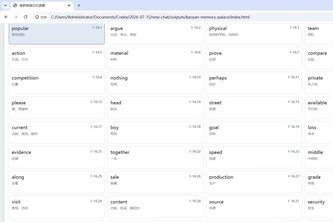
Memory Palace 5530 is a self-reported static web application that presents 5,530 graduate English vocabulary words through an interactive six-level memory palace structure. The author states it was built using OpenAI Codex during a hackathon and runs entirely offline in a browser.
What changed
The project emerged from the author's personal need to learn vocabulary for a postgraduate entrance exam, leading to a self-described innovation in how vocabulary is learned—by navigating spatial memory structures rather than lists. It represents an experimental approach to learning tools using AI-assisted development.
Single most important open question
Is there any evidence of user adoption or product-market fit beyond the author’s personal experience and prototype?
Note: This analysis is based solely on the self-reported, unverified description provided by the project author. No external verification, traction data, revenue figures, or customer information are available.
What The Product Actually Is
- The description states that Memory Palace 5530 is a static web application built with HTML, CSS, and JavaScript.
- It presents 5,530 graduate English vocabulary words through an interactive six-level memory palace.
- The application includes:
- 139 interconnected rooms
- Instant vocabulary search
- Category and frequency filters
- Memory associations for each word
- Learning progress tracking
- Review queue
- Custom vocabulary import
- CSV learning route export
- Fully offline support
Inference: The product is described as a browser-based tool, not a SaaS offering or subscription service. It does not appear to have backend infrastructure or cloud dependencies.
Positioning & Claim Evolution
- The author claims the app transforms vocabulary learning by using the ancient "method of loci" (memory palace) technique.
- It positions itself as an alternative to traditional methods like rote memorization and endless word lists.
- The project is framed as a personal solution to a specific problem—learning English vocabulary for exams—and not yet positioned as a scalable product or platform.
Claim: "Instead of scrolling through long vocabulary lists, learners navigate through rooms and build spatial memory while studying."
This is a self-stated positioning claim, not verified evidence of effectiveness or traction.
Target Customer & ICP
- The description states that the author is “not a native English speaker” and was preparing for a postgraduate entrance exam.
- The app targets individuals who need to learn graduate-level English vocabulary.
- No explicit segmentation beyond this personal use case is described.
Inference: The target customer appears to be non-native English speakers studying for academic exams, but there is no evidence of broader market targeting or user personas.
Business Model & Pricing Evidence
- There is no mention of pricing, monetization strategy, or business model in the description.
- The app is described as a static website running offline.
- No indication of subscriptions, paid features, or commercial use cases.
Not evidenced: No evidence of any revenue streams, pricing tiers, or monetization plans.
Technical & Delivery Signals
- Built with HTML, CSS, JavaScript, and runs entirely offline.
- Developed collaboratively with OpenAI Codex during a hackathon.
- The author states that Codex was used for architecture design, implementation, search system, responsive interface optimization, and code refactoring.
- The project is described as a “static web application,” implying no backend or database.
Inference: The delivery approach relies heavily on AI-assisted development tools, but there’s no evidence of scalability, performance testing, or production deployment beyond the prototype stage.
Traction & Maturity Signals
- The project was submitted to an OpenAI hackathon (Devpost).
- No mention of users, downloads, usage metrics, or feedback.
- No evidence of product iterations, user testing, or market validation.
- The author describes it as a prototype built in one week during a hackathon.
Not evidenced: No data on adoption, retention, or engagement. No signs of product maturity beyond initial development.
Competitive Context
- No mention of competitors or competitive landscape.
- The description does not reference existing vocabulary learning tools or platforms.
- The use of the memory palace method is described as unique to this implementation, but no comparison with other tools is made.
Not evidenced: No evidence of market analysis or awareness of competing products.
Open Questions & Risks
- The app is a single-person project built in a hackathon setting.
- No evidence of product-market fit, user feedback, or real-world usage.
- The lack of backend infrastructure raises questions about long-term scalability and feature expansion.
- The author’s personal motivation (exam prep) may not align with broader commercial appeal.
Inference: Risk of limited viability if the core idea does not resonate beyond the author's niche use case.
Questions the description leaves open
- What is your evidence that users find this method more effective than traditional vocabulary lists?
- Have you tested the product with others outside of your own experience?
- How do you plan to scale beyond a single-person prototype and into a broader market?
- Are there any plans for monetization or commercial use?
- What are the technical limitations of running entirely offline, especially as features expand?
Overall Assessment
- The project is described as a personal prototype built during a hackathon.
- There is no evidence of traction, revenue, or customer validation.
- It lacks any indication of a scalable business model or commercial strategy.
- The author’s claim about AI-assisted development does not imply product maturity or market readiness.
Assessment: Not ready for investment or partnership. Requires significant validation and iteration before any commercial viability can be assessed.
User Stories BotA demo video on every pull request
Get a demo video on every new feature
GitHub App that watches your pull requests and records a narrated, captioned demo.
Save time on demo prep and make informed decisions faster with a video walkthrough of every new feature.
Source
Submitted to the OpenAI 2026 hackathon on Devpost. Project home on Devpost. Back to the full gallery on Devpost.
This competitive analysis was produced by top-founders.com (opens in a new tab)
Generated by a language model from this project's public Devpost page — its tagline, the author's own write-up and any built-with tags listed there — as captured in August 2026. Short quotations are the author's words. It is an opinion on the idea as a business, not on the people behind it, and it reflects the description as published then. If the project has moved on, request a correction below. The analysis is not independent research and contains no verified traction, revenue or customer data.
An independent guide by KFG International LLC — not affiliated with, endorsed by, or connected to Devpost or OpenAI.