

Archive position — measured, not model output
0 likes on Devpost
2,263 of the 7,850 archived projects have more likes, and 5,587 share exactly 0 — so this project's #7,207 place in the like-ranked listing is a tie-break inside that group, not a ranking.
Projects (log scale)
Likes on Devpost. ▲ marks this project's group.
Show the figures
| Likes | Projects | Share of archive |
|---|---|---|
| 0 | 5,587 | 71.2% |
| 1 | 1,758 | 22.4% |
| 2 | 284 | 3.6% |
| 3–4 | 132 | 1.7% |
| 5–9 | 75 | 1.0% |
| 10+ | 14 | 0.2% |
 User Stories BotA demo video on every pull request
Get a demo video on every new feature
GitHub App that watches your pull requests and records a narrated, captioned demo.
Save time on demo prep and make informed decisions faster with a video walkthrough of every new feature.
Executive Summary
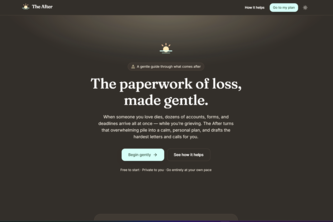
The After is a self-reported SaaS product built for individuals navigating post-death administrative tasks. The description states it uses AI (GPT-5.6) to guide users through a calm, step-by-step process of handling accounts, forms, and deadlines after someone dies. It includes features like personalized checklists, draft letters, document vaulting, and region-aware notifications.
The project is described as a hackathon submission with no evidence of revenue, customers, or traction beyond the authors' own claims. The team size is reported as two (Mokshit Surana, Archit Rathod). It was built using Next.js, React, Supabase, OpenAI API, and deployed on Vercel.
The single most important open question: Is there any evidence of real user adoption or market demand beyond the authors’ own demonstration?
What The Product Actually Is
The description states that The After is a digital companion designed to help people manage the administrative burden after someone dies. It builds a personalized checklist from a conversation, explains steps in plain language, drafts letters and phone scripts, keeps documents private, and adapts notifications based on the user’s country.
It is described as an app built with Next.js 16, React 19, TypeScript, Tailwind, Supabase for data/auth, GPT-5.6 via OpenAI API, and deployed on Vercel.
The authors state that it was built using Codex, where GPT-5.6 helped design and ship real features including accessibility passes, SEO, metadata, structured data, and region logic.
Inference: The product appears to be a web-based SaaS application with AI-driven personalization and administrative task management.
Positioning & Claim Evolution
The description states that The After positions itself as a “gentle companion” for the hardest admin there is — post-death paperwork. It aims to reduce overwhelm by turning complex tasks into one calm plan, walking users through it step-by-step.
It claims to start with a gentle conversation instead of a form, and to explain every step in plain words. The authors say they wanted to build “the companion we would want in that moment” — calm, patient, and human.
The product is described as being built for people who are grieving and need help with practical matters such as banks, benefits, subscriptions, government offices, and digital accounts.
Inference: The positioning is emotional and niche, targeting a specific pain point during grief. It claims to be a compassionate, low-overhead solution that adapts to the user's situation.
Target Customer & ICP
The description states that The After is for people who are left behind after someone dies — those dealing with the practical side of loss.
It mentions that it helps with tasks like banks, benefits, subscriptions, government offices, and digital accounts. It also notes that the list of people to notify adapts to the user’s country.
Inference: The primary customer is an individual in a post-death administrative context, likely someone who has recently lost a family member or close friend. The ICP appears to be emotionally vulnerable individuals with limited time or capacity to manage complex paperwork.
Business Model & Pricing Evidence
The description does not provide any information about pricing, monetization, or business model.
Inference: No evidence of how the product will generate revenue or whether it is intended to be free, subscription-based, or otherwise monetized.
Technical & Delivery Signals
The project is described as built with:
- Next.js 16
- React 19
- TypeScript
- Tailwind CSS
- Supabase (for data and auth)
- GPT-5.6 via OpenAI API
- Deployed on Vercel
It was built using Codex, where GPT-5.6 assisted in feature design and implementation.
The authors mention they implemented two modes: a keyless demo mode and a full mode with Supabase and GPT-5.6.
They also note that the app runs with no API keys at all for the core flow, allowing anyone to try it instantly.
Inference: The technical stack is modern and cloud-native. It uses AI extensively but attempts to maintain accessibility without requiring user authentication or API keys in its basic mode.
Traction & Maturity Signals
The description does not include any evidence of traction, revenue, customers, or adoption beyond the authors’ own demonstration.
It notes that it was submitted to the OpenAI 2026 hackathon and is a self-reported project with no external validation or user data.
Inference: There is no evidence of product-market fit, customer acquisition, or usage metrics. The project appears to be in early development stage.
Competitive Context
The description does not mention any competitors or existing solutions in the space.
Inference: No competitive landscape is described, which makes it difficult to assess how this product fits into the broader market or what unique value it offers.
Open Questions & Risks
- The project is self-reported and unverified; there is no evidence of traction, revenue, or customer adoption.
- The use of GPT-5.6 raises concerns about scalability, cost, and dependency on external APIs.
- The product targets a sensitive emotional context (grief), which could carry reputational or ethical risks if not handled carefully.
- No pricing model or monetization strategy is described.
- The team size is only two members; this may limit execution capacity.
Questions the description leaves open
- What specific user feedback have you received from people who tried the demo?
- How do you plan to scale beyond a hackathon prototype?
- Are there any legal or regulatory considerations in handling post-death administrative tasks?
- What is your roadmap for localization and international expansion?
- How do you intend to monetize this product, if at all?
- Have you considered partnerships with funeral homes, hospices, or nonprofits working in grief support?
Overall Assessment
Not evidenced.
The description provides no information about revenue, customers, traction, or business model. It is a self-reported hackathon submission without any indication of commercial viability or market readiness.
Inference: Without evidence of real users, adoption, or monetization, this project cannot be evaluated for investment or partnership potential at this time.
User Stories BotA demo video on every pull request
Get a demo video on every new feature
GitHub App that watches your pull requests and records a narrated, captioned demo.
Save time on demo prep and make informed decisions faster with a video walkthrough of every new feature.
Source
Submitted to the OpenAI 2026 hackathon on Devpost. Project home on Devpost. Back to the full gallery on Devpost.
This competitive analysis was produced by top-founders.com (opens in a new tab)
Generated by a language model from this project's public Devpost page — its tagline, the author's own write-up and any built-with tags listed there — as captured in August 2026. Short quotations are the author's words. It is an opinion on the idea as a business, not on the people behind it, and it reflects the description as published then. If the project has moved on, request a correction below. The analysis is not independent research and contains no verified traction, revenue or customer data.
An independent guide by KFG International LLC — not affiliated with, endorsed by, or connected to Devpost or OpenAI.